
By Kerri Williams
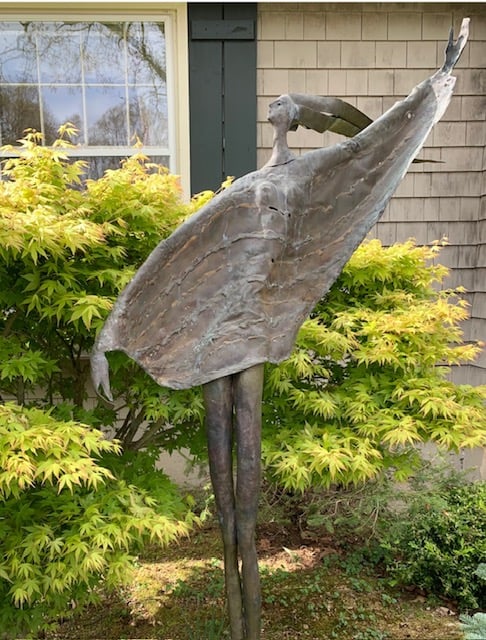
I will never forget the first time I visited my friend Joyce’s garden. She had woodland paths full of sweet flowers I had never seen before and a collection of spring daffodils that took my breath away. But what made the biggest impression was the sculpture in her back yard called “Dancer” by Easton artist Lubomir Tomaszewski.
The sculpture made me want to break into dance myself, right in the middle of the lawn. I had to ask Joyce how she came to own it, and there was a remarkable story.
Joyce and her husband had gone to see an exhibition of Tomaszewski’s work in Westport, and she had loved what she saw.
Months later, when her husband had wanted to give her jewelry for her birthday, Joyce had said she would rather have a piece of Tomaszewski’s work.
The couple drove to his house and picked out “Dancer,” and the artist offered to deliver and site the sculpture. “Who could object?” Joyce questioned.
When Joyce asked the artist where his sculpture should go, he responded, “On top of the rock, of course!” That was more than 20 years ago, and the statue is still there. “I love her,” Joyce said. Tomaszewski, who established an art movement called Emotionalism, died in 2018 at age 95.
Since that day, I have been intrigued by sculpture in gardens, whether in a private one like Joyce’s or in public gardens. Westporters are lucky to have several sculptures placed in town parks that everyone can enjoy when out for a stroll or a picnic.
Kathie Bennewitz, town curator, has been working to site more sculptures in parks in cooperation with town agencies. In a recent conversation, she talked about the decisions involved, which can also apply to homeowners who want to upgrade their own gardens with sculpture.
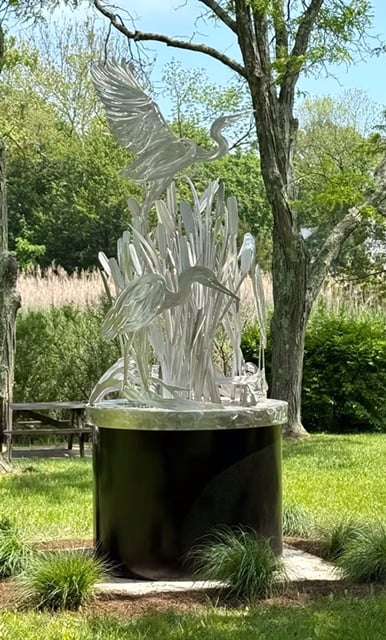 ‘Egrets,’ a sculpture by Babette Bloch, can be seen near the water at Canal Green Park – Contributed photo
One of the sculptures that was recently placed is called “Egrets” in Canal Green Park downtown. The Parks & Recreation Department helped to clear a privet on the creek edge so that the sculpture, by Babette Bloch, could be installed.
In this instance, the artist was able to meet Bennewitz by the creek to help decide where the sculpture would be placed. The final siting was “just perfect,” she said, with dappled lighting hitting the stainless-steel sculpture during the day.
While it is not always a possibility, Bennewitz likes getting the artist involved in placing a sculpture.
My niece Victoria Goulart, an artist living in Rhode Island, agrees that it is nice to be involved in siting a sculpture. But she adds that the final decision should be up to the owner because it is such a “personal and emotional” decision. “That being said, placing the sculpture in the right landscape is as important as the composition of the art itself,” Goulart said.
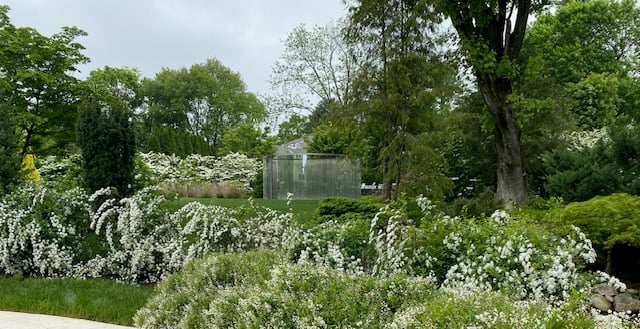
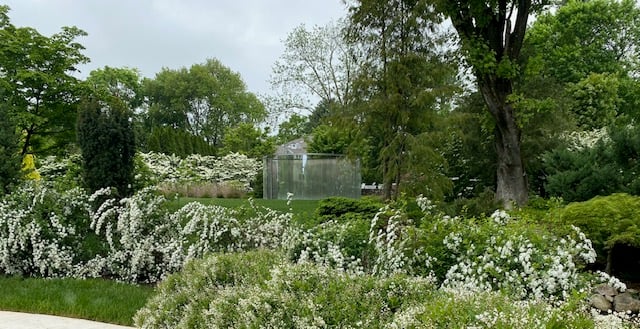
Another example of finding the right spot for a sculpture on private property came when deciding where to place a Dan Graham sculpture at Prospect Gardens. The piece was shown at Tuileries in Paris and on the rooftop of the Metropolitan Art Museum in New York City before it came to Westport.
Cindy Shumate, the owner of Synscape Designs who works for the owners as a landscaper, recounts that originally the sculpture was going to be placed closer to the house, but she thought it might be too large for that space. Instead, it was installed in a grassy space that was surrounded by mature viburnums. “It has turned out to be the perfect spot,” she said. Townspeople can see the sculpture firsthand during the fall open house for Prospect Gardens, which takes place on Sept. 19 from 10 a.m. to 4 p.m.
Another homeowner who has placed sculpture in her garden said that each piece she acquired has its own story in how it ended up in her landscape.
“Sometimes the sculpture is called to your garden. Other times the garden calls to the sculpture,” said Nathalie Fonteyne, a UConn master gardener who is also president of the Westport Garden Club.
In some instances, Fonteyne said she noticed that a particular spot in her garden needed “a shock of color” or some structure of an architectural element. Other times, a sculpture can add interest to an area that is barren in winter. She purchased a sculpture in the form of two large balls, blue and red, for her former garden that added different interest depending on the season.
If, like me, you have been moved to dance by spotting a sculpture in nature, you might want to consider adding a piece of art to your own backyard. While it is a deeply personal decision, you might end up with the perfect touch to your landscape and a great story to tell.

Kerri Williams
Kerri Williams is an award-winning writer and journalist. She has worked as a reporter at the Norwalk Hour, as Living editor at the Darien News-Review, and managing editor for the Norwalk Citizen-News. For Westport Journal, she is a reporter as well as a gardening columnist, writing “Cultivating with Kerri.” She recently published her first children’s book – “Mabel’s Big Move,” based on her daughter with special needs.