
NBA free agency is nearly complete, with Jalen Duren left as the only significant free agent remaining. Now is the time of year when rookie-scale extension talks pick up steam. These extensions allow former first-round picks to sign after their third season, starting in the offseason and running through the start of the regular season. They can go up to five years and 25 percent of the salary cap, with escalators that can push them to 30 percent for accolades like All-NBA.
Victor Wembanyama was predictably the first player off the board, signing a five-year maximum extension projected at $252.3 million. His extension was unusual for a couple of reasons.
First, Wembanyama didn’t receive the escalators that could’ve boosted his contract’s total value to $302.8 million. The $10 million in annual savings is arguably the most consequential move of the offseason. The Spurs’ ability to delay going into the luxury tax for multiple years could be the difference between winning a championship while Dylan Harper and Stephon Castle are still on their rookie contracts.
The other unusual element was the timing. Wembanyama agreed to and signed the extension on July 10, nine days after the start of free agency. The Spurs technically could’ve started negotiations after the Finals ended in mid-June. Since 2018, there has been at least one rookie-scale extension agreed to during the moratorium period between July 1 and July 6.
We finally got our second rookie-scale extension on September 3, with Amen Thompson agreeing to a five-year, $208 million extension with the Rockets. He received standard 8 percent raises that will start him at $35.9 million and end at $47.3 million. The deal has an average annual salary of roughly 21 percent of the salary cap and could become a significant positive value if Thompson becomes an All-Star as the third-highest-paid player on his team.
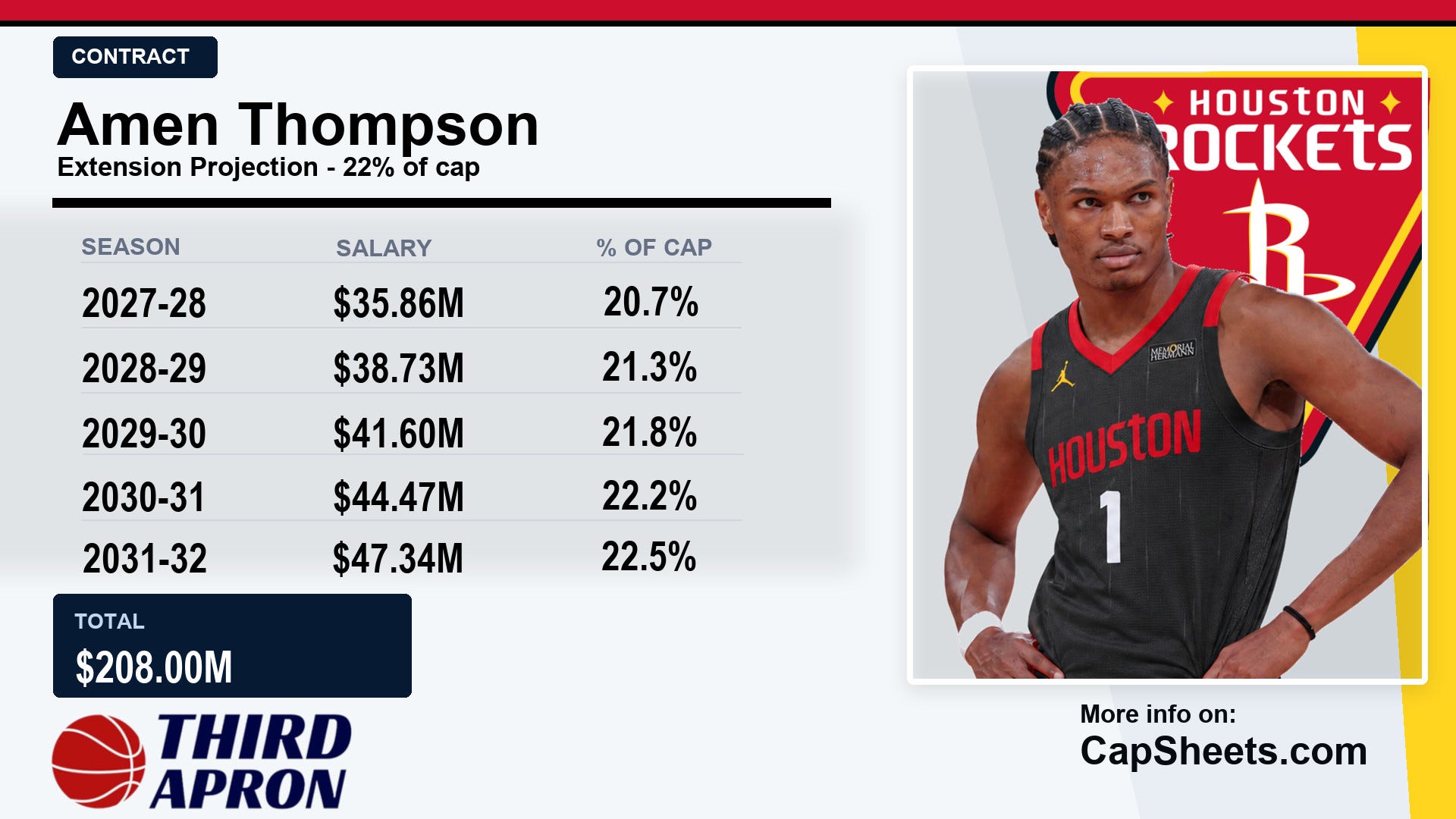
The Rockets have been one of the league’s most prudent contract negotiators. They’ve managed their cap sheet well and are now in a stronger position to retain Fred VanVleet in 2027 free agency, with Thompson getting roughly $9 million less annually than the 25 percent max. Houston will probably still be a luxury tax team, but they should be able to remain under the second apron with marginal moves, such as moving off one of their 2027 first-round picks.
Typically, there have been three or four rookie-scale extensions done within the first week of free agency this decade. Only one rookie-scale extension was done before the end of the moratorium period last year with Jabari Smith Jr. This year, there were none, with the first agreement coming after the moratorium period with Wembanyama.
Thompson’s signing makes him the second-latest second rookie-scale extension in any draft class since 2018.
It’s apparent teams are negotiating harder in rookie-scale extension talks. Not only are deals taking longer to get done, but fewer maximum extensions are being handed out. As the salary cap increases, so is the threshold for who gets a maximum contract. It’s possible Thompson would’ve been automaxed if he entered the league earlier, based on previous precedents.