
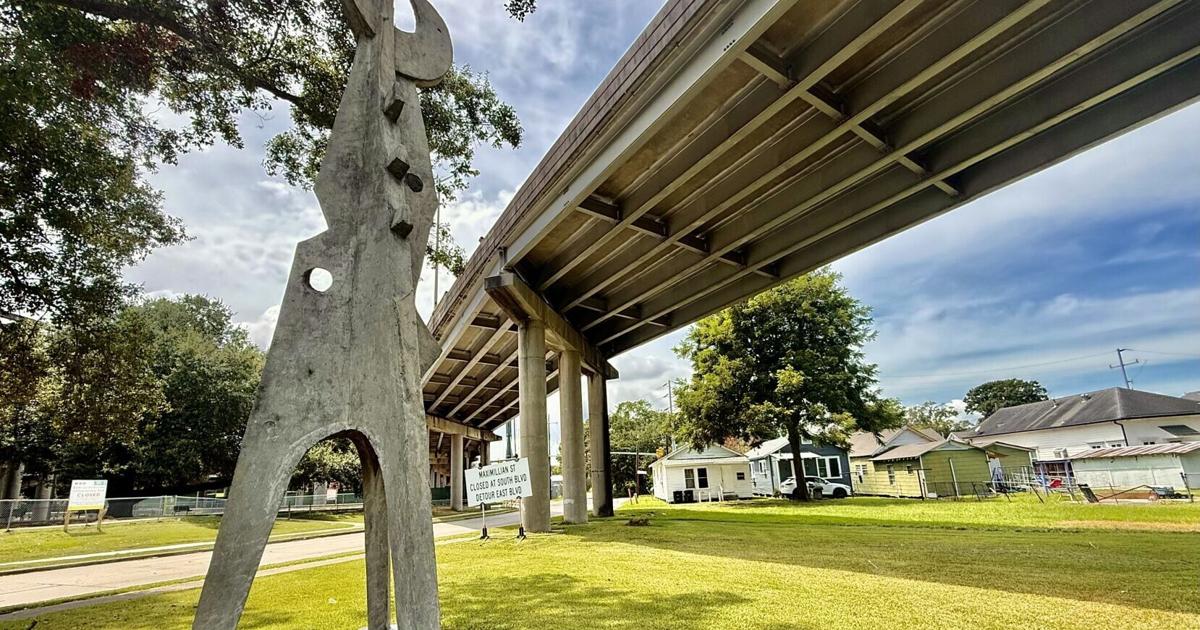
When Christy Jarreau approaches the point where Interstate 110 splits into I-10 West and I-10 East in Baton Rouge, the first question that comes to mind is, “What is it?” followed by a second, “How did it get there?”
The interstate forms a kind of triangle at that point, and rising not quite from the center is what appears to be a totem-like structure.
“It has what looks like a crescent moon at the top,” the the Watson reader said. “And it looks like it’s made of concrete. So what is it, and where did it come from?”

Late Baton Rouge artist Emerson Bell, who created the sculpture ‘Unity and Destiny of Children.’ He built the sculpture on location in BREC Expressway Park in 1977.
FILE PHOTO
An oddity
The object’s mystic presence beneath the interstate is an oddity in the same sense as the black slate monoliths in Stanley Kubrick’s classic 1968 film, “2001: A Space Odyssey.” It’s definitely there, but it doesn’t seem to belong.
Yet, as an authentic city landmark created by a noted Baton Rouge sculptor, it does belong.
“It was made by Emerson Bell, and it’s titled, ‘Unity and Destiny for Children,'” said Randell Henry, professor of art at Southern University. “He and I were friends, and I remember when he was making this.”
Henry, standing in Expressway Park, squints his eyes in the August afternoon sun while gazing toward the top of the sculpture’s 26 feet. Well, it actually stands a couple of feet higher these days.
Late Baton Rouge artist Emerson Bell received funding from the National Endowment for the Artsm, the Louisiana State Arts Council, the Mayor’s Office of Youth Opportunity and Baton Rouge Parks & Recreation for his 1977 sculpture, ‘Unity and Destiny for Children.’ The project was sponsored by the Arts Council of Greater Baton Roueg.
STAFF PHOTO BY ROBIN MILLER
“It experienced some damage and was restored a few years ago,” Henry said. “When they restored it, they mounted it on these concrete pillars.”
He points to the individual pillars beneath each of the sculpture’s three legs. Photos in archived editions of the newspaper show the sculpture’s legs making direct contact with the ground, which was the way Bell built the piece in the park.
An April 10, 1977, a feature story in the newspaper features photos of Bell shaping rebars and wire mesh to create the the sculpture’s abstract form. He bypassed mounting it on a pedestal, opting instead to have the sculpture organically jut from the ground.
Once the shape was in place, Bell covered the wire mesh with oriental stucco sand and a mixture of cement.
A close look at Emerson Bell’s sculpture ‘Unity and Destiny for Children’ in Baton Rouge, Louisiana
Built on location
Which answers Jarreau’s second question. The sculpture wasn’t built in a studio and moved to the park — Bell built it on location. He was 44 years old at the time.
The year was 1977, and Bell had been awarded funding by the National Endowment for the Arts, the Louisiana State Arts Council, the Mayor’s Office of Youth Opportunity and the Baton Rouge Parks & Recreation Commission.
But the idea for Bell’s piece began taking shape in 1976, when he was the artist-in-residence for the Expressway Park Summer Enrichment program.
“The children would ask him when he was going to do something big,” a 1977 newspaper article states.
Emerson Bell said the sickle shape at the top of his sculpture, ‘Unity and Destiny for Children,’ is ‘a figurative representation of a bird, which is free.’ Bell was 44 years old when he created the sculpture on location in BREC Expressway Park in Baton Rouge in 1977.
STAFF PHOTO BY ROBIN MILLER
“Unity and Destiny for Children” was his response to their question.
All of the agencies involved in funding the project are listed on a brass plaque installed beneath the sculpture. The project was sponsored by the Arts & Humanities Council of Greater Baton Rouge, now known as the Arts Council of Baton Rouge. However, the plaque isn’t visible to drivers zooming by on the interstate, and many may be too focused on their destinations to notice.
How to get there
But if the traffic slows to a standstill, as often happens around rush hour, the sculpture attracts wandering eyes. For those who are curious, the easiest route for a closer look is to turn either left or right off North Boulevard at First United Methodist Church onto T.J. Jemison Boulevard.
The street’s name will change to East Boulevard where the Baton Rouge Greenway begins, and it’s from East Boulevard where a left turn onto South Boulevard leads directly to Expressway Park. A picnic table and tennis court stand on the right side of the road, and the sculpture stands tall on the left side. Parking is available in a small lot beside the picnic table, and traffic is minimal.
Southern University Professor of Art Randell Henry stands in front of Emerson Bell’s sculpture, ‘Unity and Destiny for Children’ in BREC Expressway Park in Baton Rouge. Henry and Bell were friends, and Bell often visited Henry’s studio.
STAFF PHOTO BY ROBIN MILLER
From there, walk across South Boulevard and look up. The sculpture will take on a more three-dimensional identity, its appearance changing on each of its three sides.
Seeking higher consciousness
In the 1977 article, Bell described the piece as “generations of children seeking a higher consciousness, with three entrances for the children to walk through, and seven slats protruding from the higher portions of the sculpture representing ‘steps in life.'”
Though some viewers have mistaken the figure at the top for a crescent moon, Bell said “the sickle-shaped top of the work is a figurative representation of a bird which is free.”
The sculpture’s totem appearance also was purposeful with Bell saying he created it with “ancient human overtones, as well as African overtones.”
Though the brass plaque beneath Emerson Bell’s sculpture does not have the full title, it does provide information about the piece’s funding and sponsorship. Bell created the ‘Unity and Destiny for Children’ in 1977 in BREC Expressway Park in Baton Rouge.
STAFF PHOTO BY ROBIN MILLER
“I felt, as a sculptor, this was my unique time to introduce this to my hometown — my heritage,” he said.
Bell died at age 74 on April 13, 2007. He was born in Baton Rouge in 1932, and though he was not formally educated in the arts, he gained his knowledge through artist associations and practice.
“He would always stop by my studio and sit and talk about art,” Henry said. “He also visited Southern University from time to time to visit with (sculptor) Martin Peyton, and he was great friends with Alvin Batiste.”
Batiste was a renowned jazz musician who also taught at Southern University’s Alvin Batiste Jazz Institute.
“Emerson played the flute, and he would often play jazz with Alvin Batiste,” Henry said.
A detail shot of three of the seven slats Emerson Bell molded into his sculpture, ‘Unity and Destiny of Children.’ Bell said the slats portrude ‘from the higher portions of the sculpture representing steps in life.’ The sculpture stands in BREC Expressway Park beneath the Interstate 10-110 split in Baton Rouge.
STAFF PHOTO BY ROBIN MILLER
Artist-in-residence
Bell eventually would be named the East Baton Rouge Parish School system’s first National Endowment for the Arts’ artist-in-residence teacher, and his paintings would land in the permanent collections of the LSU Museum of Art and New Orleans Museum of Art, among others.
Back in the park, Henry walks around his friend’s sculpture, taking in every part of the piece.
“Do you see the round holes up there?” he asked, pointing toward the top. “He said those are portals that children pass through in life, and the sculpture is tall, because he wanted the children to reach high.”
And once they reached the bird at the top, they would soar away from noisy traffic of the interstate into a bright future.