
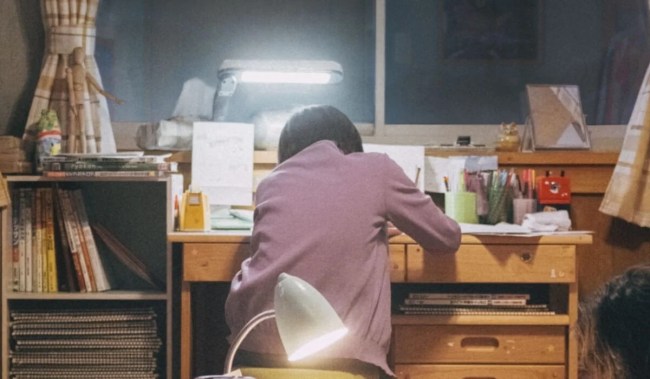
The magic trick of Kiyotaka Oshiyama’s 53-minute anime film “Look Back” is how its brevity gives visceral dimension to the defining tension of its story: That between the time it takes to create something (in this case, a portfolio of one-shots), and the time it takes to consume it. By contrast, the magic trick of Hirokazu Kore-eda’s 100-minute live-action “Look Back” is that it somehow manages to accomplish the same thing despite running twice as long.
As slavishly faithful to Oshiyama’s anime as Oshiyama’s anime was to Tatsuki Fujimoto’s original manga, Kore-eda’s muted but affecting drama retells the bittersweet tale of two very different schoolgirls in western Japan who are bonded together by their shared love of comics. The popular and boisterous Fujino (expressively played through her tweenage years by Furi Nanase) is famous among her classmates for the yonkoma cartoons that she draws for the school newspaper, and carried by the unique self-confidence that comes from discovering your purpose in life at such a young age. Alas, Fujino’s entire worldview is rattled off its axis when she’s in fourth grade — when a severely anxious local shut-in named Kyomoto begins to submit yonkoma of her own as a tentative way of engaging with the world beyond her bedroom. The recluse’s work naturally lacks the finger-on-the-pulse wit of Fujino’s strips, but it compensates for that with the careful attention of its linework and background detail. A heated rivalry is born.


That rivalry eventually blossoms into a beautiful collaboration, as Fujino is tasked with delivering Kyomoto’s diploma to the shut-in’s seemingly abandoned house at the end of sixth grade (no version of this story makes any mention of her parents’ whereabouts, but the director of “Nobody Knows” can’t help but charge this brief glimpse of Kyomoto’s barren home life with a tacit sense of tragedy), and, in what feels like a predestined twist of fate, inadvertently draws the recluse out of her room. By that point, Fujino’s natural resentment towards Kyomoto’s ability — and her obsessive failure to outdo it — has caused her to question her purpose, but it turns out that Kyomoto is Fujino’s biggest fan, and so Fujino agrees to an ego–saving creative partnership. Half a lifetime down the road, she will be haunted by that decision as if it just happened yesterday. But first: happiness.
Their talents combined under the alias “Kyo Fujino,” the girls hole up in Fujino’s bedroom and busy themselves with becoming the most prolific young manga artists in all of Japan. The work they make together consumes the rest of their teenage years in a restless flurry of creative expression. It’s a slipstream of late nights, shared dreams, and debilitating hand cramps so transformative that Fujino and Kyomoto turn into other people right in front of our eyes, as the actors playing them are seamlessly recast with Natsuki Deguchi and Aju Makita (as clean a baton-pass between younger and older versions of the same characters as I’ve ever seen before).
The joy of creation is privileged above the quality of Kyo Fujino’s work, but it’s clear that a powerful new force in the manga world is beginning to emerge from their sleepy corner of the country, a place as far removed from the industry epicenter in Tokyo as Kyomoto used to be from the rest of the world. Of course, “Look Back” has never depicted the small city of Nikaho as the kind of nowheresville that you might expect to backdrop a Cinderella story about a pair of backwater artists who try to make a name for themselves; Fujimoto himself grew up in that semi-rural idyll, and its hyper-expressive landscapes are key to the natural beauty of his work.
While Kore-eda’s films are often tendered with a limpid beauty, his subtle visual style is always strictly in service to his humanism, and there was reason to be concerned that his “Look Back” might fall short of the impossibly lush nostalgia that both the manga and its anime adaptation suffused into every frame. It doesn’t. Maybe the closest thing I’ve seen to the likes of a live-action Makoto Shinkai movie, Kore-eda’s drama — shot across an entire calendar year, so as to capture the natural dynamism of the Nikaho weather — is an intoxicating mosaic of emerald green fields, periwinkle winter sunsets, and snow so white that one shot of Fujino and Kyomoto trudging uphill makes it appear as if they’re walking across a blank sheet of paper. Virtually every scene during the first half of the film takes place in a different season than the one before it, but Senzo Ueno’s sumptuously high-contrast cinematography smoothes them all into the unbroken flow of a lucid memory. The color scheme is magical enough to reflect the specialness of Fujino and Kyomoto’s time together, but also grounded enough to preserve the material reality of what that time required of them.
And time, ultimately, is what “Look Back” has always been about in any and all of its forms. The time it takes Fujino to scratch out a crudely drawn yonkoma vs. the time it takes Kyomoto to illustrate one of her own. The hundreds upon thousands of hours it takes for the girls to create a shared portfolio of work they can sell to the big magazines in Tokyo vs. the few short minutes it takes for them to sell a manga executive on their talent. The years it takes to forge the kind of friendship that most people will never be lucky enough to find in one lifetime vs. the seconds it takes to rip it apart.
Previous incarnations of this story, specifically Oshiyama’s anime, have weaponized their concision to emphasize how fast that time goes by, even when every sleepless night of work the girls spend together feels like it will never end. Kyomoto maintains a quiet love for the process, but all of the tedious pencil-work and shading drives Fujino insane; I felt my entire body relax when she upgrades to a digital tablet during the movie’s second half. Why draw if it’s not fun?
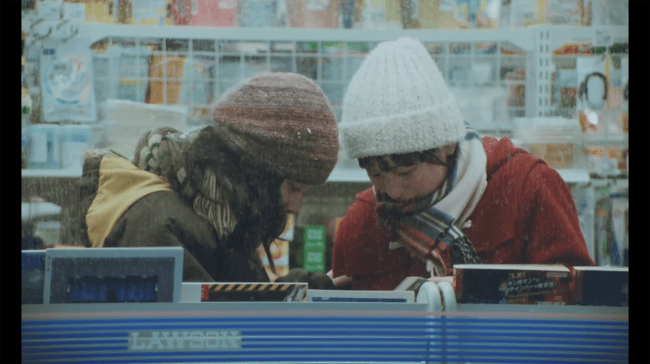 ‘Look Back’
Kore-eda’s “Look Back” doubles the time required to cover the same events, a lengthening owed more to the rhythm of familiar scenes rather than the introduction of new ones. The slower pace is an inevitable byproduct of the pivot from animation to live-action, as the two forms naturally operate at different speeds, and Kore-eda — whose movies have never been accused of being too fast — refuses to fight against that. Recognizing, perhaps, how this feather-light Bildungsroman automatically forfeits a key part of its power by undoing the meta-textual overlap between the girls’ chosen medium and the one used to bring their story to life, Kore-eda focuses on what he might be able to get in return.
Time is his best answer. By stretching the property’s thin plot further than anyone has in the past, and creating a palpable incongruity between the gentle flow of one scene to the next and the tilt-a-whirl speed at which the seasons tick by in the background, Kore-eda endows his “Look Back” with a temporal vertigo all its own. Where the anime careened forward like a runaway train, this much smoother adaptation speeds through time like a Shinkanesen moving so fast that it hardly feels like it’s moving at all.
In addition to a number of lovely grace notes (e.g. the girls attend a theatrical showing of Murnau’s “Nosferatu,” a match-cut transposing the movie screen onto the window of the train they ride home when it’s over), that flattening effect allows the out-of-nowhere twist that bisects every version of this story to hit with an even more devastating and inexplicable numbness than it did before. Aided immensely by the fleshed-out feeling of his cast’s nuanced performances (another major advantage that live-action brings to the table in this instance), and also by a lovely Yuta Bandoh score that’s measured where the music in the anime was more in your face, Kore-eda’s film is able to sit with the film’s defining tragedy with a patience that breeds a different feeling than I’ve gotten from “Look Back” before.
It goes without saying that Kore-eda adheres to the Möbius strip-like structure of the story’s emotional climax, which loops through holes in space and time on its roundabout journey back to the present. But where the anime rendered that reverie as the answer to a question (“Why do you draw, Fujino?”), the more abstruse tonality of Kore-eda’s version endows the same events with a less settled energy.
Many of the shots are identical to how they’ve been presented in previous versions, but here they don’t feel like the answer to Kyomoto’s question so much as they do a more urgent and galvanizing way of framing it in Fujino’s mind. The wistful melancholy remains, but now it’s bolstered by a new sense of resolve, so that every panel Fujino goes on to create won’t just be tenderized by her teenage memories, but also determined to reward the time she invested in them. Lord knows that Kore-eda could have made this movie into a tear-jerker if he wanted to, but, as his gently stirring adaptation makes clear, “Look Back” is more than just a tragedy — it’s also a call to action. It’s an invitation to create and savor those beautiful yesterdays while you still have the chance, because tomorrow will be here before you know it, if it even comes at all.
Grade: B+
“Look Back” premiered at the 2026 Venice Film Festival. GKIDS will release it in theaters later this year.