
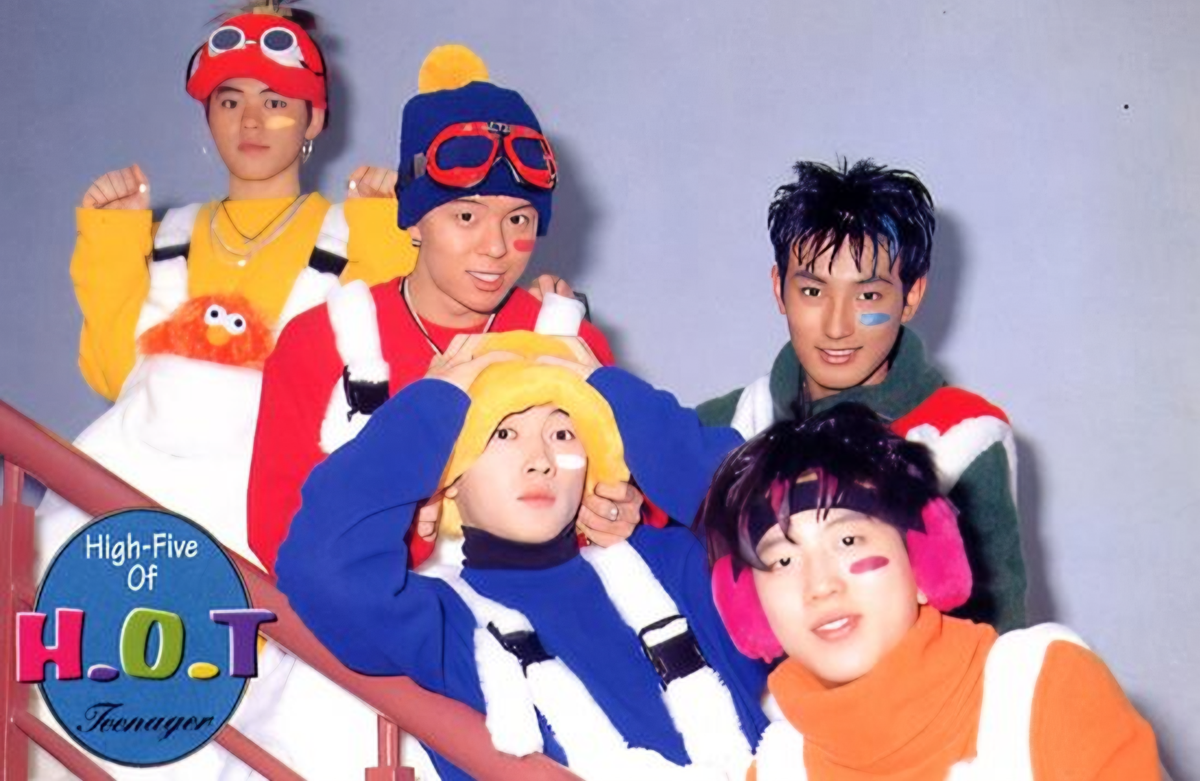
K-pop boy band H.O.T. / Captured from X
The blueprint that K-pop now exports to the world, with its casting and training pipeline, its fixed member roles and its official fan club carrying a designated color, was drawn up in under five years by a group of teenagers who introduced themselves to the nation on live TV.
That was 30 years ago.
On Sept. 7, 1996, a group of five male high school students — Moon Hee-jun, Jang Woo-hyuk, Tony An, Kangta and Lee Jae-won — stepped in front of viewers as H.O.T. and performed “Age of Violence.” Viewers went wild, teenagers in particular.
The name stood for “High-five Of Teenagers,” and the group was the first act SM Entertainment, a top K-pop conglomerate, planned and built from scratch.
Their timing was almost too perfect. Earlier that year, another boy band, Seo Taiji and Boys, had retired, and teenagers installed H.O.T. in the vacancy the trio had left behind.
Where Seo Taiji and Boys had been a self-made phenomenon, H.O.T. were assembled on purpose. The group was the product of meticulous planning and strategy at SM, which set a concept first and then filled it by casting and auditioning students who understood the emotional register of their own generation better than anyone.

K-pop boy band H.O.T. / Captured from X
Formula, then follow-up
What made the group a template rather than simply a hit was its second single.
“Age of Violence,” the debut lead track of the group’s first studio album, “We Hate All Kinds of Violence,” combined gangster rap to lyrics criticizing school violence, and it functioned as the opening signal.
The follow-up, “Candy,” pulled a fandom together in earnest and captured teenagers with a melody they could not shake, and the mittens and knit caps the members wore while promoting it hardened into an H.O.T. look of its own.
Alternating between a dark concept and a bright one, executed by the same five performers, remains standard operating procedure three decades later.
The hits kept coming, and they alternated in the same way the first two singles had. “Full of Happiness,” arrived in 1997 as pure sweetness. “We Are the Future” and “I Yah!” went the other way, carrying social criticism that was unusual for a group marketed to schoolchildren. “Hope,” written by Kangta, became something else again — a song that outlived the group and turned into an SM standard.
The commercial run that followed was equally formative. H.O.T.’s first four albums were all million sellers, and the group took home 12 grand prizes at year-end music awards, achievements without precedent at the time. In 1999, H.O.T. became the first local music act to headline a solo concert at Seoul Olympic Stadium.
The fans
That booking points to what may be H.O.T.’s most durable contribution.
Club H.O.T., the group’s official fan club, drew roughly 220,000 paying members over its lifetime. Counting those without official fan club membership, the figure approached 700,000 fans.
The club improvised its own rules as it went. Which balloon color belonged to which act was itself something that had to be decided, and H.O.T. settled on white. The balloons did the work light sticks do now. Held up across a stadium floor, they turned a crowd into a single block of color that read instantly on television, and they marked who in the room belonged to whom.
The scale of it left marks outside the concert hall. So many schoolgirls nationwide left class early on H.O.T. concert days that the education ministry issued an order against it.
When the members reunited at Olympic Stadium in 2018, 17 years on, the white balloons of the 1990s had become white light sticks that organizers could switch to other colors by radio signal. The arrangement of the room was the same.
Abroad, the group arrived before the vocabulary did. H.O.T. performed at Beijing Workers’ Gymnasium in February 2000 at the invitation of China’s culture ministry, and Kangta has since described that night as the “origin point” of everything that followed.
He has said the concert was covered so heavily by local media that the word “hallyu,” or Korean wave, entered circulation, and that the singers who went abroad in its wake are what eventually became K-pop.

K-pop boy band H.O.T. in 2025 / Captured from Tony An’s social media
30th year
The group did not survive its own success. In May 2001, at the height of the group’s popularity, contract terms could not be agreed with SM, and Tony An, Jang and Lee left the agency, formally ending the group, while Moon and Kangta renewed their contracts.
Full reunions have been rare since: the Olympic Stadium in 2018, Gocheok Sky Dome in September 2019 and headline sets at the Hanteo Music Festival last November, the group’s first performance together in six years and two months.
The anniversary year has been busier. All five reunited for a local ad campaign, their first appearance together in about 25 years, recreating their old costumes and makeup for “Age of Violence,” “Candy” and “We Are the Future” across seven videos, which drew more than 10 million views within a day of their release on Feb. 1.
Their reach is easier to measure elsewhere.
Maggie Kang, who directed Netflix’s “KPop Demon Hunters,” told reporters in Seoul last year that she had loved Seo Taiji and Boys and H.O.T. since she was young, which means the biggest K-pop story of the past two years was made in part by someone who grew up following a Korean boy band.