
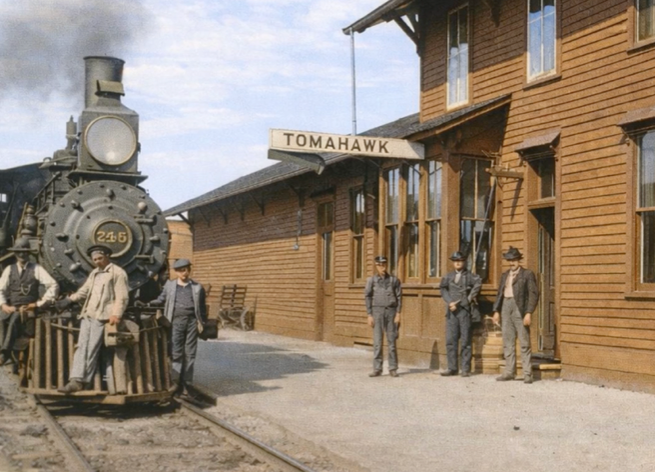
A new documentary about Tomahawk asks a question that reaches beyond one Northwoods community: How does a lumber town born during Wisconsin’s logging boom survive long after the boom is gone?
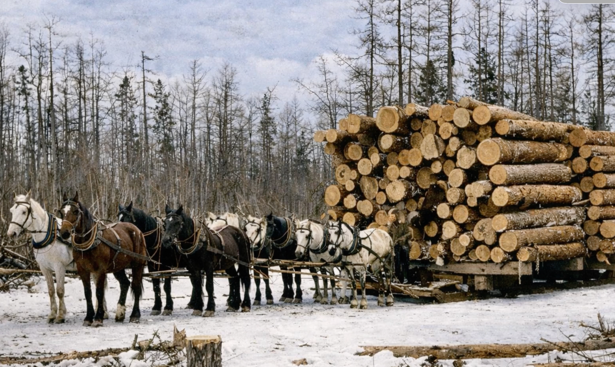 A film still from the September 2026 documentary “Tomahawk, City in the Pines” shows a glimpse of the logging industry in the community’s early days. Photo courtesy film producer Clay Schmit
“Bill Bradley had a vision of a city that would thrive and exist long after the usual boomtown era would fade,” producer Clay Schmit said in an interview on WPR’s “Morning Edition.”
Understanding Wisconsin, Together.
WPR’s “Wisconsin Today” newsletter keeps you connected to the state you love without feeling overwhelmed. No paywall. No agenda. No corporate filter.
That vision is the starting point for “Tomahawk: City in the Pines,” a feature-length film exploring the people, places, industries and defining moments that have shaped Tomahawk since William H. Bradley founded the city in 1886.
The film grew out of a two-year collaboration between Schmit, a Tomahawk native, and John Newcombe, a Los Angeles-based, Academy Award-winning filmmaker.
Dozens of residents, historians, organizations and businesses contributed to the project as the filmmakers assembled nearly a century and a half of local history. The result is about 90 minutes long — considerably shorter than it could have been.
“If we put in everything that we researched and actually made film of, the film would be over two hours long,” Schmit said. “At some point, you just have to say, we can’t tell everything.”
What remains is a story that moves through Tomahawk’s lumbering origins and into the generations that followed, examining how industries changed, landmarks disappeared and residents repeatedly rebuilt a community that has retained much of its identity.
“Tomahawk: City in the Pines” premieres at 7 p.m. Saturday, Sept. 12, at the Tomahawk High School Auditorium, 1048 E. King Road. The screening is free and open to the public. Schmit and Newcombe will take questions from the audience after the film.
Additional screenings are planned in the Tomahawk area, and the filmmakers say the documentary is expected eventually to be available through online streaming platforms, giving former residents and others interested in Northwoods history a chance to see it beyond the premiere.
The following interview has been edited for brevity and clarity.
Shereen Siewert: The film begins with William H. Bradley. What was here before the story that most people think of as Tomahawk began?
Clay Schmit: Bill Bradley was a lumber baron from Maine, and then he moved into Michigan. He even spent some time in Iowa and Minnesota. But he settled his operations at the confluence of three rivers.
There’s the Tomahawk River, which flows originally out of Lake Tomahawk and comes down and hits the Wisconsin River. At just about the same point, there’s a river from the west called the Somo River. And so it was a confluence of those three rivers that, in those days, was known as the Forks.
Early on, there were Ojibwe people living in the area and traveling through, and there were some fur traders. There was one guy named Bouchard who had a little trading post on an island right at the Forks. And that’s what was here in the very early days.
Bradley was up here scouting timber with somebody. They were in a boat. Bradley took a look at the place where these rivers came together and said, “I’m going to build a town right here.”
One of the things that’s fascinating about this story, and I think the people in Tomahawk are going to be delighted to learn about, is that not only was Bill Bradley a multimillionaire, he was one of the richest men in Wisconsin. In fact, he actually retired at age 38. And then he got bored. And so that’s when he came up north and started looking for more timber to cut.
He was exceptionally generous. He was building businesses and running them at a loss so that the people who worked in the woods and the mills could thrive.
He opened a mercantile and a drugstore that were open 24 hours a day with no one there to tend them. The doors were open. If somebody got hurt in the mill, they had access to whatever they needed to get patched up.
He was an amazingly generous guy who did everything he could to help the city flourish.
SS: What did you find in your research that surprised you the most?
CS: One of the things that is delightfully surprising is how the city has really stayed the same size since about 100 years ago. We’ve always been about 3,500, give or take 100 or two. I remember the same number when I was a kid.
So you have to ask yourself the question: What is it that keeps a town essentially the same size, with the same amount of growth, the same amount of dynamic quality that Tomahawk has? And it has to do with the perseverance of people in the face of difficulty.
One of the difficulties was — and it almost seems comical when you see it in the film — every mill that was built burned, and they would rebuild it and start again, or they’d move it across the river and start again.
And why were there so many fires? Well, because you’re dealing with lumber and sawdust and steel machinery that can throw sparks. So it was never a surprise when a mill burned down. They would just build it back and keep on doing it.
And then there were many, many fires through the history of Tomahawk, especially downtown, wiping out several blocks in town. They would just rebuild.
One of the most interesting fires was the Mitchell Hotel. There’s a kind of crummy-looking hotel on the corner of Main Street right now called the Tomahawk Hotel, which has long since been turned into something else. But it was the site of the original Mitchell Hotel.
Bill Bradley wanted to build the finest hotel in Wisconsin. So he built a hotel that rivaled the Pfister in Milwaukee. And it was spectacular in every way. Everybody came, and all of the big shots came and stayed there.
That was built around 1895 or something like that, and it burned down, sadly, in 1929. If that hotel had stayed there and was still available to us, it would really be a hallmark of the city and of the Northwoods because it was so spectacular.
SS: You interviewed people who have lived this history, not just studied it. Was there a story or a moment when the project stopped feeling like a history film and became something a little more personal?
CS: Oh, very much so. Our best resource is a 92-year-old gentleman. He and his wife just took it upon themselves to gather historical stuff, and they worked with the Historical Society.
But because he’s 92, he has personal memories going back to these places that we can only just imagine now. And when we were building the film, he was always correcting us: “No, that mill was on the other side of the river.” He knew. That’s what he saw with his own eyes.
A wonderful guy named Andy Zastrow. And Andy was invaluable to us. Sitting and talking with Andy is just a delightful recounting of this man’s life in this neat town.
SS: When you condense 140 years of a community into one film, you’re also deciding what becomes part of the public memory. What responsibility did you feel in making those choices?
CS: That really became difficult toward the end. John is talking about perhaps doing a deleted-scenes set so that people might have access to some of what we couldn’t include. Some of the really great personal reflections, quotations from early settlers and everything, just had to be left out. And that’s kind of sad, but it had to happen.
SS: What is the most Tomahawk story in the film — something that could have only happened here?
CS: Well, I’ll tell you a great story. A man named Frank Winter, back in the ’30s, decided he wanted to make wooden boats. So he started a little factory making wooden boats, the Tomahawk Boat Company.
And you can find, every once in a while somewhere in the country — I’ve heard of a story, one in Florida — a wooden Tomahawk boat in a restaurant or something as a decoration. So you can see them here and there, but they’re very rare.
In the late ’50s, he turned to making fiberglass boats. And the fiberglass boats that he made here in Tomahawk were world-class.
In 1961, I think it was, Harley-Davidson found out about this fiberglass factory. And so they bought it from Frank Winter. And for one year, they made boats and cowlings for Harleys. Then they phased the boats out and turned it into a Harley factory.
And right now, we have two Harley-Davidson factories, one in town and one on the edge of town. It all came from Frank Winter starting out making wooden boats.
Transcript
Expand
Collapse
Transcript Terms of Use
Transcripts are provided for accessibility and convenience and may be created using a mix of automated tools and human review. While we strive for accuracy, transcripts may contain errors or omissions and are provided “as is” without warranties of any kind. The audio version is the official record of WPR programming. All transcripts are owned by WPR and protected by U.S. and international copyright law. They are provided for personal, non-commercial use only. You may not reproduce, modify, distribute, or use transcripts for public or commercial purposes without prior written permission from WPR. For permissions, contact listener@wpr.org.
From our bureau in Wausau, this is Morning Edition on WPR News. I’m Shireen Siewert. A new feature-length documentary is putting the history of 1 northern Wisconsin community on the big screen. Tomahawk City in the Pines traces the defining moments that shaped the community. The film was produced by Tomahawk native Clay Schmidt and Academy Award-winning filmmaker John Newcomb. It premieres September 12th at Tomahawk High School. Clay Schmidt joins us now. Welcome.
Good morning, Shireen.
The film begins with William H. Bradley and Tomahawk’s founding in 1886. What was here before the story that most people think of as Tomahawk begins?
He came during the lumbering, the lumber baron days. And he was a lumber baron from Maine. And then he moved into Michigan. And then he even spent some time in Iowa and Minnesota. But he settled his operations at the confluence of three rivers. There’s the Tomahawk River that flows originally out of Lake Tomahawk and comes down and hits the Wisconsin River. At just about the same point, there’s a river from the west called the Somo River. And so it was a confluence of those three rivers that were in those days were known as the Forks. Early on, there were Ojibwe Indians living in the area, traveling through, and there were some fur traders. And there was one guy named Bouchard who had a little trading post on an island right at the forks. And that’s what was here in the very early days. Bradley was up here scouting timber with somebody. They were in a boat. Bradley took a look at the place where these rivers came together and said, I’m going to build a town right here. One of the things that’s fascinating about this story and I think the people in Tomah are going to be delighted to learn about is that not only was Bill Bradley a multimillionaire, he was one of the richest men in Wisconsin. In fact, he actually retired at age 38. And then he got bored. And so that’s when he came up north and started looking for more timber to cut. But Bill Bradley had a vision of a city that would thrive and exist long after the usual Boomtown era would fade. And it was his drive and his contributions. He was exceptionally generous. So he was building businesses and running them at a loss so that the people who worked in the woods and the mills could thrive. He opened a mercantile and a drugstore that was open 24 hours a day with no one there to tend them. The doors were open. If somebody got hurt in the mill, they had access to whatever they needed to get patched up. Amazingly generous guy that did everything he could to help the city flourish.
You had access to old photographs, artifacts, and people’s memories. did you find that surprised you the most?
One of the things that is delightfully surprising is how the city has really stayed the same size since about 100 years ago. We’ve always been about 3,500, give or take 100 or two. I remember the same number when I was a kid. So you have to ask yourself the question, what is it that keeps a town essentially the same size with the same amount of growth? the same amount of dynamic quality that Tomahawk has. And it has to do with the perseverance of people in the face of difficulty. One of the difficulties was, and it almost seems comical when you see it in the film. every mill that was built was burned and they would rebuild it and start again, or they’d move it across the river and start again. And why were there so many fires? Well, because you’re dealing with lumber and sawdust and steel machinery that can throw sparks. So it was never a surprise when a mill burned down and they would just build it back and keep on doing. And then there were many, many fires through the history of Tomahawk. downtown especially, wiping out several blocks in town, they would just rebuild. One of the most interesting fires was the Mitchell Hotel. There’s a kind of a crummy looking hotel on the corner of Main Street right now called the Tomahawk Hotel, which has long since been turned into something else. But it was the site of the original Mitchell Hotel. Bill Braddy wanted to build the finest hotel in Wisconsin. So he built a hotel that rivals the Fitzer in Milwaukee. And it was spectacular in every way. And everybody came and all of the big shots came and stayed there. And that was built like around 1895 or something like that. And it burned down, sadly, in 1929. And if that hotel had stayed there and was still available to us, it would really be a hallmark of the city and of the North Woods because it was so spectacular.
You interviewed people who have lived this history, not just studied it. Was there a story or a moment when the project stopped feeling like a history film and became something a little more personal?
Oh, very much so. Our best resource is a 92-year-old gentleman. He and his wife just took it upon themselves to gather historical stuff and they worked with the Historical Society. But because he’s 92, he has personal memory of going back to these places that we can only just imagine now. And when we were building the film, he was always correcting. No, that mill was on the other side of the river. He knew. That’s what he saw with his own eyes. A wonderful guy named Andy Zastro. And Andy was invaluable to us. Sitting and talking with Andy is just a delightful recounting of this man’s life in this neat town.
When you put 140 years of a community into 90 minutes, you’re also deciding what becomes part of the public memory. responsibility did you feel in making those choices?
That really became difficult toward the end because if we put in everything that we researched and actually made film of, the film would be over two hours long. And at some point you just have to say we can’t tell everything. John is talking about perhaps doing a deleted scenes set so that people might have access to that. Some of the really great personal reflections quotations from early settlers and everything just had to be left out. And that’s kind of sad, but it had to happen.
What is the most tomahawk story in the film, something that could have only happened here?
Well, I’ll tell you a great story. So a man named Frank Winter back in the 30s decided he wanted to make wooden boats. So he started a little factory making wooden boats, Tomahawk Boat Company. And you can find every once in a while somewhere in the country, I’ve heard of a story, one in Florida, a wooden Tomahawk boat in a restaurant or something as a decoration. So you can see them here and there, but they’re very rare. In the late 50s, he turned to making fiberglass boats. And the fiberglass boats that he made here in Tomahawk were world class. In 1961, I think it was, harley-davidson found out about this fiberglass factory. And so they bought it from Frank Winter. And for one year they made boats and cowlings for Harley’s. And then they phased the boats out and they turned it into a Harley factory. And right now we have two harley-davidson factories, one in town and one on the edge of town. All came from Frank Winter starting out making wooden boats.
The name of the film is Tomahawk City in the Pines. It premieres September 12th at Tomahawk High School. Clay Schmidt, thank you so much for your work on this and for joining us today.
Thank you, Shireen. My pleasure.
If you have an idea about something in central Wisconsin you think we should talk about on Morning Edition, send it to us. Our e-mail address is central at wpr.org. And remember, you can always find great stories from WPR News, including this one online at wpr.org. I’m Shireen Siewert from our bureau in Wausau. This is Morning Edition on WPR News.