
The Athletic has live coverage of the 2026 U.S. Open.
NEW YORK — A year ago, Carlos Alcaraz showed up at the Billie Jean King National Tennis Center with a buzz cut and a rocketing serve, unlike any arrow he had ever had in his quiver before.
He lost three service games in seven matches, and won the U.S. Open men’s title.
No one ever had a chance.
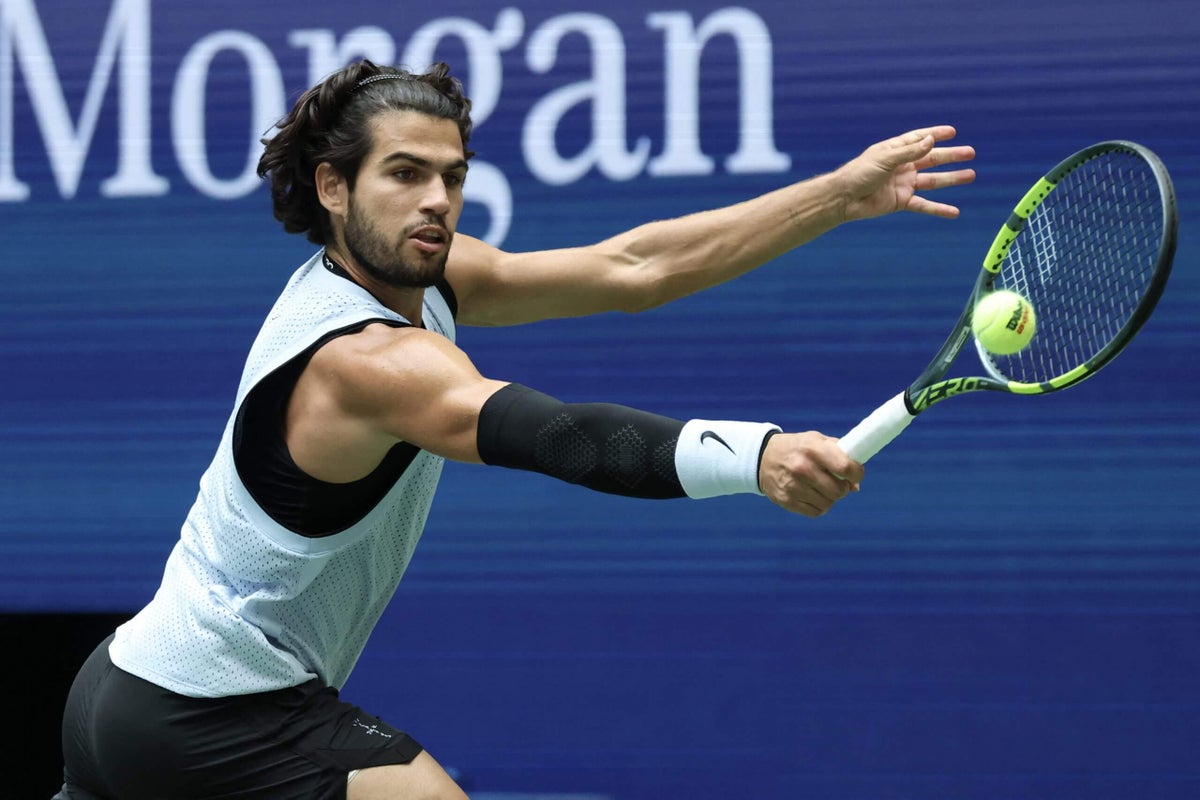
This year, he has shaggy mane and uses a thin headband to keep it all under control, plus a serve that is nowhere near as potent as it was 12 months ago.
That’s OK. In the absence of the 132 mph blasts and the sidewinding aces, a subtler but no less devastating arrow is doing its work.
A player has a ball in his hand. Alcaraz is across the net, waiting. For once, on a tennis court, the odds are against him. In men’s tennis, before even hitting the ball, the server has around a 66 percent chance of winning the point.
Alcaraz tightens those odds, however, because he gets many first serves back into play and wins many of the points when he does.
“I’m trying to make them think a little bit,” he said after befuddling Tommy Paul in the fourth round Monday. By the middle of a 6-4, 6-3, 6-4 win, Alcaraz’s returns had Paul stutter-stepping backward on many of his serve points.
Alcaraz created 14 break points. He only needed to convert four to make the win comfortable.
Now comes Alcaraz’s biggest test yet in this tournament: Ben Shelton, Tuesday night, in Arthur Ashe Stadium.
This is one of those bright-lights, New York events, featuring perhaps the flashiest, most naturally gifted player the sport has ever seen against the most exuberant and, at this moment, most realistic U.S. hope for glory.
Shelton combines college-tennis exuberance with the explosiveness of a superstar from a football field or a basketball court. He is the top-ranked American, yet still has so much to prove, especially against the best of the best on the biggest stage in the game — at his home Grand Slam.
Alcaraz, 23, has already won seven Grand Slam tournaments. He is the youngest man to win all four. He will relish every moment in Tuesday’s contest, and not just because it’s what he lives for.
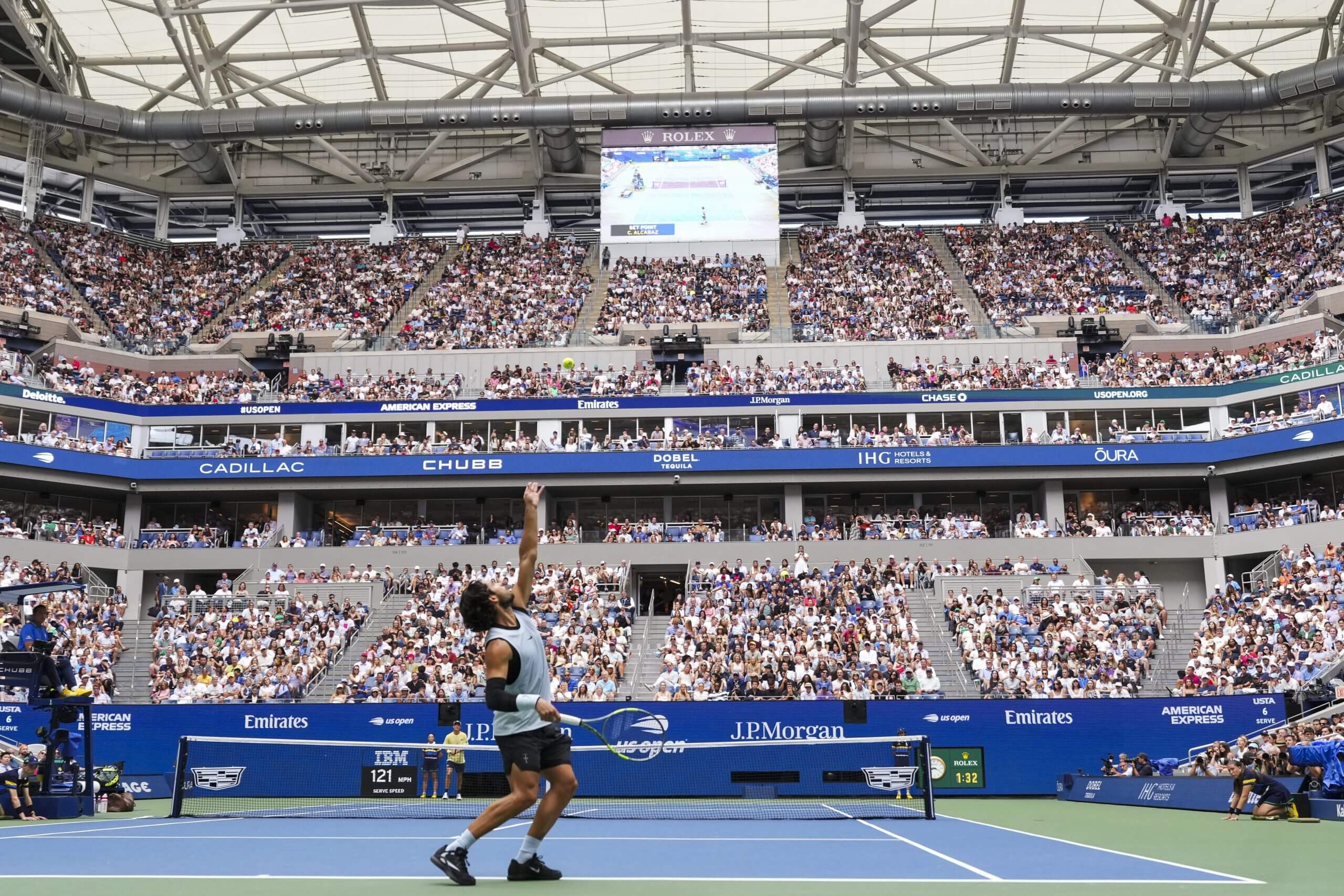
12 months ago, Alcaraz’s serve was among his most commanding assets. This U.S. Open, it has been functional but less dominant. (Jeff Dean / USTA via Getty Images)
He is also returning from a wrist injury, one of the most dangerous and dreaded a player can have. Somehow, after five months away, he has turned this U.S. Open, which was supposed to be a referendum on his readiness for tennis, into just another tournament in just another year.
“Excited for the battle,” Shelton said in a news conference after he had pummeled a resurgent Stefanos Tsitsipas in the fourth round Sunday night.
“Never played him here in New York, and obviously in the position that I want to be in.”
The 6-2, 6-3, 6-4 win was Shelton’s most complete and focused performance of the tournament.
Against Tsitsipas, Shelton smacked 12 aces, won 84 percent of his first-serve points and never faced a break point.
It’s not quite Pete Sampras vs. Andre Agassi. But Shelton will bring a cannon capable of cracking 150 mph, plus a nasty left-handed kicker and a growing array of point-starting weapons. Alcaraz will bring the timing, precision, dexterity and potency to try to neutralize them.
Shelton knows as well as anyone what he is up against. He hasn’t beaten Alcaraz in three tries, the last at the 2025 French Open, where he lost in four sets. He practiced with Alcaraz ahead of this tournament.
“I’ve been watching his matches,” Shelton said Monday night. “He’s playing an extremely high level. To me, he looks very normal — his normal, I mean — which is impressive after not playing for five months.”
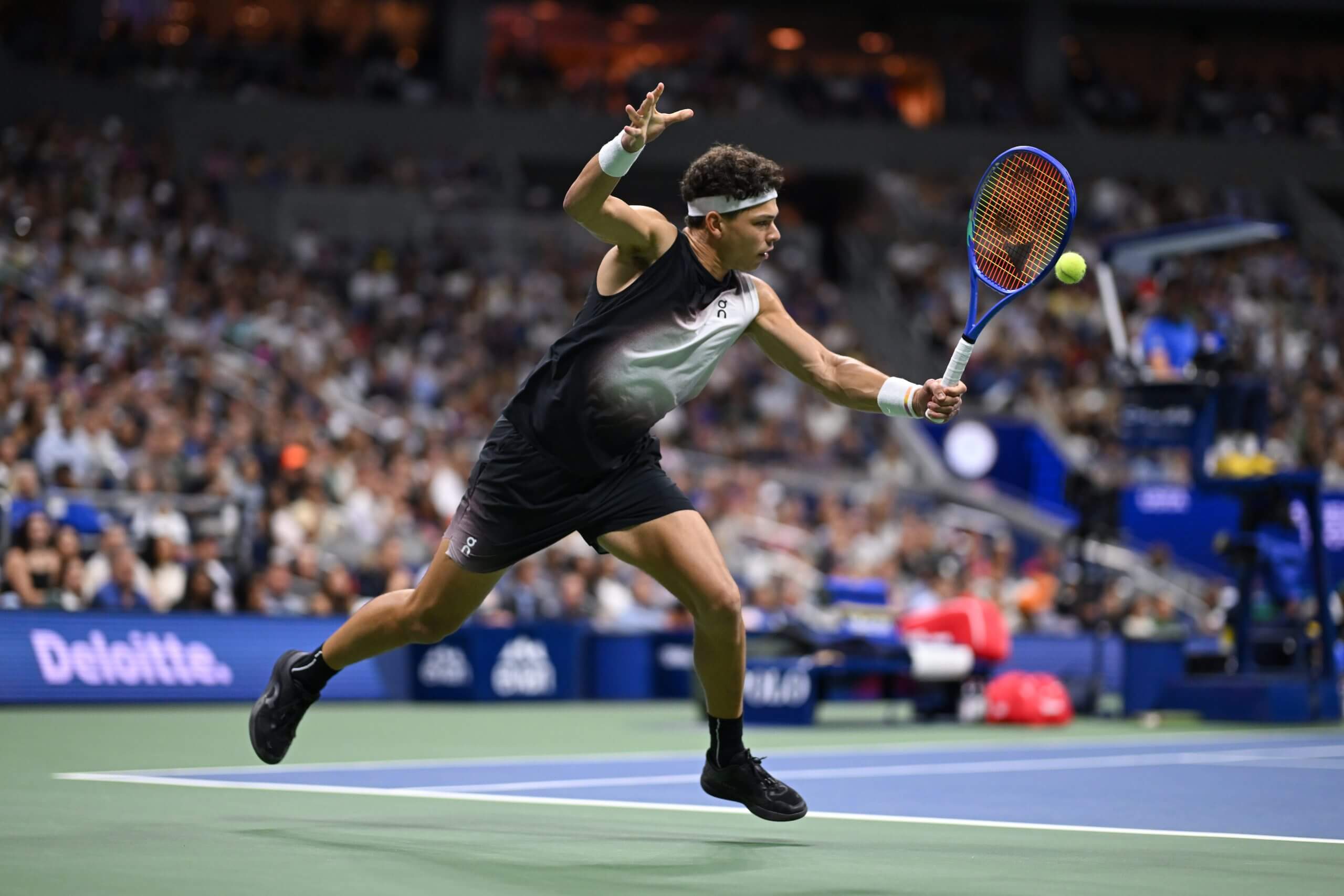
The hard-hitting Ben Shelton is Alcaraz’s opponent in what could be the matchup of the tournament so far in this U.S. Open. (Ben Solomon / USTA via Getty Images)
Nothing is normal about Alcaraz when it comes to tennis.
It’s not normal to rock up to a Grand Slam after nearly five months on the sidelines and almost immediately reassert his brand of electric dominance. Roger Federer is one of the unusual examples; he won the Australian Open in 2017 with only one team event as a tuneup after spending six months on the sidelines with a knee ligament injury.
Still, a knee injury is still a little different than a wrist injury on a tennis player’s dominant arm. Alcaraz is coming back from tenosynovitis, an injury in which fluid accumulates in the sheath that protects a key tendon in the wrist.
Like every tennis player, Alcaraz relies on the wrist of his racket hand to generate the immense levels of speed and spin that make his shots so difficult to handle. There’s no precedent for a player being sidelined with that for nearly five months and playing this well.
And even when things might look normal, such as when he shifts his position in the back of the court while awaiting his opponent’s return, Alcaraz does it in a way that produces outlandish results.
His first-serve return has been an understatedly devastating component of his game for some time. In the 2025 season, he won a higher proportion of first-serve points than anyone. He has not been outside the top five on the ATP Tour for that metric since 2021.
It was the bedrock of his Wimbledon win over Novak Djokovic in 2023. It was the key to his Australian Open semifinal win over Alexander Zverev in January, because it established the two-set lead that he would relinquish due to cramps before winning in five. And it was what turned the final against Djokovic — along with some physical issues for the 24-time major champion — after Djokovic had blasted through the opening set.
In New York, Alcaraz’s first major flash of danger on his return came in the fourth set of his second-round match against Jaime Faria of Portugal. Faria was down a break and scrambling to survive, having snatched the opening set by getting past Alcaraz’s defenses.
He sent Alcaraz off the court to catch up with a deuce-side slice serve outside the tramlines. Alcaraz sent it searing back across the court to within inches of the far sideline. Faria could only chip it, almost off his toes. The point was gone. A couple of points and one brutal return later, so was the game.
Alcaraz can basically do whatever he wants on returns these days. He chips. He takes big cuts. He lunges and blocks. He goes down the line, across the court, whatever the situation calls for.
For most of the first set against Paul in the fourth round, Alcaraz was everywhere in the back of the court when Paul was serving.
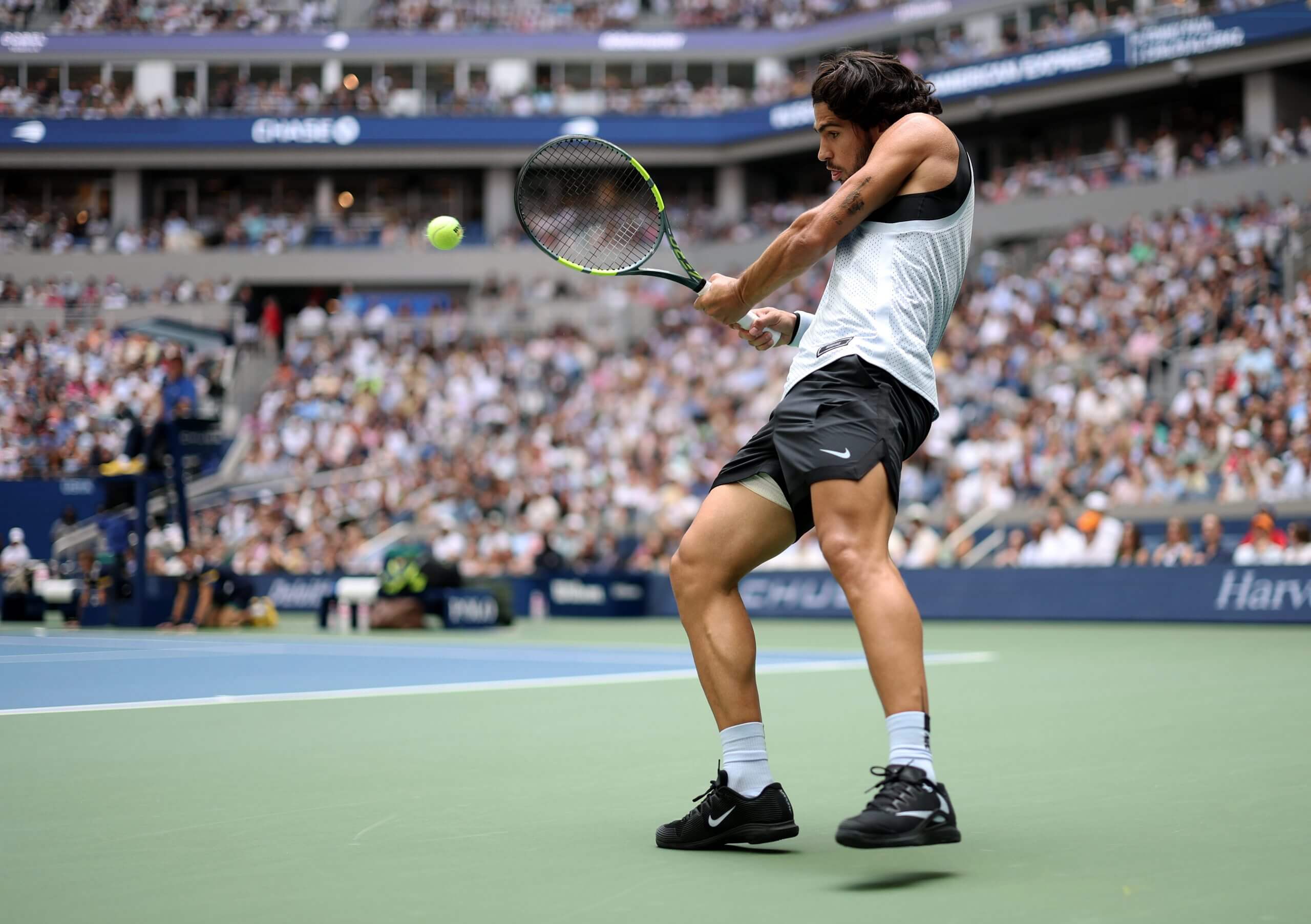
(Julian Finney / Getty Images)
Sometimes, he was so close to the back wall that only the top of his head was visible on television. Sometimes, he was right up on the baseline. He made similar adjustments against Faria, starting with his toes close to the whitewash in the first set and retreating by the middle of the second.
In the 10th game, with Paul serving at 4-5, Alcaraz settled into his goldilocks zone, about eight feet behind the baseline. From there he blasted a series of returns off high-quality first serves that had Paul scurrying after balls like someone who had just dropped a wad of $100 bills on a windy day.
The only way Paul managed a point the whole game was with a 136 mph bullet to the corner that Alcaraz didn’t even bother moving for. Alcaraz kept moving around throughout the next two sets, to keep Paul off-balance. But every so often he would find that eight-feet-deep position again to send Paul scurrying.
After the win, Alcaraz said that when an opponent doesn’t change their position, the server doesn’t have to think or feel pressure.
“You’re thinking just about your serve, not about the opponent,” he said.
“When you change the position of the return, if you’re going back, if you’re going into the court, you make them feel or think a little bit.”
Paul noticed every move. His brain churned. He felt the pressure.
“On first serve he did a good job of — almost every ball he had his strings on, he put it back in the court and deep,” Paul said in his news conference.
“Starting early in the match he was closer to the baseline trying to take my second serve early. Then he backed up end of the first, and most of the second he backed up, took all my second serves from deep.
“Then, basically after he got the break in the third, he went back up again. I think he was trying to apply extra pressure by coming in. He definitely wanted to make points quick and kind of rush me.”
Every tennis player will say that mixing up the return position is a good strategy, but most of them don’t do it too much, especially on crucial points, because it’s really hard.
“If you as a returner feel confident that you can switch it up and still make the return, I think it’s a great strategy,” Taylor Fritz said in a news conference earlier in the tournament.
“For me, sometimes if I’m consistently standing in one spot and it feels OK, it’s not an easy call to just go back to the fence on a break point,” he said, adding: “You’re hitting from a spot where you haven’t really hit from before.”
That doesn’t seem to matter all that much to Alcaraz.
Paul won 63 percent of his first-serve points in their match. On tour the past year, he’s averaging 74 percent.
In the first round, Roman Safiullin won 64 percent of his first-serve points. He averages 71 percent
Faria? 73 percent on tour, 64 percent against Alcaraz. Wu Yibing? 70 percent on tour. 53 percent against Alcaraz.
Now comes Shelton, a freight train in tennis shoes who will be looking to make the radar gun go higher than 148 mph, his fastest serve so far in this tournament, and also hit the right spots with kicks and curveballs to keep Alcaraz honest.
“He has a lot of spins and slices,” Tsitsipas said of Shelton’s main weapon. “He’s difficult to predict. That was something that was very difficult to deal with today. It can kind of come from anywhere with any kind of spin.”
On average, Shelton has won 76 percent of his first serve points the past year. He will need every bit of that and maybe a little more against Alcaraz Tuesday night.
“He uses the crowd, the people behind him, especially when he’s playing here at home,” Alcaraz said of Shelton.
It’s a safe bet he’s got a plan to counter that, too.