

Chapter 1: The global capital map is shifting
The geopolitical realignment currently unfolding has dramatically changed how investors assess risk and rewards, with many institutional players with large pools of capital looking to diversify. For proof, look no further than the Canada Investment Summit, attracting some of the world’s biggest investors, with a total of more than $100 trillion under management.
With so much capital in search of a new home, and nation building very much in style, competition is heating up. Many countries, looking to shore up their domestic economies, are trying to create the necessary conditions to attract large amounts of foreign direct investment (FDI) to fund critical infrastructure and technology. The big winners will be those who best combine higher returns with speed, certainty and market access.
Canada is well positioned for this new dynamic.
Our analysis indicates that with some changes to its playbook, Canada could unlock $1 trillion in incremental capital expenditure in the next five years, transforming the country into the G7’s GDP growth leader. That scale of investment implies a 10-15% increase in GDP per capita and up to 1.4 million direct jobs.
But before diving into what it will take for Canada to capitalize on this generational opportunity, it’s important to zoom out. When you do, it becomes clear that global capital is caught in three crosscurrents, each pulling in a different direction.
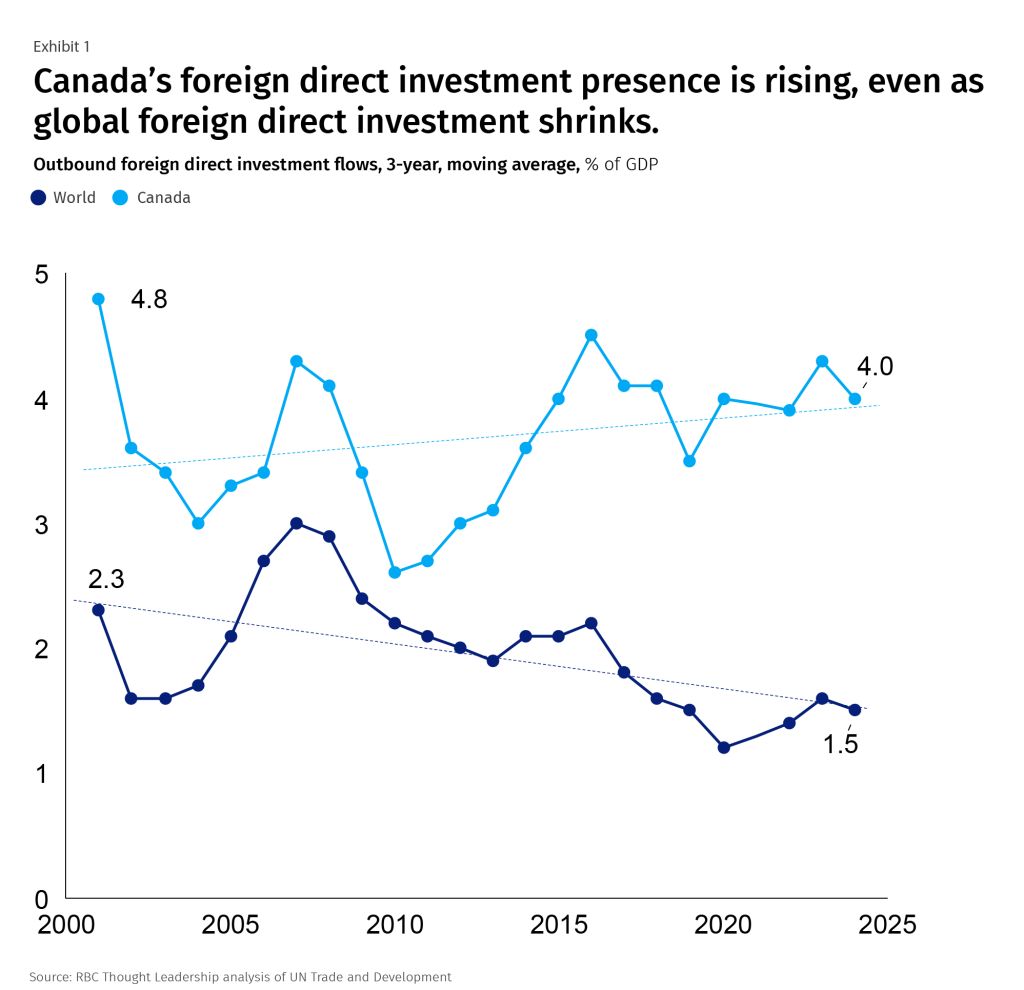
First, global FDI is becoming scarcer and concentrating in future-shaping industries (Exhibit 1). Data centres, semiconductors, electric vehicles and batteries, pharmaceuticals, and enabling industries such as critical minerals and energy have absorbed roughly three-quarters of announced greenfield FDI since 2022.
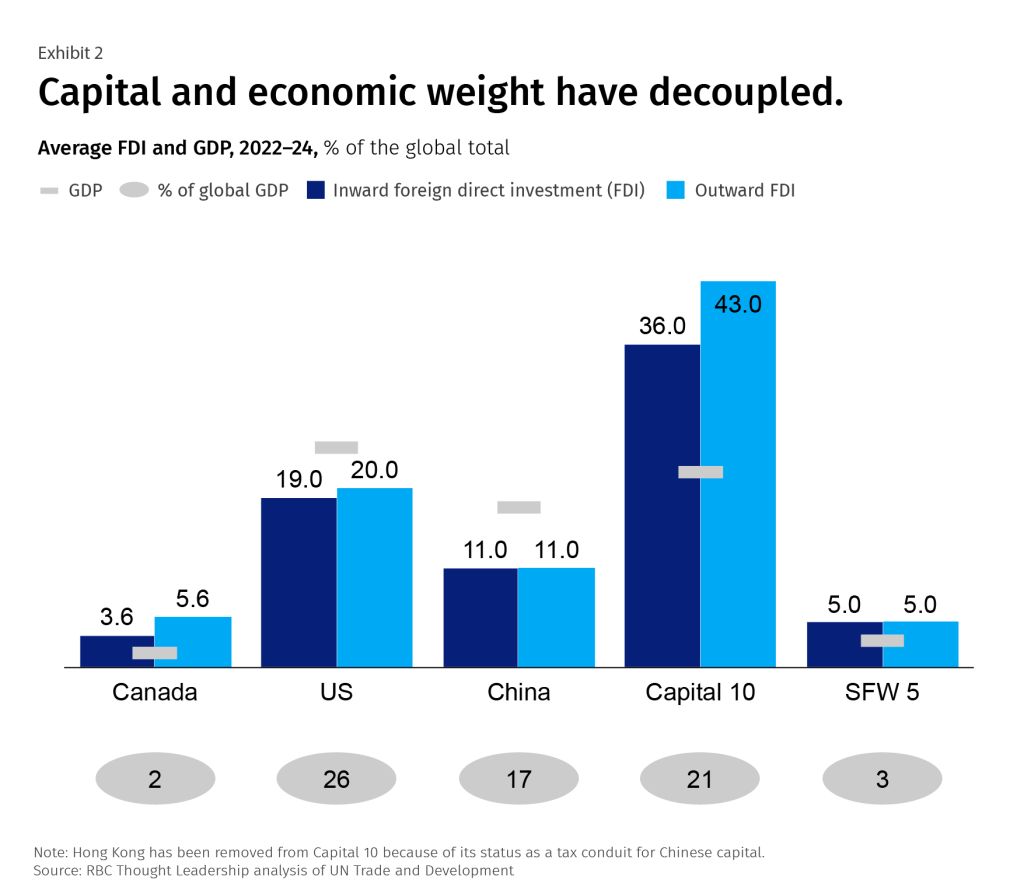
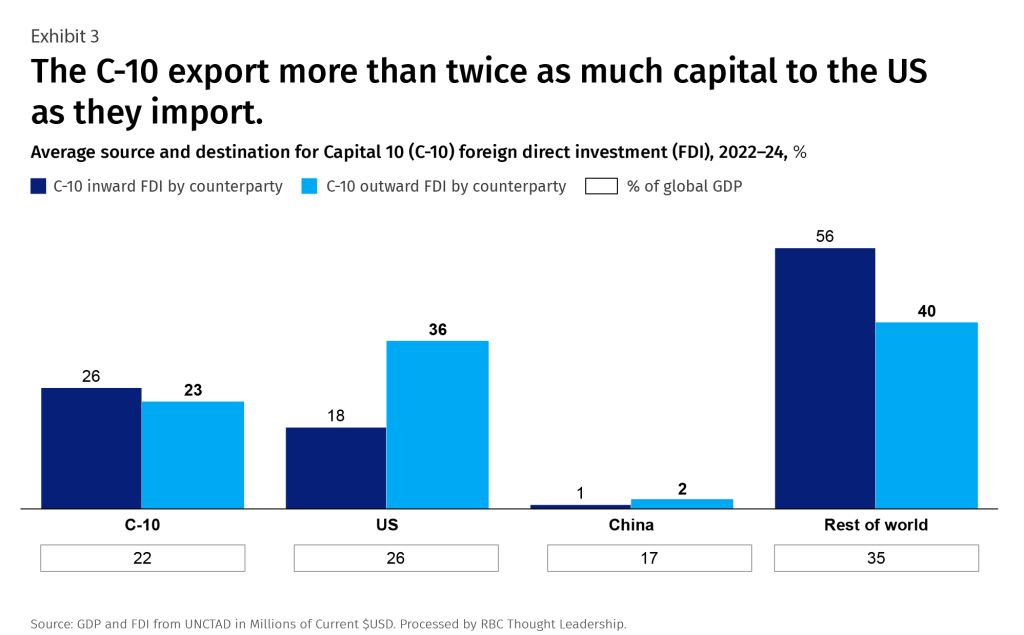
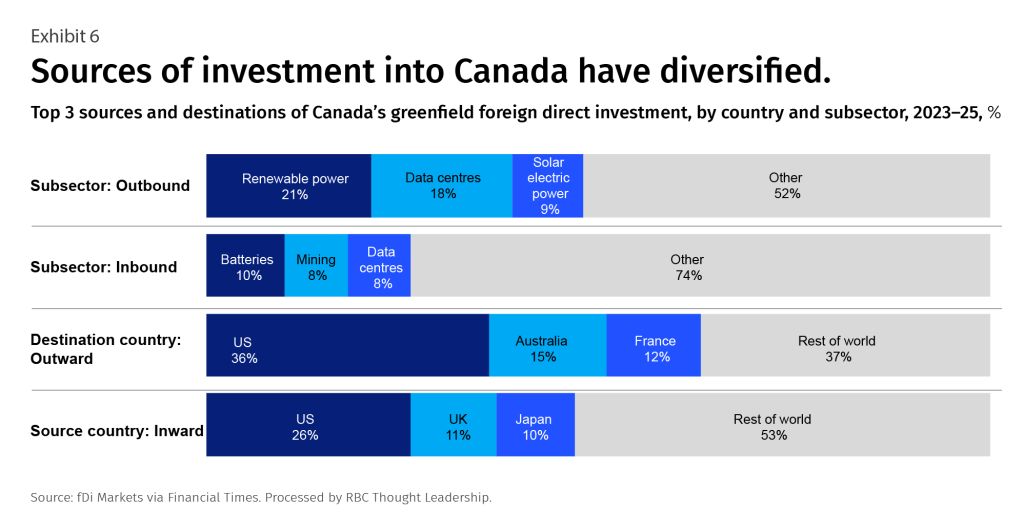
Second, the U.S.—long the world’s biggest destination for FDI—is changing politically and turning inwards. Strong domestic capital expenditure in the U.S., reinforced by efforts to strengthen America’s investment competitiveness in new and old sectors, has meant Corporate America is investing more at home (Exhibit 2). The world’s biggest sources of capital have also invested heavily in U.S. assets, drawn by its deep capital markets and impressive returns. The U.S.’s share of Canada’s outbound FDI, for example, is now 36%, up from 11% over the past two decades. Many global institutional investors are eyeing new avenues to park their capital.
Third is the rise of what we’re calling the Capital 10, or C10, comprising the ten largest sources of foreign capital outside of the U.S. and China. The group of middle-power nations—Canada, Japan, Singapore, Germany, France, Australia, Spain, Brazil, Sweden, and South Korea—has quietly become the super heavyweight in global FDI (Exhibit 3). Collectively, these countries produce a fifth of global GDP but control 43% of global outward FDI—over 40% more than the U.S. and China combined, despite having half the economic mass.
Canada is in a unique position within the C10. In recent years, the country has attracted 3.6% of the global inward FDI against just 2.0% of global GDP (and is punching even further above its weight on outward FDI, at 5.6%).2 But relative to its potential—abundant resources, a highly educated workforce, and clean, affordable power—Canada remains an underinvested jurisdiction.
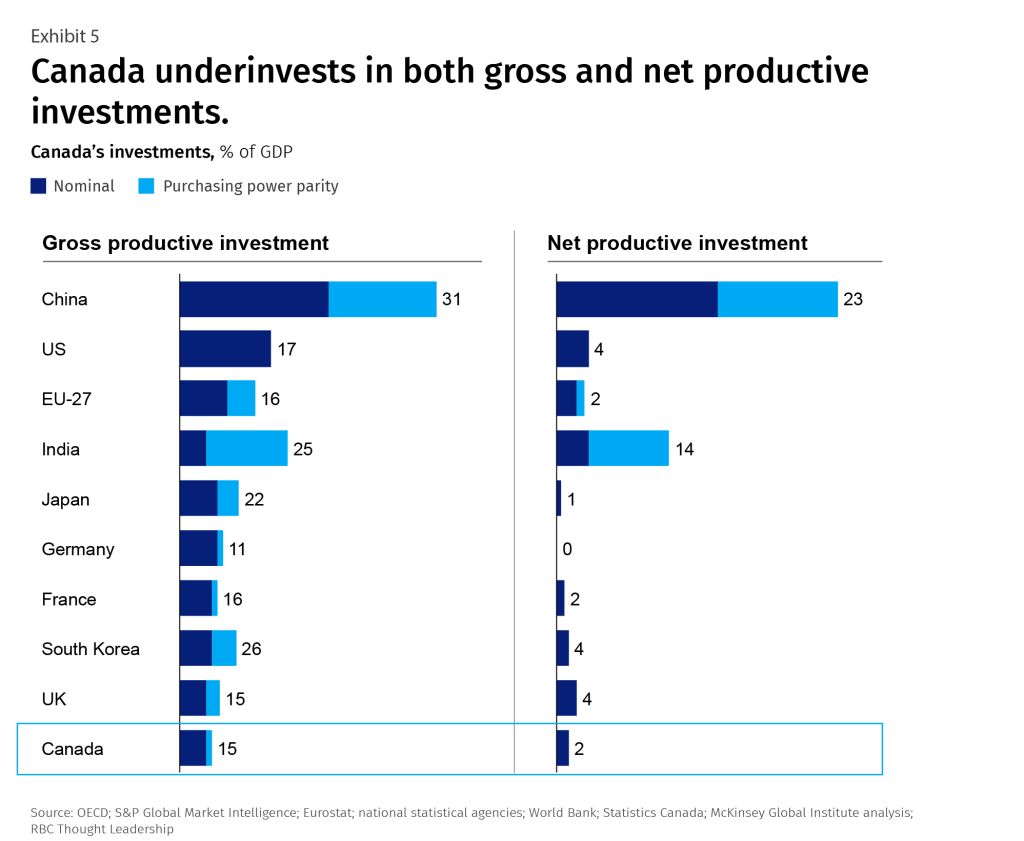
Despite its many strengths, Canada’s domestic investment has trailed peers. Canada’s capital stock per worker is roughly $125,000, the fourth lowest among peers and well below the U.S. ($337,000) (Exhibit 4). And though Canada’s GDP per worker ranks fourth highest in the same group, giving Canada the second-most-efficient capital-to-output ratio in the set, the country invests too little to sustain it. Domestic capital expenditures stand at 15% of GDP, tied with the U.K. near the bottom of the peer group. On a net basis, after depreciation, Canada’s investment rate falls to just 1.6% of GDP, the third lowest of the peer group (Exhibit 5).
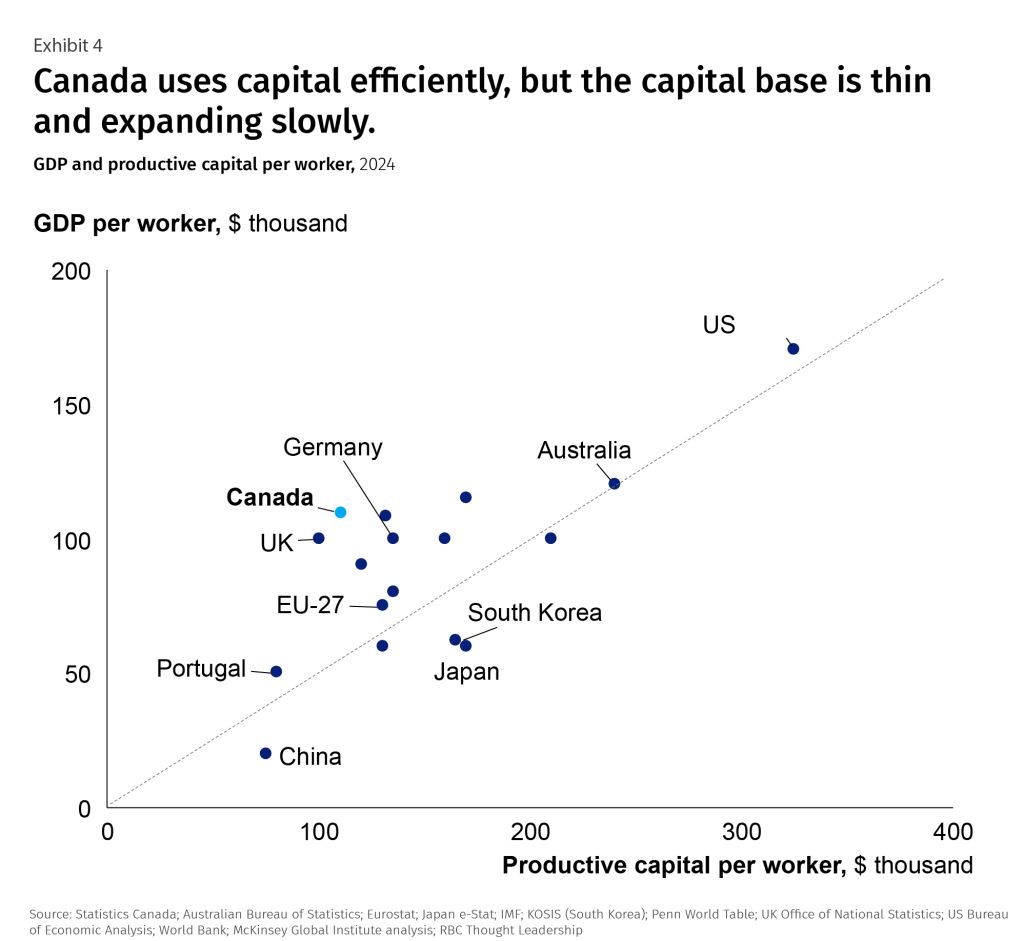
Canada has been doing more with less, but that’s not a sustainable growth strategy. Increasingly, Canadian capital is finding its way abroad (Exhibit 6).
Reversing that trend requires a reset.
To attract fresh capital, Canada will need to pivot toward and scale new industries. Two decades ago, thanks to the oilsands boom, oil and gas was the dominant inbound industry in Canada by a wide margin—39 cents of every inbound dollar. Today, it’s two cents.3 In contrast, Canadian institutional investors and corporations have become major participants in the global AI and data-centre build-out, causing outbound Canadian investment in data centres to hit $20 billion in 2025—a sum that nearly equals cumulative inbound data-centre investment since 2005.4 Some of that domestic capital seeking high-tech opportunities abroad could be redirected back home, given the right conditions and returns.5
Realizing this potential will also require Canada to improve its investment attractiveness at the industry level and address the constraints limiting capital formation. The next chapter examines five future-shaping industries to highlight Canada’s investment competitiveness against its peers.