
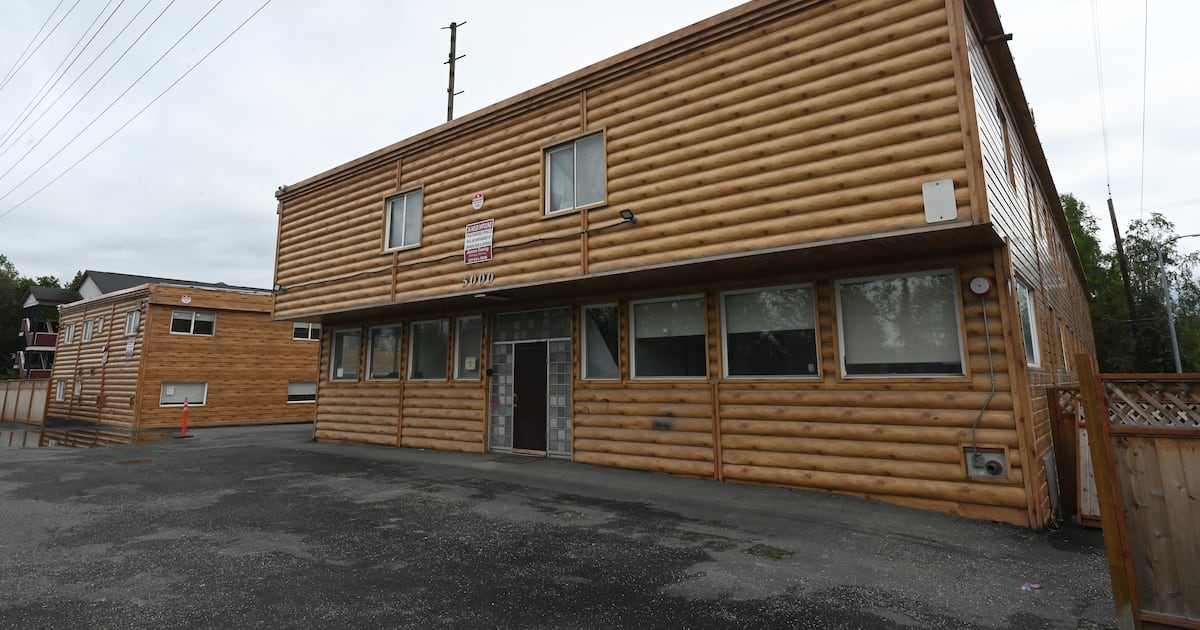
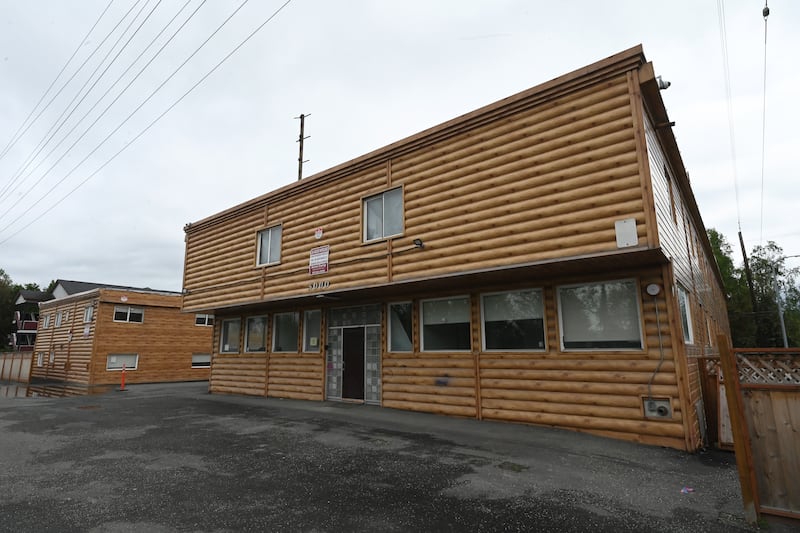
 The Anchorage Recovery Center’s main campus is located at 5000 Taku Drive. The building was vacant when photographed July 9. (Bill Roth / ADN)
Anchorage Recovery Center’s main behavioral healthcare campus in the Russian Jack Springs Park neighborhood is listed as open 24 hours. Photos on its online Google profile show a brightly lit front office and furnished rooms for clients.
But the main building at 5000 Taku Drive is vacant, and a notice posted outside says it’s slated for interior demolition. The metal front door is locked and has a series of scratches, dents and shattered glass. The contractor hired for the renovation project filed nearly $300,000 in liens on the property for unpaid labor and materials a year ago.
No work has been done since.
Anchorage Recovery Center is the Municipality of Anchorage’s chosen behavioral health provider at Willow Commons, a new tiny home community meant for people experiencing homelessness and struggling with addiction.
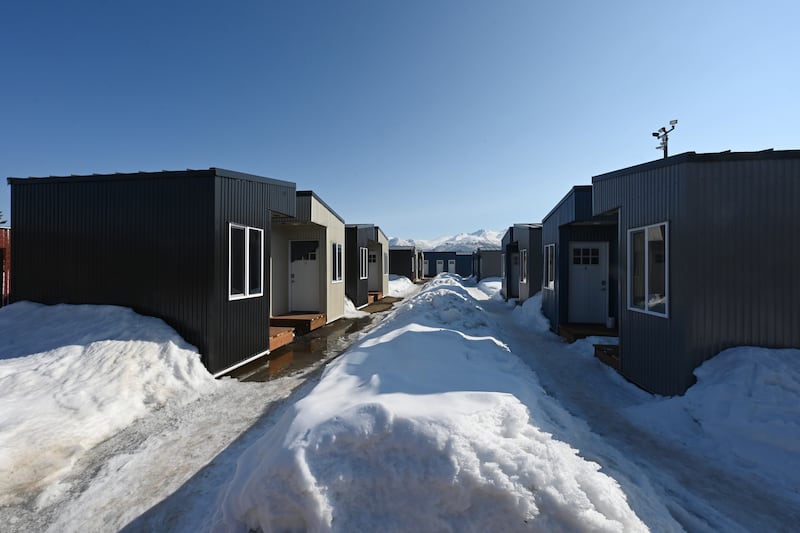 Willow Commons transitional living has 32 microunits on municipal land, located near the Tudor Road bus barn, for people participating in substance use treatment and who are unhoused. Photographed on April 2. (Bill Roth / ADN archive)
Since the municipality signed a contract with Anchorage Recovery Center in February, the provider’s tendency to not pay its bills has tainted its relatively new reputation. On top of the liens, Anchorage Recovery Center has been involved in multiple lawsuits this year. One lawsuit accuses the provider of fraud and alleges that Anchorage Recovery Center owes more than $250,000.
[Previous coverage: Anchorage substance use treatment provider sued for breach of contract by nonprofit]
Anchorage Recovery Center formed as a for-profit company in October 2024, according to state business filings. Other than the vacant building at 5000 Taku Drive, as of August, its website contains no locations for other treatment facilities. No information is posted about its staff.
Last fall, the Anchorage Fire Department cited Anchorage Recovery Center for illegally operating its drug rehabilitation business without a certificate of occupancy, a document that ensures a building is safe to live and work in. Several former employees alleged the building at 5000 Taku Drive was in poor, potentially dangerous condition when Anchorage Recovery Center saw clients there.
The Anchorage Health Department, aware of the both the building code violation and legal disputes, plans to continue working with Anchorage Recovery Center. Under the existing contract, the provider is set to expand its operations to the renovated Golden Lion Hotel in Midtown later this year.
“We maintain close contact with ARC to manage the contract, and so far, ARC’s current performance under the contract has been satisfactory,” municipal spokesperson Emily Goodykoontz said.
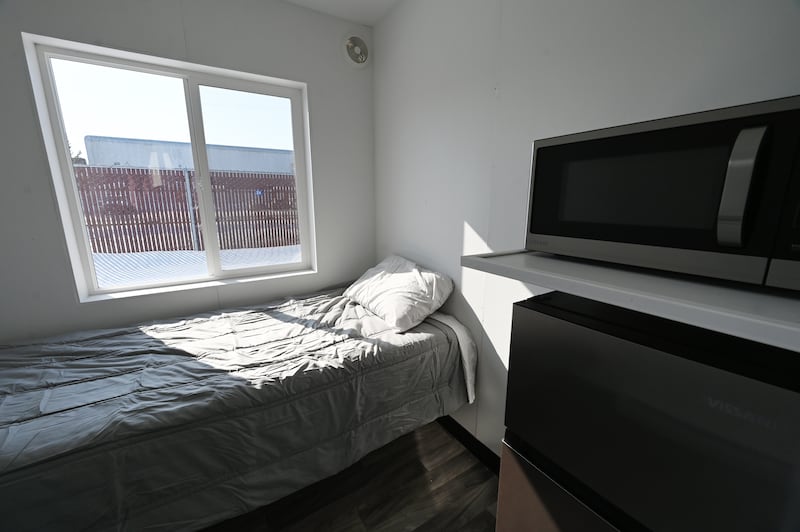 Interior of a microunit at Willow Commons. (Bill Roth / ADN archive)
The municipality awarded a $500,000 contract to Anchorage Recovery Center to run Willow Commons, a two-year pilot project led in conjunction with the Anchorage Community Development Authority, last winter. Clients moved into the microunits in late March.
The first 24 “recovery residences” were paid for with $1.2 million in opioid settlement funds. The municipality received another $400,000 from private funder Bloomberg Philanthropies to build an additional eight units.
The municipality had previously engaged with Anchorage Recovery Center during intermittent meetings meant to address behavioral health crises and unsheltered homelessness, said Thea Agnew Bemben, a special assistant to Mayor Suzanne LaFrance.
“I didn’t have a ton more awareness than that, other than being glad that we had new providers that wanted to work with the folks we’re trying to connect to services,” she said.
The municipality moves through an established evaluation process before it hires new contractors, Goodykoontz said.
The health department received proposals from two potential operators for Willow Commons. Contracts are awarded to the highest-scoring bidder based on a set of criteria such as “organizational capacity, operational plans, and qualifications,” she said.
Anchorage Recovery Center Executive Director Anita Peakes and other leadership did not respond to the Daily News’ multiple requests for comments by phone and email.
Main campus
Photos inside the buildings on Anchorage Recovery Center’s main campus show sheetrock missing from the walls, exposed wiring, holes in the ceiling, missing door handles and boarded-up windows, according to a 17-page failed fire inspection report from Jan. 30, 2025.
A month after the inspection, Zinnia Health, the parent company of Anchorage Recovery Center, hired Anchorage and Mat-Su area-based Hiland Construction as the general contractor to renovate the organization’s main campus, a three-building parcel known as Wonder Park.
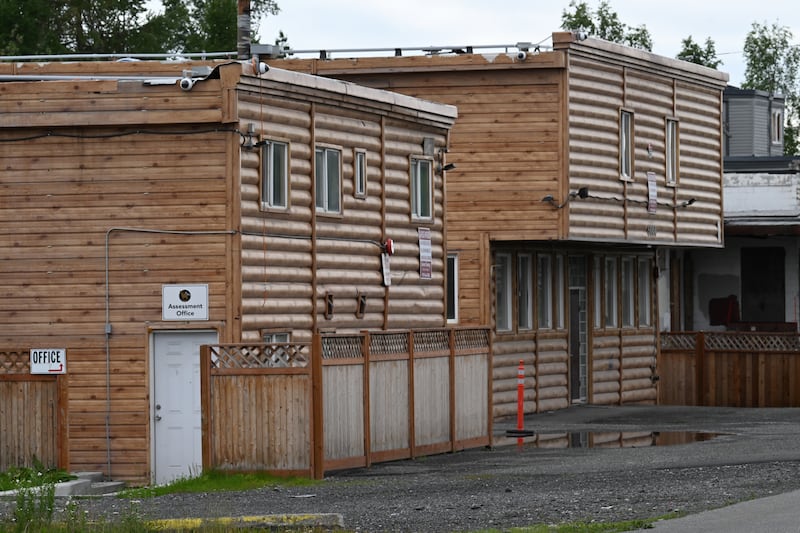 The Anchorage Recovery Center’s main campus is located at 5000 Taku Drive. (Bill Roth / ADN)
Zinnia Health stopped paying bills three months in, said Hiland Construction president Jason Novotny.
“We started submitting construction documents, architectural plans and electrical, (etc.) and then that’s when things fell apart. That’s when we started not getting paid,” he said.
His crew halted construction in June 2025. Shortly afterward, Hiland Construction filed two liens against the property, according to records from the state recorder’s office.
When construction stopped, many of the buildings’ structural deficiencies had not been fully addressed, Novotny said.
Rainwater steadily leaked into one of the units where a pump had been installed on the roof to divert the water, he said. After a fire, one of the property’s previous owners decided to build a second roof over the damaged one instead of replacing it, creating a danger of collapse, he said.
This is the same building Anchorage Recovery Center decided to start doing business in before the fire department shut down operations in that location. While the notice of violation city officials issued did not specify who was inside the building, former employees said it included clients in recovery.
During contract negotiations in early 2026, a municipal fire inspector shared the complaint and inspection report for 5000 Taku Drive, Goodykoontz said. In response, the municipality added additional parameters in the final contract to protect the city from “any similar issues, rather than disrupting the procurement process” for Willow Commons, she said.
When Anchorage Recovery Center vacated the building, the provider relocated to multiple locations where “corrective actions” and re-inspections were necessary, Goodykoontz said. The municipality also confirmed with state regulators at the Alaska Division of Behavioral Health that the provider was following protocol, she said.
The mayor’s office did not share details about the condition of the other facilities.
Alaska Department of Health spokesperson Shirley Sakaye said the department does not provide information regarding “actions, reviews or investigations involving individual providers.”
City officials approached Anchorage Recovery Center leadership about the lawsuits to evaluate any potential risk to municipal operations, Goodykoontz said.
“Based on those discussions and ongoing monitoring, the municipality verified that ARC possesses the legal and operational capacity to fulfill its contract,” she said.
State records show the liens on the 5000 Taku Drive property were released in June. The building remains shuttered.
[Much-needed mental health resources to open soon in Anchorage]
Red flags
The week before clients moved into Willow Commons in March, Alaska Billing Services, an Anchorage-based medical billing company, sued Anchorage Recovery Center for breach of contract.
Prior to working with Alaska Billing Services, Anchorage Recovery Center “struggled to navigate the Alaska market’s medical billing environment,” according to the lawsuit. In June 2025, Alaska Billing Services entered a yearlong billing agreement that it says took the provider “from zero income to generating millions of dollars in revenue.”
The deal started falling apart with a series of missed payments and a story about a $219,000 lost Medicaid check that needed to be reissued, said attorney Dustin Glazier, who is representing Alaska Billing Services in the ongoing lawsuit.
Based on an internal investigation led by the medical billing company, no checks were “ever issued, stolen or reissued by Medicaid,” the lawsuit states. And, after agreeing to lift the service hold and resume billing, Alaska Billing Services discovered that Anchorage Recovery Center was “actively and covertly” working to transition its clearinghouse directly to Alaska Medicaid to self-bill, the lawsuit states.
Glazier called it an attempt to “intentionally” cut Alaska Billing Services out of the process while still owing substantial past invoices.
In the course of filing a lawsuit, the medical billing company also found Anchorage Recovery Center’s parent entities, Zinnia Health and ZH Operations, had shuffled ownership. In their argument, Alaska Billing Services alleges Anchorage Recovery Center changed ownership to “avoid responsibility for the actions of the company,” Glazier said.
Anchorage Recovery Center countered that medical billing company failed to meet deadlines under the contract. The provider’s legal representative, the Law Offices of Blake Fulton Quackenbush, offered no comment when reached Tuesday.
In May, Anchorage Recovery Center became ensnared in a second legal dispute alleging that the provider did not pay rent at a previous location where they housed clients, and stole supplies.
Northern Alliance Reentry, a locally owned nonprofit that offers similar substance use disorder treatment services, alleged that Anchorage Recovery Center owed them more than $16,000. While she was repaid in July, co-founder Ashleigh Valcarcel said earlier this year that the nonprofit felt “blindsided by their business dealings.”
The payment was a “huge relief,” she said.
Novotny, the Hiland Construction president who also runs a sober living house in the Turnagain neighborhood through the nonprofit Joe’s House Foundation, said Anchorage Recovery Center temporarily housed clients at his facility. The organization left without paying the rent.
“They may be legitimate on paper, but in terms of business practices there’s some major red flags,” he said.
In online reviews of Zinnia Health facilities, many clients gave the company one star, citing fraudulent billing and the prioritization of profits over patient care.
Anchorage Recovery Center is scheduled to start offering outpatient care at the Golden Lion Hotel, recently renamed Alder Place, in October, Agnew Bemben told Assembly members during a Housing and Homelessness Committee meeting in August.
According to reports given to the health department every three months, Willow Commons has stayed full and has not experienced “any major problems,” she said.