
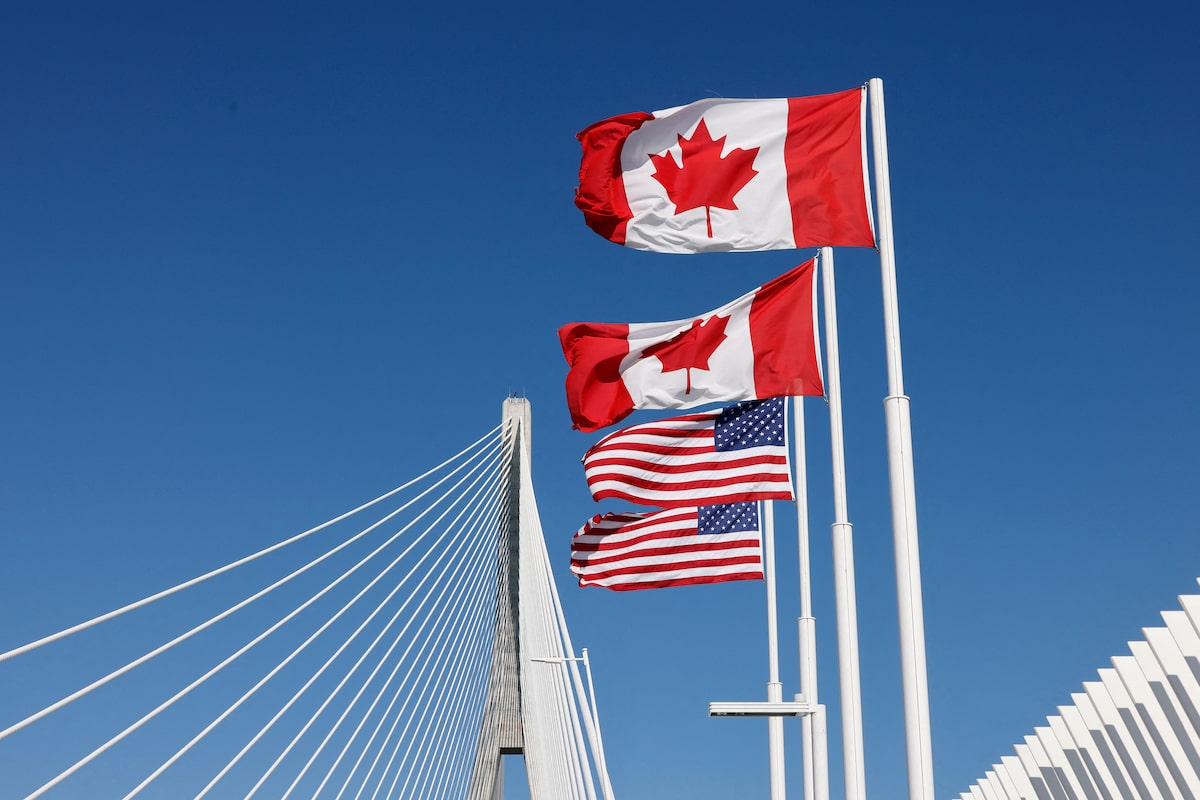
Flags of Canada and United States fly across the international border on the Gordie Howe bridge on Sept. 6.JEFF KOWALSKY/AFP/Getty Images
09/09/26 15:55Wisconsin Governor says his state pays the price for tariffs
– Adrian Morrow
Harley-Davidson motorcycle engines are assembled at the company’s Powertrain Operations plant in Menomonee Falls, Wisconsin.Scott Olson/Getty Images
Wisconsin Governor Tony Evers is calling on his state’s Republican members of Congress to put pressure on U.S. President Donald Trump to end his “reckless and erratic” trade war with Canada, warning that it is damaging the local economy.
In an open letter to Senator Ron Johnson and the six Republican members of the state’s House delegation, the Democratic Governor accuses them of sitting on their hands as Trump has imposed “illegal” tariffs on the country’s trading partners over the past year and a half.
Wisconsin’s other senator, Tammy Baldwin, and two members of its House delegation are Democrats.
“This latest trade war only adds insult to injury for the Wisconsin businesses and consumers across our state who are already struggling to make ends meet due to President Trump’s disastrous economic policies and tariff taxes,” Evers writes.
In the letter, he points out that Canada is Wisconsin’s “closest trading partner,” importing US$7.5-billion worth of goods from the state last year, more than any other foreign country. He says Wisconsin businesses have paid an estimated US$5.4-billion in Trump’s tariffs, while households in the state have had to spend an average of US$2,035 more because of tariffs and rising gas prices.
Canada’s retaliation, meanwhile, will damage Wisconsin’s cheese producers and paper-making industry, he warns.
Wisconsin is a key swing state that helped deliver Trump the presidency in 2016 and 2024. The battle to succeed Evers in November’s election is a knife-edge contest between Democratic nominee David Crowley and Tom Tiffany, currently a Republican member of Congress.
09/09/26 15:44New Brunswick brewer Moosehead prepares for U.S. ban
– Nathan VanderKlippe
Andrew Oland, CEO of Moosehead Breweries, holds a can in production in Saint John.Chris Donovan/The Globe and Mail
For nearly a half-century, Moosehead Breweries has sold its beer in the U.S. Now, the New Brunswick brewer is preparing to have its products blocked from a country that consumes 15 per cent of its volume, after the Donald Trump administration said it would ban Canadian-made beer later this month.
Moosehead sells its lager across the 50 states, but generates most of its sales along the Atlantic seaboard, from Hannaford stores in Maine to Publix in Florida.
The prospect of losing that is “material,” Moosehead CEO Andrew Oland said in an interview Wednesday. His family has owned the brewery since its founding in the year of Confederation, persisting in the business of Canadian beer through decades of occasional disaster, including destruction by the Halifax Explosion in 1917.
“We’ve got a history of dealing with adversity. So this is another one of those challenges,” Mr. Oland said.
At a national scale, the beer makers of Canada – many the property of foreign corporate owners – can shrug off the U.S. ban. Last year, Canadians bought $9.2-billion of beer. Canadian sales to the U.S. amounted to just $28-million.
But most of those U.S. exports last year were made by Moosehead, which brews in Saint John and calls itself the country’s largest major brewery still owned by Canadians.
Other Canadian beer brands sell in the U.S., but the Labatt consumed south of the border is largely brewed there. Conversely, Bud Light on Canadian shelves is made in Canada.
Moosehead made its first U.S. sale in 1977 – breaking into that market was easier at the time than selling to other Canadian provinces – and has maintained partnerships with American brands. Moosehead now makes some of the Twisted Tea, Truly Hard Seltzer and Sun Cruiser sold in Canada.
Still, Moosehead is zealous about its Canadian credentials and does not expect to move production south, nor to skirt the looming ban by exporting bulk beer for bottling in the U.S., Mr. Oland said. The U.S. has barred imports of packaged beer, leaving open the possibility of shipping in other large-volume formats.
“Our focus is on brewing the beer here in Saint John. Our consumers want an authentic Canadian beer,” Oland said. The company recently posted a billboard in Toronto declaring “A Moose Never Backs Down.”
09/09/26 13:24Trump’s latest tariff threat hits Quebec-made motorcycles
– Nathan VanderKlippe
BRP was spun off from Bombardier in 2003. Its owners include the Bombardier family, Caisse de dépôt et placement du Québec and Bain Capital, the Boston-based private equity giant.Christinne Muschi/The Canadian Press
First, Donald Trump threatened to ban Canadian-made Bombardier planes from the U.S. Now, he’s barring imports of land vehicles from Bombardier Recreational Products that are built in Quebec.
The latest trade measure from the U.S. – a counterpunch to Canadian retaliation against American tariffs – bans a number of Canadian goods for sale in the U.S., including motorcycles with gas engines larger than 800 cc.
That prohibition will apply to three-wheeled vehicles made by BRP, the company told The Globe and Mail. (Canada this week imposed 50-per-cent tariffs on large U.S.-made motorcycles, which will apply to many models of Harley-Davidson.)
“On the basis of the information available at this time, we can confirm that our Can-Am Spyder and Canyon models produced in Valcourt, Canada, will be excluded from importation into the U.S., starting September 29, 2026,” BRP spokesperson Emilie Proulx said in a statement.
“The impact of these new U.S. measures are expected to be limited on our fiscal 2027, as the vast majority of production and shipments for the current season are completed.”
BRP calls its Spyder RT, which has two wheels in the front and a single in the back, “an ultra-stable luxury vehicle for those looking to visit sites they never thought possible.” Current-year models start at $34,000. The Canyon shares the three-wheel architecture in a square-cornered, military-look vehicle the company calls “adventure-ready.” Its top-end trim sells for $41,000.
BRP was spun off from Bombardier in 2003. Its owners include the Bombardier family, Caisse de dépôt et placement du Québec and Bain Capital, the Boston-based private equity giant.
09/09/26 12:58Canadian dollar edges lower as trade war intensifies
– Reuters
The Canadian dollar weakened against its U.S. counterpart on Wednesday as an escalating trade war between the United States and Canada offset higher oil prices, while bond yields climbed.
The loonie was trading 0.2 per cent lower at $1.3805 per U.S. dollar, or 72.44 US cents, giving back much of the previous day’s gains. It moved in a range of $1.3767 to $1.3820.
09/09/26 12:50Provincial impact of Trump’s latest trade war blow
– Jason Kirby
Workers assemble at the Bombardier Recreational Products production facility in Valcourt, Quebec.Graham Hughes/The Globe and Mail
The burden from the Trump administration’s latest trade war blow doesn’t land evenly on the provinces, in the same way the original list of Section 338 tariffs targeted certain regions more than others – particularly Ontario and Quebec.
When the newly-tariffed goods are combined with products facing outright bans, Ontario will endure the biggest hit, both in dollar terms and intensity. The new tariffs and bans cover an estimated $2.4-billion worth of Ontario’s 2025 exports to the U.S., or roughly 1.24 per cent, with alcohol and steel accounting to much of that pain. (To allow for international comparisons, provincial exports are measured at a broader level of detail than what the U.S. tariffs and bans target, resulting in somewhat higher estimates.)
Roughly $1-billion of Quebec’s exports are covered by the new proclamations, or 1.23 per cent of total exports, with the top items being steel, alcohol and motorcycles – likely aimed at BRP Inc.’s three-wheeled motorcycles.
As with the original Section 338 targets, Alberta and Saskatchewan, along with New Brunswick and PEI, escape the new measures largely unscathed.
09/09/26 12:35Consumers and businesses are resilient in the face of economic upheaval, bank CEOs say
– Stefanie Marotta
Bank CEOs say clients are adjusting to economic uncertainty amid an escalating trade war with the U.S.Fred Lum/the Globe and Mail
The chief executive officers of Canada’s biggest banks are signalling caution over the escalating U.S. trade war, but say consumers and businesses have been resilient and loan defaults are manageable.
As the turmoil has intensified, concerns have mounted over potential defaults alongside higher pressure on people’s wallets. Loan losses at the banks have remained within the lenders’ expectations since the U.S. embarked on its trade war more than a year ago, and bank CEOs told a conference on Wednesday that clients are continuing to adjust to continuing economic uncertainty.
Royal Bank of Canada CEO Dave McKay said that the bank has seen credit risk across clients improve as they adjust to the uncertain environment.
As more sectors are targeted by tariffs, companies are pulling back slightly and making more conservative decisions on their investments and borrowing.
“They’re going to manage their expenses not knowing the duration of this conflict and the magnitude of the loss of those clients’ bases, and whether they can pivot their sales to another market or not,” McKay said during an event Wednesday held by Bank of Nova Scotia .
09/09/26 12:03Canada doesn’t need to retaliate further: Canadian Chamber of Commerce
– Bill Curry
A worker operates a forklift in front of steel coils at the manufacturing plant of Ideal Roofing in Ottawa on Aug. 25.Justin Tang/The Canadian Press
The Canadian Chamber of Commerce says its initial analysis of the latest U.S. trade announcements is that the planned measures are relatively contained overall. The national business group is urging Ottawa to hold back on further retaliation for now.
In an interview, Matthew Holmes, the chamber’s executive vice-president, said the impact will be “existential” for some Canadian companies that are directly affected by the planned tariffs or import bans.
But he says the American response could have been far worse.
“It allows the U.S. to kind of take a bit of a tough guy stance, while not really pouring gasoline on the fire,” he said.
The Canadian government has not yet said whether it will respond with further trade measures. Holmes advises against such an approach.
“I don’t think we need to retaliate further,” he said. “I think we need to be vigilant, watchful, monitor what’s happening in the U.S., but not get distracted or pulled into an emotional response because of, you know, social media or kind of tough guy tactics. I think we need to let that play out.”
Holmes also said the U.S. decision to delay its actions until Sept. 29 suggests there’s a window for further talks.
“I think that’s a really positive thing,” he said.
09/09/26 11:34Analysis: Economic impact of new U.S. measures more muted than headline suggests
– Mark Rendell and Jason Kirby
On the surface, the latest U.S. counterpunch against Canada – which introduced import bans on alcohol and several other products – appears to be significant.
However, looking under the hood at the data, the likely hit to the Canadian economy could be muted. And there are signs the Trump administration calibrated its move to avoid dramatically escalating the trade war with Ottawa.
Starting on Sept. 29, the U.S. will bar the import of a range of Canadian alcoholic beverages, including beer sold in cans and bottles, rye whisky and many types of wine. It will also ban Canadian whey protein, molasses and motorcycles.
All these products, however, were already subject to a 50-per-cent tariff, imposed last month under Section 338 of the U.S. Tariff Act of 1930.
“I think Trump, if you were to ask him, he would say, ‘Oh, we really now put the screws tight on Canada,” said Wolfgang Alschner, a trade law professor at the University of Ottawa. “Then you look at the data, and it’s really more of a nothing-burger. Because if your whisky is already tariffed at 50 per cent, you are not going to buy that Canadian whisky.”
Likewise, the changes in tariffs announced on Tuesday are something of a wash – at least from a macroeconomic perspective.
The Trump administration added US$1.85-billion worth of new Canadian goods to its list of products facing 50-per-cent Section 338 tariffs, based on 2025 trade numbers. But it also dropped US$1.74-billion of products from the original list released in July. All told, the total value of tariffed goods under Section 338 inched up from US$20.15-billion to US$20.26-billion.
The impact isn’t even. Furniture, dairy and some wood products are getting hit harder. But tariffs on cement, electronic switchboards, lead, salt and toilet paper have been removed.
Some Canadian companies will certainly be hurt by the new measures, “but in the grand scheme of things, this is not big,” said Alschner. “The United States has all the possibilities to really inflict pain on the Canadian economy, but that’s not what they’ve chosen to do.”
09/09/26 11:10Maine senator calls for Trump administration to de-escalate trade war
– Adrian Morrow
U.S. Sen. Susan Collins said in a Politico interview that the Trump administration has not considered how Canada’s countertariffs will affect smaller states like Maine.CJ Gunther/Getty Images
Maine Senator Susan Collins is calling on the Trump administration to de-escalate its trade war against Canada.
One of the few remaining moderate Republicans in the Senate, Collins is up for re-election this fall in a blue state that Democrats are targeting in their bid to take control of the upper chamber.
On X, she thanked the administration for lifting tariffs on Canadian cement and road salt. They were among a handful of products that received a reprieve on Tuesday while many others – most Canadian alcohol and motorcycles, and some dairy products – will be subject to an import ban.
Collins said she had lobbied U.S. Trade Representative Jamieson Greer and Commerce Secretary Howard Lutnick for the cement and road salt exemptions. Those tariffs were hammering cement companies in the state and jeopardizing the budget of small towns that need to salt their roads in the winter, she said.
But Collins hit back at the administration’s tariffs, singling out in particular its 50-per-cent levy on Canadian paper.
“Significant tariffs – including those on forest products – remain in effect and will lead to higher costs for Maine families and uncertainty for businesses. I urge the Administration to continue to work to deescalate this conflict and reach a trade resolution with our Canadian partners,” Collins wrote.
Collins is one of four GOP senators who voted last year to end some of Trump’s tariffs on Canada. The others were fellow moderate Lisa Murkowski of Alaska, libertarian Rand Paul of Kentucky and Mitch McConnell, also of Kentucky and a former leader of the Republican Senate caucus. The measure was purely symbolic, as it would also have had to pass the House and be signed into law by Trump to have taken effect.
While many elected Republicans broadly favour free trade, few have been willing to openly challenge Trump during his current presidential term.
09/09/26 10:05Tariff price hikes may take time to hit shelves as retailers work through inventory
– The Canadian Press
Canada’s countertariffs on U.S. goods have kicked in but retail experts say there will be a lag before Canadian shoppers see price increases on store shelves.Christinne Muschi/The Canadian Press
Canada’s countertariffs on U.S. goods have spurred a fresh flood of retaliatory measures, but retail experts say there will be a short lag before shoppers see price increases on store shelves.
Matt Poirier with the Retail Council of Canada says it will take time for stores to work through existing inventory and begin stocking newly tariffed goods.
He says items with a shorter shelf life and other fast-selling products will likely see prices rise first, followed by durable goods with slower inventory turnover like ovens and washing machines.
Canada’s retaliatory duties – ranging from 15 to 50 per cent on nearly $28-billion worth of American products including clothing, carpets and electronics – prompted U.S. President Donald Trump on Tuesday to ban imports of certain Canadian goods starting Sept. 29.
Trade experts say Canadian shoppers may be briefly shielded from the full impact of the trade war as new tariff costs are negotiated along the supply chain and businesses temporarily absorb some of the cost by accepting smaller profit margins.
They say the first noticeable signs of the countertariffs on Canadian shelves are likely to be fewer promotions and less product choice as retailers replace American goods with Canadian or overseas alternatives.
09/09/26 09:50Trade war creates boom for lobbying firms with access to U.S. President
– Irene Galea
It was the first day back at work for Congress after the summer recess, and two blocks away from the White House, a stream of sharply dressed guests were stepping out from black Suburbans and striding toward a street-level doorway on 15th Street NW.
The entrance was inconspicuous, save for the umbrellaed valet stand out front and the darkened, hemispherical camera mounted at eye level by the door. The building’s plaque was half-hidden by a shrub, but cursive lettering across the forest-green doormat spelled out a name: Ned’s Club, Washington D.C.
This private members’ club − a newcomer among the city’s many exclusive institutions − has become the buzziest watering hole for lobbyists, politicians and White House staffers to foster just those ties, according to insiders. The Globe and Mail is not identifying the sources because they were not authorized to discuss matters of the club.
Personal connections have always mattered in the lobbying world. But as global interests have sought to influence policy set by U.S. President Donald Trump, connections at the executive level now count more than ever, industry sources told The Globe.
There has been lots to lobby over since last year, when Mr. Trump imposed tariffs on most countries. In the first two quarters of 2026, a record 17,000 clients spent a total of US$2.6-billion lobbying the U.S. federal government, according to data from Open Secrets, a non-profit tracking public disclosures.
“When Trump starts throwing around the ‘tariff’ word, we start getting phone calls,” said Hunter Morgen, a trade lobbyist and partner at Ballard Partners, currently D.C.’s highest-earning lobbying firm.
09/09/26 09:30Canada to blame for Washington’s escalation of trade war, says Trump trade czar
– The Canadian Press
U.S. Trade Representative Jamieson Greer speaks to reporters outside the White House on Aug. 24. Greer says Canada is to blame for Washington’s decision to escalate the trade war with its northern neighbour.Mark Schiefelbein/The Associated Press
U.S. Trade Representative Jamieson Greer says Canada is to blame for Washington’s decision to escalate the trade war with its northern neighbour.
Greer says the escalation was a “natural consequence” of Canada discriminating against American exports and choosing “senseless retaliation” over a near-final trade deal.
He says President Donald Trump plans to defend the interests of American workers and exporters, and restore reciprocity in bilateral trade relationships.
The five new orders, which will take effect later this month, will completely bar imports of certain Canadian goods, including motorcycles, some dairy products and alcoholic beverages. But the orders also exempted some Canadian products from being tariffed altogether, including toilet paper, road salt, and cement.
09/09/26 09:30Rift with Canada shows potential to become a pressing U.S. election issue
– Nathan VanderKlippe
State park workers install a Canadian flag atop the Peace Arch in Blaine, Wash. The Canada-U.S. fracture has grown deep enough that Democratic political consultants are preparing polling questions to gauge public sentiment on the matter.Elaine Thompson/The Associated Press
At the northern edge of Washington state, the political establishment is contemplating a question no one can remember asking before.
Could Canada be an election priority this year?
“Historically, this hasn’t been a topic of interest,” says Alicia Rule, a Washington state representative who lives in Blaine, just south of the most important West Coast land border crossings.
But after more than a year of sparring between the two countries – with Canadians cancelling travel plans, increasingly hostile rhetoric from the White House and now a surge of punishing tariffs that has upended cross-border trade – that is changing.
The U.S. fractures with Canada have grown deep enough that Democratic political consultants are preparing polling questions to gauge public sentiment on the matter, a reflection of how the Canada question could drive ballot decisions during midterm voting later this year.
09/09/26 09:30Carney focuses on attracting investment and economic growth as U.S. conflict deepens
– Steven Chase
Federal cabinet ministers will fan out across the country in the days ahead to reassure companies of support they can access during the escalating Canada-U.S. trade war, while Prime Minister Mark Carney’s office says his focus as formal talks with Washington remain stalled is on attracting investment and stimulating economic growth.
Two sources said ministers such as Industry Minister Mélanie Joly and Finance Minister François-Philippe Champagne will step up a media blitz, including meetings with businesses and chambers of commerce. This will involve guiding companies through the process of applying for support. The Globe and Mail is not identifying the sources, who were not authorized to discuss the matter publicly.
Audrey Champoux, deputy director of communications in the Prime Minister’s Office, said Carney’s priorities right now include affordable housing, new infrastructure and next week’s federal investment summit to attract foreign capital to Canada, as well as this fall’s federal budget.
She said Carney’s government, which has set a goal of doubling non-U.S. trade over a decade, will continue to focus on “building at home and diversifying trade abroad.”
“Our government will always stand up for Canada and focus on what we can control while we will build Canada strong for all,” Champoux said in a statement.
09/09/26 09:30Ottawa assessing Trump’s latest measures, LeBlanc says
– Mark Rendell, Adrian Morrow and Nathan VanderKlippe
Dominic LeBlanc, the minister responsible for Canada-U.S. trade, said in a social media post on Tuesday evening that he was in contact with his American counterpart, U.S. Trade Representative Jamieson Greer. “When the US is ready to engage, our government will work in good faith and constructively towards a more secure mutually beneficial trading relationship that fully respects Canadian sovereignty,” he wrote.
09/09/26 09:30Trump bans imports of some Canadian goods in response to Ottawa’s countertariffs
– Mark Rendell, Adrian Morrow and Nathan VanderKlippe
Canadian alcohol is among the goods targeted in the U.S. President’s latest tariff measures.Justin Tang/The Canadian Press
U.S. President Donald Trump has issued a sweeping ban on imports of Canadian alcohol, motorcycles and some dairy products as Washington ratchets up pressure in response to Ottawa’s latest countertariffs.
On Tuesday, Trump signed an order stopping the import of a broad range of alcoholic beverages, including beer sold in cans and bottles, rye whisky and many types of wine. He issued separate orders banning the import of whey protein, molasses and motorcycles.
The measures followed Canada’s decision on Tuesday to proceed with tariffs on $28-billion worth of U.S. products. Ottawa’s levies were “dollar-for-dollar” retaliation for a new round of U.S. tariffs that hit Canadian products last month.
Alongside the outright bans on Canadian products, Mr. Trump also adjusted several existing tariffs on Tuesday, increasing levies on a number of cheese products, motorboats and paper products while removing them from cement, sugar and toilet paper, among other items.
And he threatened in a social-media post to restrict Canadian companies’ ability to compete for certain U.S. government contracts.
The tit-for-tat tariffs, combined with more threats from Mr. Trump, amount to a major escalation in the trade war that has been ramping up since Ottawa walked away from the negotiating table last month.
Most of the new bans and tariffs are set to take effect on Sept. 29.