
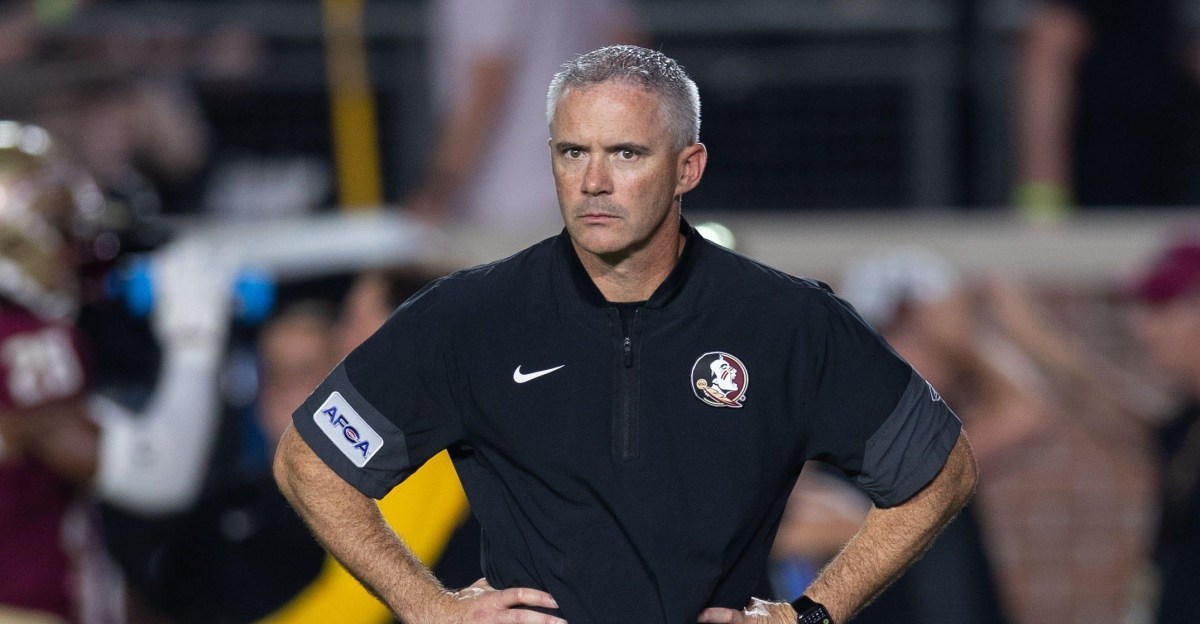
After Florida State lost to Notre Dame by 49 points in November of 2024, Florida State’s athletic department, led by athletic director Michael Alford, decided it would be cheaper to fire almost all of the staff around Norvell instead of the FSU head coach, who had just signed an eight-year, $84 million extension the prior offseason.
So the following day, offensive coordinator Alex Atkins, defensive coordinator Adam Fuller, and wide receivers coach Ron Dugans were all let go. Later in the offseason, legendary FSU defensive line coach Odell Haggins was transitioned into an off-field role.
Norvell’s final three weeks of that season, with the team already sitting at 1-9, were a bye followed by games against FCS opponent Charleston Southern and a bad Florida team. The focus was no longer on 2024, but he had a three-week head start to find new coordinators and reverse the damage in 2025.
The head coach basically tried to hedge his bets. Norvell hired Gus Malzahn, a familiar name who gave him his first big break and who ran a similar offense. On defense, Norvell made a major pivot, hiring defensive coordinator Tony White, who had no prior relationship with him and who runs a 3-3-5 scheme not even seen in FBS football.
Each coordinator brought multiple coaches with them, Malzahn taking offensive line coach Herb Hand and wide receivers coach Tim Harris Jr. from UCF, while White brought defensive line coach Terrance Knighton and safeties coach Evan Cooper from Nebraska.
14 games later, it’s hard to say any of the aforementioned assistants has succeeded in their role.
The Seminoles have lost eight of their last 10 games against Power Four opponents, the latest of which happened in excruciating fashion at home. FSU won the turnover margin (4-1) and time of possession, committed fewer penalties, and yet, walked off Bobby Bowden Field with nothing to show for it after another nothingburger of a performance, a reflection of a whole host of factors, but mostly bad coaching and schematics.
“Tonight, coming off of it, just another close game, a lot of one plays,” Norvell said in his postgame press conference. “You think back through it, some of the explosive plays that we gave up defensively, some of missed opportunities there offensively.”
On the offensive side, expectations coming into the season were low, but the Seminoles have zero juice. Malzahn’s abrupt retirement right before this year’s spring practice forced Norvell back into the spotlight of calling plays, where after two games of evidence, he does not appear to excel anymore. The Noles were an unbelievable 2-of-15 on third downs on Monday. FSU did go 2-of-4 on fourth downs, but the decision to go for it the first time, 4th-and-1 at its own 45, culminated in one of the worst play calls of the game, resulting in a turnover on downs and, shortly after that, a 14-7 deficit.
Malzahn had an up-and-down lone season calling plays for FSU’s offense, but the flatline that has been the first two games back under Norvell’s playcalling make one crave the Malzahn roller coaster.
White’s hire finally marked a departure from the norm and a move toward something new. He brought an honest energy to his press conferences and was billed as a “mad scientist” by all who talked about him. Arriving with him were two coaches with NFL backgrounds, Knighton and Cooper, to help teach his new scheme to the holdover coaches and new players. The stats backed him up, as Nebraska finished top-20 in the country in total defense in 2024.
But not everything on paper works in practice.
Even though White’s unit forced three turnovers on Monday, they were shredded. The Seminoles allowed almost 600 yards of total offense, 8.7 yards per play and gave up 8 of 14 third-down conversions.
If those stats are not bad enough, look at the explosive plays from the Mustangs, who had three receptions of 50-plus yards. Even in year two, none of the players appear understand the scheme, and coverage busts remain an issue.
Worst of all, though, all of the players White banked on taking a step forward have not lived up to expectations. The defensive line, coached by one of his disciples, Knighton, does not seem to have anyone above average. After Daniel Lyons went without a stat on the scoresheet last week, Mandrell Desir, one of the highest-paid players on the Seminole roster, did not record a tackle against SMU. Of the seven Seminole defensive linemen with 10 or more pass-rush snaps, not one had a pass-rush grade over 65.0 according to Pro Football Focus. Florida State did not record a sack either, meaning that Knighton has as many cryptic Twitter posts since the start of fall camp (3) as FSU has sacks this season.
On the backend, none of the safeties are on the same page, even after Norvell said the defense spent all week stressing communication, to the point where FSU played crowd noise on defense in practice to get familiar with a loud stadium. Even though Ashlynd Barker played well against SMU, the coverage busts and poor angles stem from bad coaching and execution. Safeties CJ Richard Jr. and Ma’Khi Jones, two transfers brought in this offseason because they fit the scheme, played over 59 snaps each yet both had a coverage grade under 60 according to PFF (below average). Richard had the highest total defensive grade of the two at 60.3.
The Seminoles lost the game on defense because the front seven, which the coaching staff praised all season, couldn’t generate pressure, forcing White to blitz and opening up massive coverage busts and space on the back-end.
As seen across the country on a weekly basis, getting the coordinators right can solve many problems. Norvell had the chance to quickly dig himself out of his 2024 hole by landing two exceptional play callers. Unfortunately for him, those decisions should be the last major choices he makes before what appears to be his inevitable firing.