
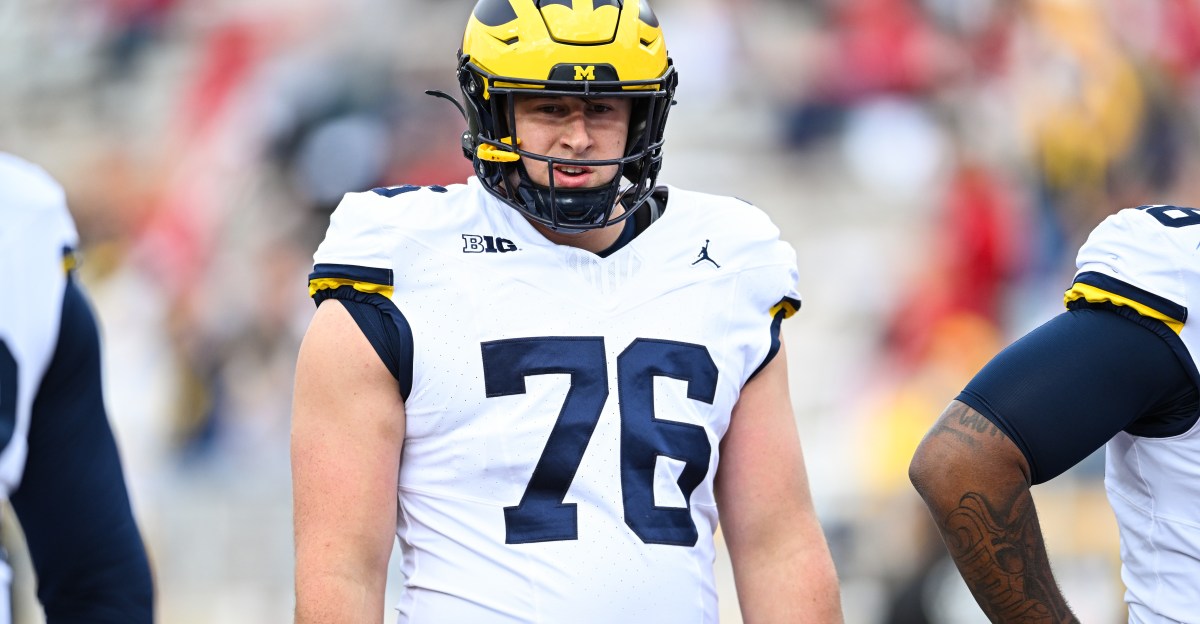
Michigan fans didn’t have to wait long to see just how serious Jason Beck was about bringing the “Rhino” role with him to Ann Arbor. In the season opener against Western Michigan, offensive lineman Manuel Beigel played 26 of Michigan’s 51 total offensive plays as the Rhino, so this clearly isn’t just a short-yardage gimmick.
Today, we’ll discuss the Rhino position, how the concept was created, what the Rhino does, and much more.
Where the Rhino came from and what it is
The concept goes back to Beck’s time at Virginia, but the name came later at Syracuse. Chris Elmore, a versatile player who lined up at fullback, tight end, offensive line and defensive line, was nicknamed “Rhino,” so Beck eventually started using the nickname for the role itself.
The idea is pretty simple: put a sixth offensive lineman on the field as a jumbo tight end, giving the offense another blocker while still maintaining the ability to throw. It worked successfully at his other stops, so he brought it to Utah last season, where Kyle Whittingham and offensive line coach Jim Harding helped make it a major part of the offense.
Solatoa Moea’i was Utah’s primary Rhino in 2025, playing 328 snaps as an in-line tight end, according to Pro Football Focus. Beck has said Utah used six offensive linemen roughly 400 to 500 times last season; the Utes went 11-2 while averaging more than 41 points and 482 yards per game.
Michigan wasted no time using it
Now at Michigan, Beck deployed the Rhino position during the season opener vs Western Michigan. Beigel, a 6-foot-5, 307-pound junior who spent most of his career on the defensive line, was Michigan’s primary Rhino against the Broncos.
Beigel played 26 snaps against Western Michigan, meaning he was essentially a sixth starter along Michigan’s offensive line. The results, however, were mixed.
One example came on a Wildcat long-trap play with Jordan Marshall taking the direct snap. Beigel (No. 96) lined up as the extra offensive lineman, and the formation gave Michigan favorable numbers to run the ball. But an opposing defensive end blew up Beigel’s attempt to reach the second level, allowing the linebacker that Beigel was supposed to block to fill the running lane. Marshall gained just one yard on the play.

That play was representative of a larger problem. Michigan finished with only 108 rushing yards on the night, and its offensive line struggled to consistently create space. Still, the amount of times Michigan used Beigel might be more important than how well it worked in Week 1.
This wasn’t something Beck saved for a 3rd-and-short situation. The Wolverines used the Rhino as a regular part of their offense, just as Beck, Whittingham and Harding did at Utah.
The entire point of the Rhino is versatility. If Beigel can become a reliable blocker both in the running game and in pass protection, Michigan can put six offensive linemen on the field without automatically telling the defense a run is coming.
Week 1 showed there’s still work to do, and it also showed the Rhino likely isn’t going anywhere, even though Whittingham said in his press conference earlier this week that the Wolverines may have “missed the mark” with its usage over the weekend.
Beigel playing more than half of Michigan’s offensive snaps in his first game at the position tells us plenty about how much Beck believes in the concept. Now Michigan just has to make it work, and fast, with Oklahoma coming to Ann Arbor on Saturday afternoon.