
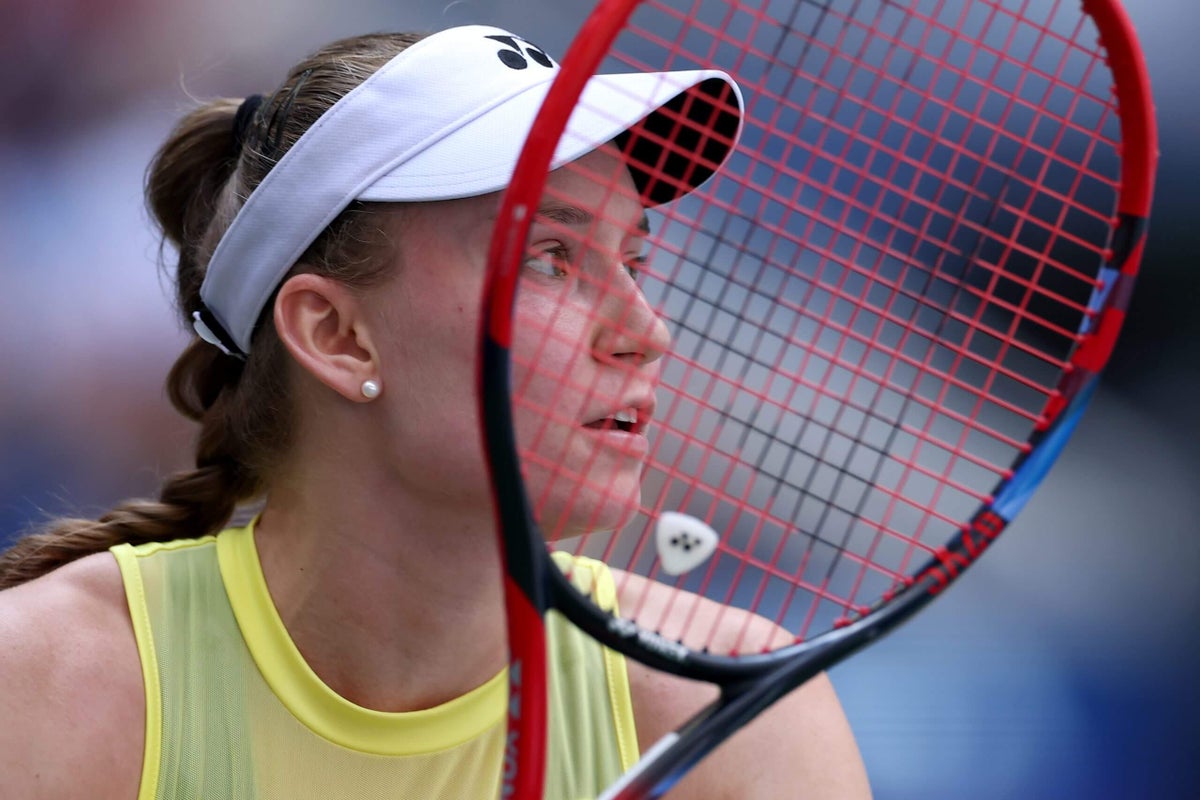
The Athletic has live coverage of Aryna Sabalenka vs. Jessica Pegula and Coco Gauff vs. Elena Rybakina at the 2026 U.S. Open semifinals.
NEW YORK — Women’s tennis has a new world No. 1.
Elena Rybakina took the top spot from Aryna Sabalenka on Wednesday at the U.S. Open with a quarterfinal win over China’s Zheng Qinwen, 3-6, 6-1, 6-4. It is her first time at the summit of women’s tennis.
Born in Moscow but representing Kazakhstan — which makes her the country’s first tennis player to reach the top of the rankings — 27-year-old Rybakina has been a top-five player for years. She inched towards tennis’ apex earlier this season after winning the Australian Open to claim her second Grand Slam title, then won the Stuttgart Tennis Grand Prix on clay in April. She owns the second-most wins on the WTA tour this year with 47, following Jessica Pegula’s 50.
She remains focused on winning. It’s a funny thing, to take over the No. 1 ranking in the middle of a Grand Slam tournament. Top players are wired to celebrate one thing, and only one thing, at a major.
“It’s a great achievement, and I feel like you will appreciate and think about it even more when you finish your career,” Rybakina said in a news conference, when asked about the milestone.
“…It’s nice whenever you’re done to say, ‘Okay, I won these tournaments, I’ve been No. 1, it’s amazing.’ But right now, it’s great. You never know how long you’re going to stay. I want to win the titles still in tournaments, so all my thoughts are just for the next match.”
Rybakina’s new ranking elevates her to the top of a tour with whose leadership she has not always aligned.
In February of 2025, the WTA barred her coach, Stefano Vukov, from coaching and obtaining credentials for a year after an investigation that found Vukov had engaged “in abuse of authority and abusive conduct” toward Rybakina, including “compromising or attempting to compromise (her) psychological, physical or emotional well-being.”
Vukov has denied breaching the WTA’s code, and Rybakina has repeatedly stated that Vukov’s conduct towards her has never been abusive. Vukov’s ban was lifted in August 2025 after an appeal.
He remains her coach and has been courtside during her matches in New York.
Rybakina was a mostly steady force in a season of relative shakiness at the top of the tour’s leaderboard.
After she won the year’s first Grand Slam in January, the major-title winners club admitted two new members as the old — well, older — guard looked on. Mirra Andreeva won the French Open at 19, and Linda Nosková won Wimbledon at 21.
If Sabalenka does not win the U.S. Open, she will log her first year since 2022 without a Grand Slam title. Coco Gauff, who faces Andreeva in the last women’s quarterfinal Wednesday, could win her third major championship. World No. 3 Pegula is still searching for her first Grand Slam title after spending years as one of the most consistent players at the top of the game. Iga Świątek, the most decorated champion in the group with six majors, is headed toward the end of a trying year that included a coaching change and a loss to Zheng in the fourth round of the U.S. Open.
Sabalenka, Gauff, Świątek and Rybakina all had significant periods of instability in 2026, but none was as apparent as Sabalenka’s — because of how demonstrative she is and how untouchable she seemed as the top player just months ago.
She spent 99 weeks as the world No. 1 after surpassing Świątek in surprising fashion in 2024.
After losing the Australian Open final against Rybakina in January, Sabalenka won their rematch in the Indian Wells final and beat Coco Gauff in the Miami Open final in March.
Then, the trouble began.
She lost to then-world No. 32 Hailey Baptiste on clay in the quarterfinals of the Madrid Open, and the wheels came off after that. Sabalenka made just two quarterfinals in her next six events. She lost two matches in which she lost at least a set 6-0 — one in a trainwreck of a quarterfinal loss to Diana Shnaider at the French Open, another to Pegula at the Berlin Open on grass.
Sabalenka faces Pegula in one U.S. Open semifinal, while Rybakina will play Gauff or Andreeva in the other.
She came back to beat Zheng in classic Rybakina fashion — by asserting her power game on a player who couldn’t keep up. Zheng’s game by no means lacks fire, but the former Olympic champion came through qualifying to reach the quarterfinals after her ranking dipped while managing a chronic elbow injury.
After coming back from trailing 5-0 in a set in two different matches in New York, Zheng’s energy finally dipped in the second set against Rybakina. She struggled with her first serve throughout the match, but serving at 4-4 in the third set, she double-faulted to give Rybakina the chance to serve out the match.
Her opponent’s misstep was a gift. Just as she has all season, Rybakina capitalized on the opportunity.