
The Athletic has live coverage of 49ers vs. Rams in Australia.
This is a story of how two flagship NFL franchises squandered MVP quarterback seasons through a special kind of systemic neglect that could haunt them in the future, Super Bowl expectations be damned.
It might yet become a story of redemption.
The Los Angeles Rams and Green Bay Packers know the agony of flying high with MVP quarterbacks, only to suffer special teams implosions in the biggest games, sabotaging legacies in the process.
Recent trades for superstar pass rushers Myles Garrett (Rams) and Micah Parsons (Packers) distract from a pointed question: What good is adding horsepower to the engine if the radiator empties onto the highway when the car climbs a steep grade?
Can the Super Bowl favorites fix their fatal flaw?
Mike Sando
In January 2022, MVP-to-be Aaron Rodgers watched his top-seeded Packers suffer a blocked field goal and a blocked punt, the latter returned for a San Francisco 49ers touchdown, during a 13-10 playoff loss at Lambeau Field.
In Rodgers’ 2014 MVP season, Seattle burned the Packers for a touchdown on a fake field goal and recovered an onside kick late in the NFC Championship Game. Those plays doomed the Packers on a day Green Bay intercepted Russell Wilson four times.
Last season, Rams MVP-to-be Matthew Stafford suffered a similar fate across three games against the eventual Super Bowl champion Seahawks. The punt-return touchdown his Rams allowed while leading 30-14 in the fourth quarter sparked Seattle to a 38-37 victory in Week 16, costing L.A. the NFC West title and No. 1 seed. In the NFC title game a month later, the Rams muffed a punt, leading to a Seahawks touchdown on the next play as Seattle advanced to the Super Bowl.
These were not isolated failures.
The Rams’ and Packers’ head coaches, Sean McVay and Matt LaFleur, have combined to employ 10 special teams coordinators, including Ben Kotwica’s interim stint with the Rams last season, during otherwise successful tenures. They have new coordinators again entering 2026, along with new hopes. But it’s clear the surface-level treatment of NFL special teams failures — fire the coordinator, hire a new one, act like everything will be fine, then repeat — cannot mask systemic problems.
And so, for the past six months, I’ve asked dozens of special teams coaches, head coaches, coordinators and front-office executives what really matters when analyzing the phase of the game that few truly understand and some head coaches treat as a necessary evil.
Their answers kept returning to decisions made long before kickoff: how much practice and meeting time the head coach commits to special teams, which players claim the final spots on 53-man rosters and which players are active on game day.
These decisions could determine whether McVay’s Rams, among the 10 strongest preseason Super Bowl favorites of the past 15 seasons, deliver on preseason expectations.
It’s late July, and the Rams are finishing practice at Loyola Marymount University when McVay strides over to check out the special teams commitment presentation I’ve prepared after all those conversations dating to the NFL combine.
The presentation begins by framing the Rams’ acquisition of Garrett as a reaction to their meltdowns against Seattle, and watching their division rival win the Super Bowl.
PowerPoint slides show the six special teams coordinators McVay has employed, each stacking over the other, from the venerable John “Bones” Fassel, who let his contract expire so he could coach in Dallas, through the latest hire, Bubba Ventrone.
“I miss him,” McVay says as Fassel’s face flashes onto the screen.
Joe DeCamillis’ face appears. He left the Rams after the 2022 season, taking a job in college because, as he said at the time, “I was just feeling like I wanted to get back with somebody that emphasized special teams.”
“Joe was good, too,” McVay says.
Next comes a look at those three Rams games against Seattle last season. The numbers tell McVay what he already feels. His offense and defense outplayed Seattle by more than three touchdowns (+23.7 expected points), but his special teams gave all of it back (-23.6, the seventh-worst differential out of 1,415 multigame season series this century, per TruMedia).
By this point, McVay has seen stark visual evidence as well: spider charts showing his 2025 team lagging far behind NFL norms in game day roster commitment on special teams, as measured by five categories:
• Core special teamers: Players whose primary role was special teams
• Depth ST rate: Rate at which depth spots were used primarily on special teams
• Depth ST degree: Degree to which depth players played special teams over offense/defense
• Low-use players: Players who were active on game day but played few snaps in any phase
• Starter relief: Starters on offense/defense who played regularly on special teams
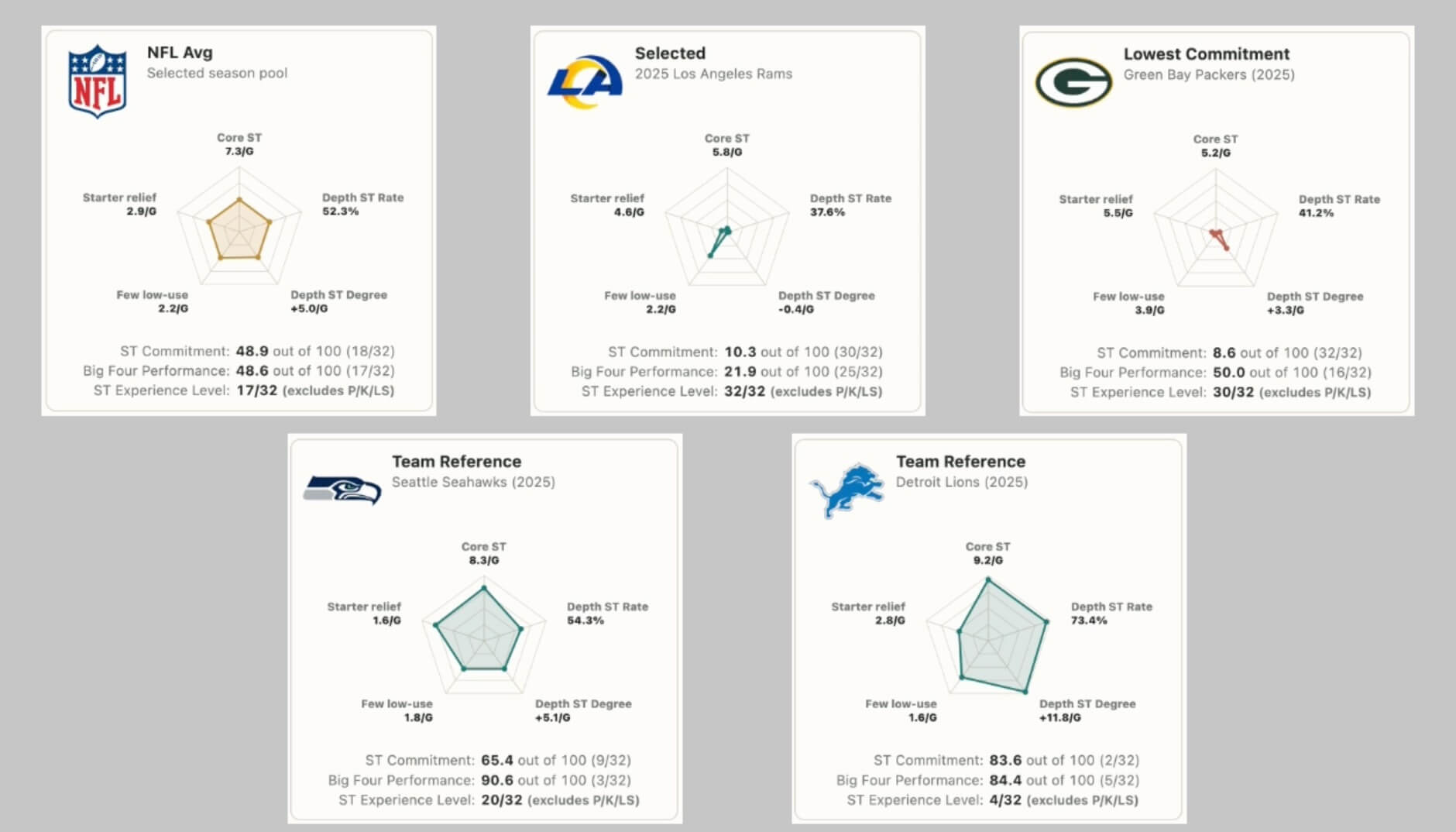
A screengrab of a presentation shown to Sean McVay this offseason, illustrating how the Rams’ commitment to special teams lagged well behind the league average in several categories in 2025. (Mike Sando / The Athletic)
“We need to f—ing coach and play better, and it needs to be more important to me,” McVay says, “so I agree with everything you are saying.”
The tension reaches into McVay’s football lineage. His grandfather, John McVay, was a 49ers executive during the Bill Walsh years and beyond.
“Who leads the NFL in punt-return average?” Walsh would ask back then. “OK, it’s so-and-so at 13 yards. Who is last in the NFL? OK, it’s so-and-so at 7 yards.”
Walsh would pause for effect and say, “I’ve got a lot of plays that can get 6 yards.”
Great organizations could build dynasties more easily before free agency and the salary cap evened the playing field starting in 1993. There was less need to win in the margins of special teams when Joe Montana was handing off to Roger Craig or throwing to Jerry Rice (those 49ers teams also had Hall of Famers on defense, led by Ronnie Lott).
These are different times, especially with the NFL introducing the “dynamic kickoff” ahead of the 2024 season.
“Special teams wasn’t as important to me as offense and defense,” McVay said, “but now, I think it is more important because there are more action plays. You are covering more kicks, you are returning more kicks, and when the ball is on the 30-yard line, or a touchback goes to the 35, you are really one first down away from being in four-down territory.”
McVay has moved up special teams periods toward the start of practice. That’s progress from August 2025, when McVay’s Rams held a joint practice with the New Orleans Saints and there wasn’t a single special teams period on the schedule.
“Mind-boggling,” a special teams coordinator from an AFC team said. “Like, how is that even a thing?”
McVay and his Saints counterpart, Kellen Moore, built their reputations as offensive play callers. Neither employed established, empowered special teams coaches, who would have pushed back against being marginalized in that way.
The implications reverberated for the Rams, even in less obvious ways. The Saints’ orientation toward offense made it easier for them to trade Rashid Shaheed to the Seahawks at the November deadline. That move, more than any other in-season trade, altered the NFL landscape.
While the Saints were subtracting a one-dimensional speed receiver with modest offensive numbers, the Seahawks were adding a game-changing return specialist. Shaheed’s 58-yard punt return for a touchdown against the Rams in Week 16 helped Seattle take away home-field advantage.
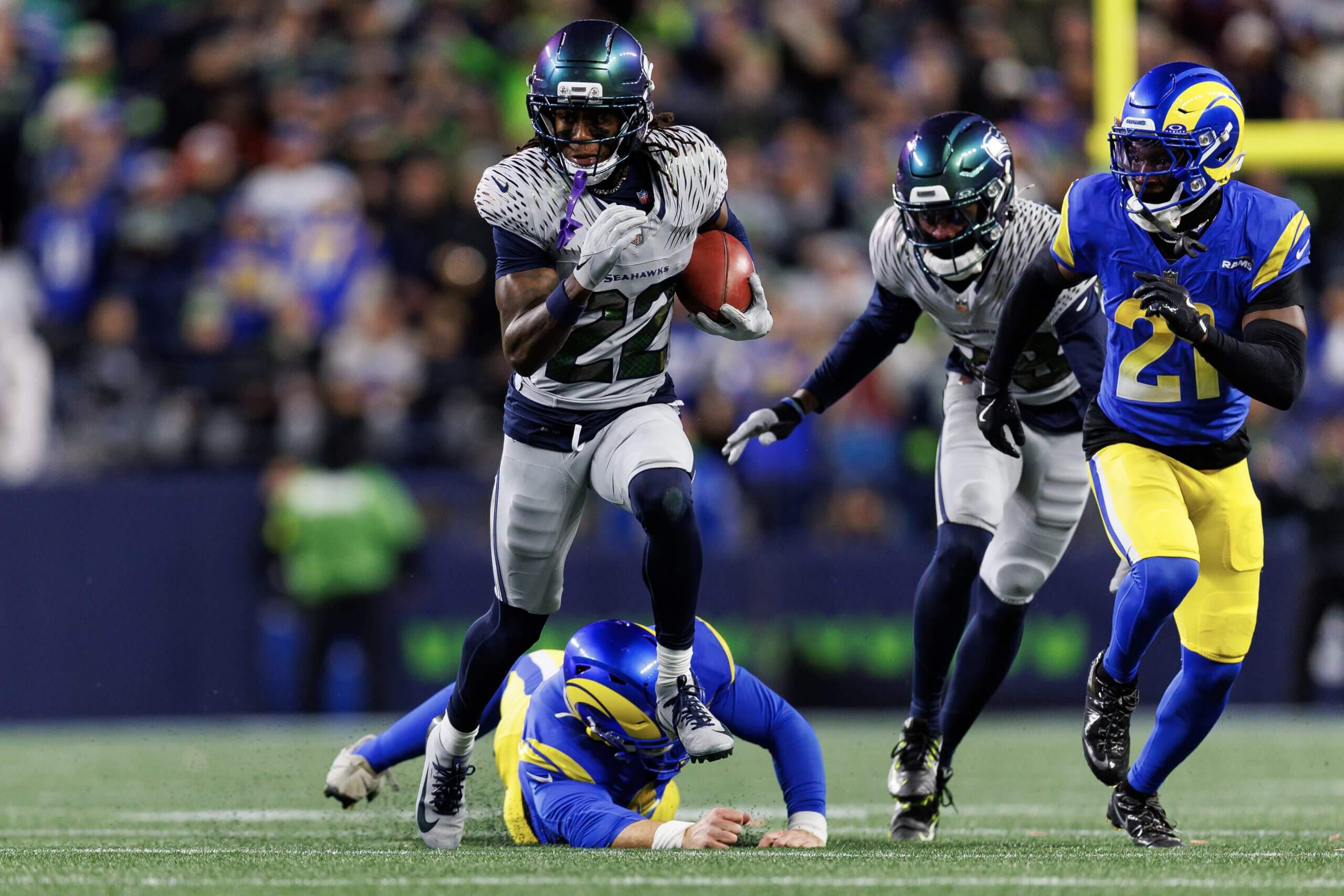
Rashid Shaheed (No. 22) helped swing the NFC’s top seed with a punt-return touchdown against the Rams in Week 16. (Brooke Sutton / Getty Images)
“I told my guys in the special teams room, this play won Seattle the Super Bowl, even though it was a regular-season game,” another special teams coach said. “This changed the course of this game, which gave them home-field advantage in the NFC. That game was over. (The Seahawks) had no morale.”
This offseason, days before the Rams rocked the NFL by acquiring Garrett, Seattle quietly traded for Irv Charles, a special teams gunner from the New York Jets. “He’s just a monster special teams player,” general manager John Schneider said of Charles last month.
Matt LaFleur is back in his office at Lambeau Field following an offseason practice, worlds away from McVay, his former boss.
Beyond the obvious differences — Green Bay has fewer residents (106,675) than 37 Los Angeles suburbs — there are structural considerations.
While the Rams’ owner, Stan Kroenke, is adding MLB’s Los Angeles Angels to a stable of sports franchises that already includes the Denver Nuggets and Colorado Avalanche, the Packers continue to operate in a time warp. As a publicly owned team, their operating structure is firm. The general manager picks the players. The coaches coach them.
GM Brian Gutekunst has evolved Green Bay’s operation from the rigid draft-and-develop philosophy his predecessor, Ted Thompson, rarely strayed from while winning one Super Bowl but not reaching another from 2005 to ’17. Still, the subject of special teams remains a sensitive one in Green Bay after years of failures that predate LaFleur and short-circuited his best shot at a championship five years ago.
Deep into the same presentation I showed McVay, LaFleur encounters a visual so stark that there is no mistaking the implications. It’s a scatter chart comparing special teams commitment to performance in the core-four phases — kickoff, kick return, punt and punt return — from 2013 to ’25. A lonely Packers logo resides in the lower-left quadrant, far away from all others.
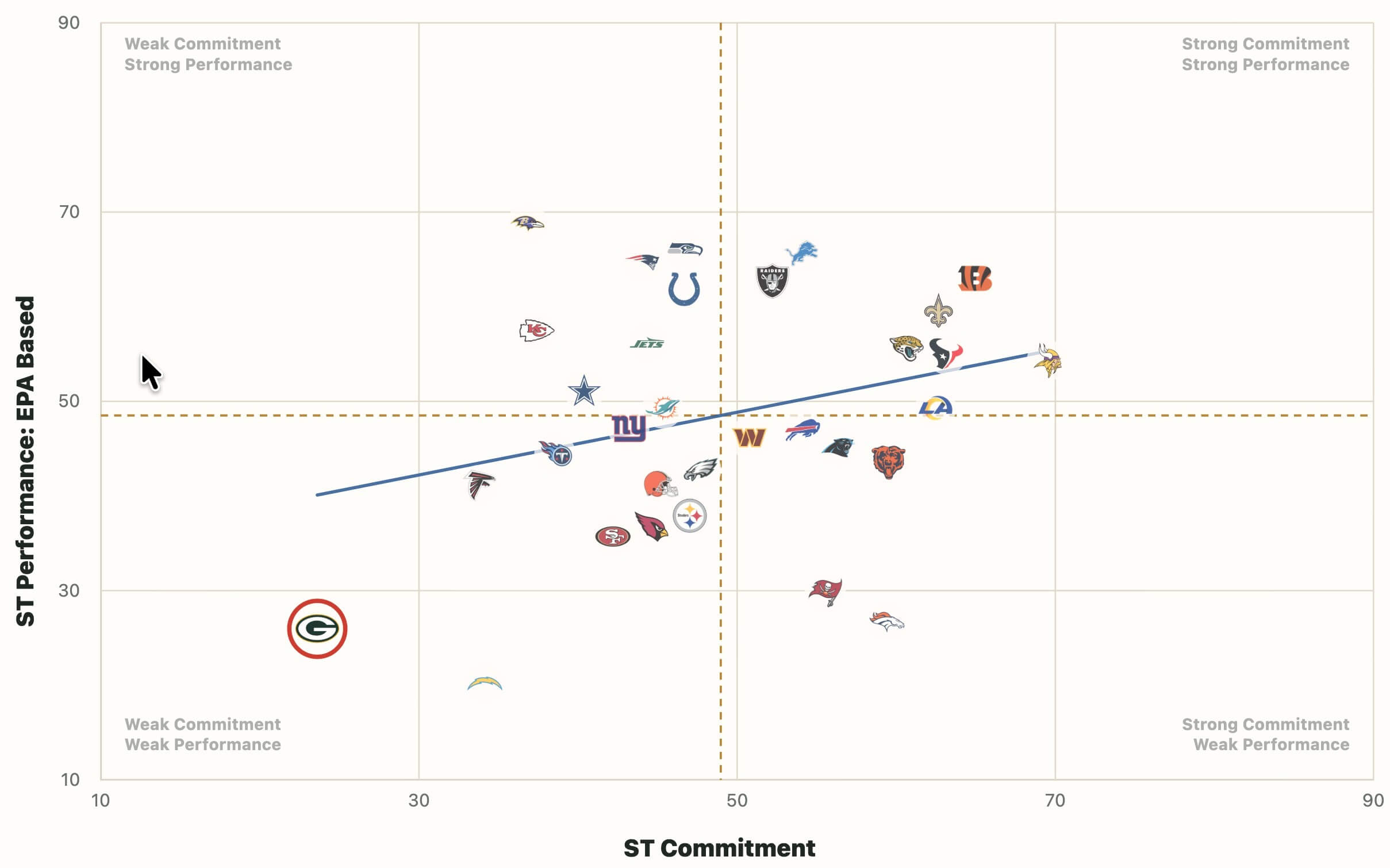
A screengrab of a presentation shown to coach Matt LaFleur during the offseason, illustrating how much less the Packers have invested in special teams — and how much worse their special teams performance has been — than the rest of the NFL since 2013. (Mike Sando / The Athletic)
LaFleur winces, until learning the Packers were a respectable 16th in core-four performance (as measured by Expected Points Added) last season. They ranked 28th in game day roster commitment.
“I felt like our kickoff coverage unit was solid, our punt team was pretty good,” LaFleur says. “We needed a punt returner and got one (Skyy Moore).”
Rich Bisaccia, the Packers’ special teams coordinator from 2022 to ’25, left Green Bay for Clemson in February, instead of coaching the final year of his contract. He came to the Packers for a chance to win with Rodgers, and because his good friend, Joe Barry, was the defensive coordinator. Bisaccia had worked with Gutekunst’s father, another plus. And he did make headway in Green Bay, as the team added Rudy Ford, Keisean Nixon, Dallin Leavitt, Eric Wilson and other special teamers.
“I’ll say this about Rich,” a coach from another team said. “He got something done up there that hadn’t really happened. He had dedicated teamers.”
Bisaccia’s successor, Cam Achord, came up under Bill Belichick with the New England Patriots, same as Ventrone, the Rams’ new special teams coordinator.
Belichick valued the third phase so much that he let his coordinator pick two or three players (beyond the kicker, punter and snapper) to keep during roster cutdowns. Larry Izzo, Matthew Slater and Nate Ebner were among the mainstays, rarely playing on offense or defense.
The Patriots ranked No. 1 in core-four EPA across Tom Brady’s tenure (2000-19), counting playoffs. The Packers ranked 32nd over Rodgers’ career in Green Bay (2005-22).
This year, Green Bay kept a few core special teamers — without obvious paths to playing time on offense or defense — on the 53-man roster. Moore, a backup at slot receiver, can handle both punt and kickoff returns. Receiver Bo Melton and linebacker Nick Niemann are among those who might not have made the cut under Thompson.
LaFleur, for his part, seems most excited about what the 39-year-old Achord offers schematically in this new era of the dynamic kickoff.
“Cam is always looking for an edge in terms of schematics, studying other people, trying to think outside the box to put us in the best possible situation,” LaFleur said.
Green Bay averaged 32.7 yards per kick return and scored on an 81-yard punt return during preseason, for whatever that is worth.
Field goal kicking, which the model treats separately from core four because it is harder for coaches to influence, was the Packers’ primary special teams issue in 2025. Rookie kicker Trey Smack made all nine tries this preseason, including from 51, 58 and 59 yards.
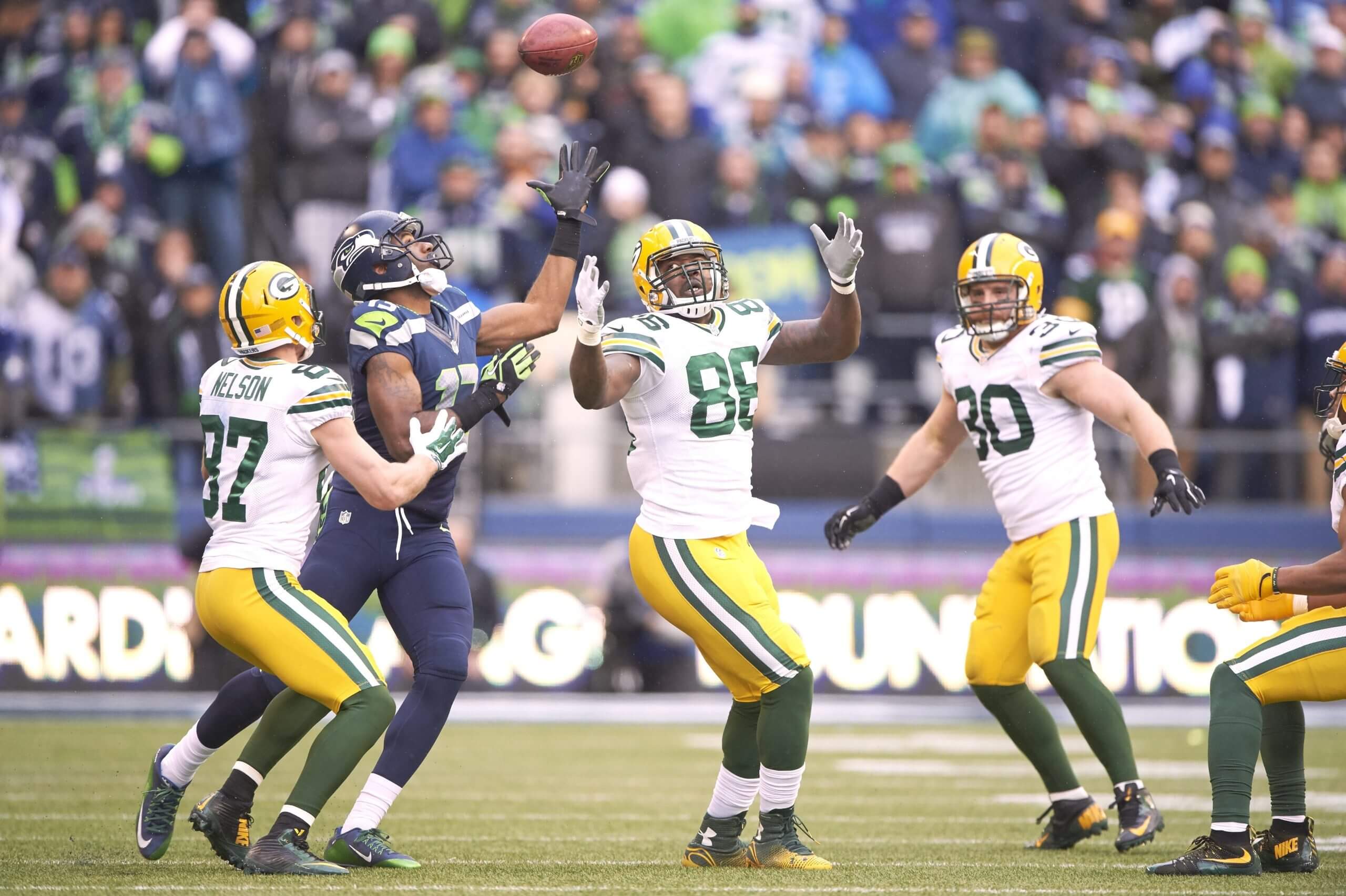
The Packers are no strangers to special teams woes, including Brandon Bostick’s infamous botched onside kick in the 2014 NFC Championship Game. (Robert Beck / Sports Illustrated via Getty Images)
Mike McCarthy lived the Green Bay special teams experience as head coach from 2006 to ’18 before spending five seasons in the same role with the Dallas Cowboys.
Green Bay was 32nd in commitment and 29th in performance during his final six seasons with the team (data exists since 2013).
Dallas was second and ninth, respectively, with McCarthy from 2020 to ’24 (Fassel was his special teams coordinator).
Same coach, different franchise, totally different commitment footprint.
Not that game day roster commitment by itself guarantees anything. It can be an indicator, but players matter. Coaching matters. Practice time matters. Achord’s 2020 Patriots ranked 32nd in game day roster commitment but first in performance, with an outstanding punter and elite special teamers in Slater, Justin Bethel and Cody Davis (who combined for eight snaps on offense and defense all season).
In the end, there is no fooling the locker room. Players know how much special teams matters, so when the Packers cut third-phase mainstays back in the day — think Chris Banjo, who went on to flourish with New Orleans after his 2016 departure from the Packers and is now the Jets’ coordinator — those moves spoke for themselves.
“Organizational philosophy is the No. 1 thing,” a veteran special teams coach with no ties to the Packers said. “New England, back when they were amazing, their organizational philosophy was that the backup players were going to dress because of their ability on special teams.
“If they had to play offense or defense, they had to try to get (the team) out of that game, and they would worry about fixing it the next week.”
Coaching trees matter. Bill Parcells proteges such as Belichick, Sean Payton and Dan Campbell tend to emphasize special teams. Walsh obviously felt another way.
It’s an open secret in the NFL that special teams coaches from the Kyle Shanahan tree have to fight for every minute of practice time they can get.
But with Brant Boyer taking over the 49ers’ units last season after a nine-year run with the Jets, San Francisco surged to 13th in commitment and seventh in performance (the 49ers were 20th and 30th, respectively, over Shanahan’s tenure previously).
New kicker Eddy Piñeiro solved a major problem by making 28 of 29 tries.
Under McVay, the Rams’ game day commitment remained high for six consecutive seasons before cratering after DeCamillis’ departure. A top-heavy roster had something to do with the dip. Using later-round picks to fill holes on offense and defense, with less regard for special teams, was another factor after the Rams traded away first-round picks.
Like the Packers, the 2025 Rams were on the high end with nearly three starters per game logging heavy snaps on special teams.
But this is a new year, with new tools to separate teams that care about special teams from those who merely say they do.
“I promise you, getting Bubba Ventrone, getting (special teams assistant) Kyle Hoke, getting (linebacker/special teamer) Grant Stuard, signing (snapper) Joe Cardona, having more intentionality about the importance of it — we’ll be better on teams,” McVay said. “I’m f—ing committed to that.”