
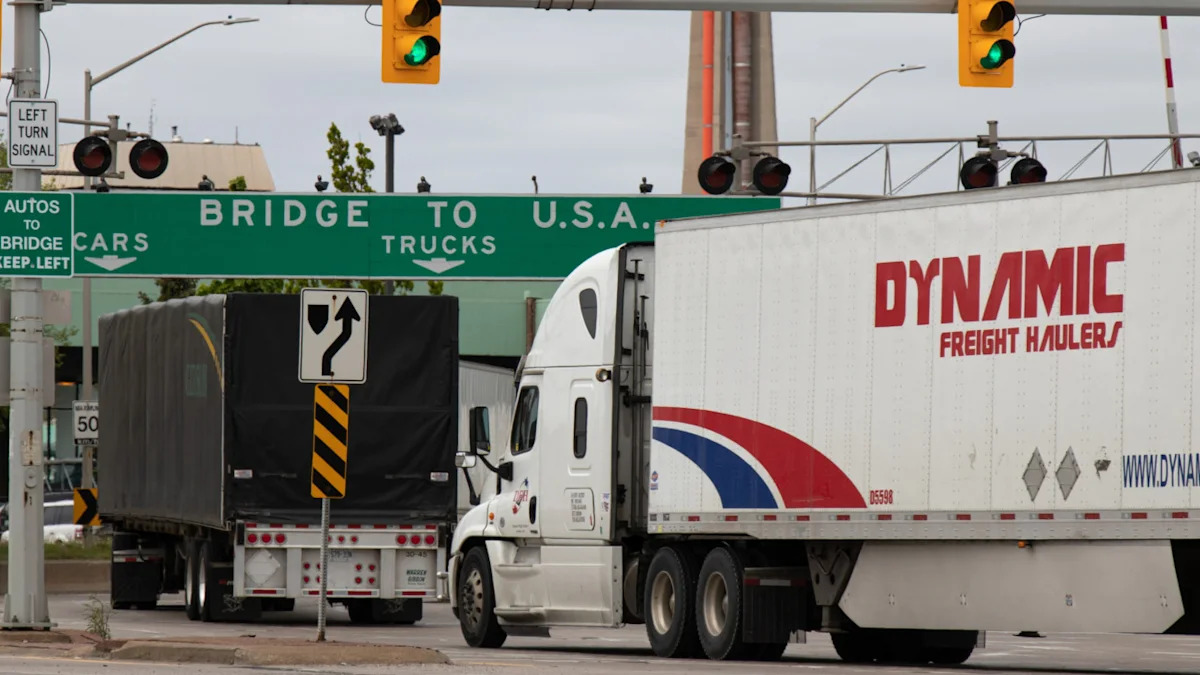
 Transport trucks pass under a
A transport truck rolling across the Ambassador Bridge in Windsor, ON this month is carrying a slightly different cargo list than it was in August. Starting September 15, the United States is charging new 50% tariffs on a batch of Canadian goods — including dairy, alcohol, metal and paper products and outboard motors — while quietly dropping tariffs on other goods such as cement, sugar, toilet paper and fishing rods.
According to a recent TD Economics client note from senior economist Andrew Hencic, the U.S. tariff shuffle shouldn’t materially affect Canadian economic growth — in the near term. Hencic wasn’t alone in this assessment. Analysts with Capital Economics, an independent macroeconomic research firm, reached a similar conclusion saying a related U.S. ban on Canadian whey, alcoholic beverages and motorcycles will have little effect on either economy.
Don’t Miss
That’s reassuring at the national level. But “no material impact” on GDP doesn’t mean it won’t affect you — especially if your paycheque, business or investment portfolio sits inside one of the affected industries or provinces.
Here’s what actually changed, who’s exposed and what to do about it.
What changes as of September 15
As Director & Senior Economist at TD Economics Andrew Hencic points out that the U.S. response to Ottawa’s counter-tariffs came in three parts:
New 50% duties on dairy, alcohol, metal and paper products and outboard motorboats — about 0.6% of U.S. imports from Canada in 2025
Tariffs removed on cement, sugars, toilet paper and fishing rods — about 0.5% of U.S. imports from Canada in 2025
A separate import ban on whey, alcoholic beverages and motorcycles, starting September 29 — under 0.3% of U.S. imports from Canada
In other words, Washington simply swapped which products get taxed. Based on analysis from TD Economics, the U.S. removed tariffs on roughly 20 products and replaced them with a wider scattershot-type tariffs across more than 300 other products.
Read more: 3 essential money moves to make once you’ve saved $50,000
Why economists are calling it a wash
While the impact may be different — tariffs removed from some items and applied to other products — the overall impact is about the same, according to Hencic.
Story Continues
As he points out, the U.S. “shifted what is covered by the tariff umbrella but has landed on a similar dollar amount that will be tariffed.”
The real damage is the uncertainty. Hencic frames it as “another manifestation of policy uncertainty” — uncertainty that keeps Canadian firms guessing about U.S. market access. As Hencic explains, uncertainty has its own cost, even when the tariff total stays flat.
Who feels the latest tariff war, first?
From a national perspective, these new tariffs aren’t much different — but the national number hides where the pain actually lands.
In the latest TD Economics report, Hencic flags Ontario, Quebec, New Brunswick and Nova Scotia as the provinces most exposed to this round of changes, while British Columbia is expected to come out roughly net neutral. That regional split lines up with where the newly tariffed goods — dairy, alcohol, metal and paper products and outboard motors — are largely produced.
If you or your household income depends on one of those industries, this isn’t a rounding error — it’s your order book, your overtime hours or your firm’s profit margins.
Plus, investors holding Canadian equities concentrated in export-heavy sectors face the same regional math, even if a broad index looks unaffected.
An even bigger risk to watch
Two things could turn a manageable shuffle into a real hit to household finances.
Analysts from both TD Economics and Capital Economics warn that continued escalation raises the odds Canada’s economy stalls or contracts in the fourth quarter — a scenario that would put pressure on jobs and the Bank of Canada’s rate path well beyond the industries directly tariffed.
Then there’s the threat of exclusion: the U.S. has floated excluding Canadian firms from its Multiple Award Schedule procurement program — a US$50-billion-a-year purchasing channel for government IT and office supplies. TD says the timing and scale of any exclusion are still unclear.
What can Canadians do, now?
It’s hard to fight off the economic impact of a trade-war that’s gone adrift, but there are some meaningful steps that every Canadian can take.
If your job or business touches dairy, alcohol, metals, paper or outboard motors — or you’re in Ontario, Quebec, New Brunswick or Nova Scotia — treat your emergency fund as a priority, not a someday task.
Check whether your investments are concentrated in trade-exposed Canadian sectors, and rebalance if you’re not comfortable with that exposure.
Don’t plan your mortgage renewal around a guaranteed rate cut; build your budget around a range of Bank of Canada outcomes, not the best case.
Watch for federal support signals from next week’s investment summit and the fall budget, which may address sectors under pressure.
Bottom line
While the current tariff turmoil may be a wash, from a national, aggregate perspective, that doesn’t mean everyday Canadians won’t feel the impact. What’s key, right now, is to use this relative calm to review your income and savings exposure — look at your job, your business, and your portfolio — and to make changes before the next escalation.
What To Read Next
The most expensive financial mistakes are often the ones you don’t see coming. Join 19,000+ Canadians who get the money moves, risks and opportunities shaping their finances — delivered free each week. Subscribe now.
This article originally appeared on Money.ca under the title: New U.S. tariffs and import bans won’t dent national GDP growth, economists say — here’s what it could cost Canadians
This article provides information only and should not be construed as advice. It is provided without warranty of any kind.