
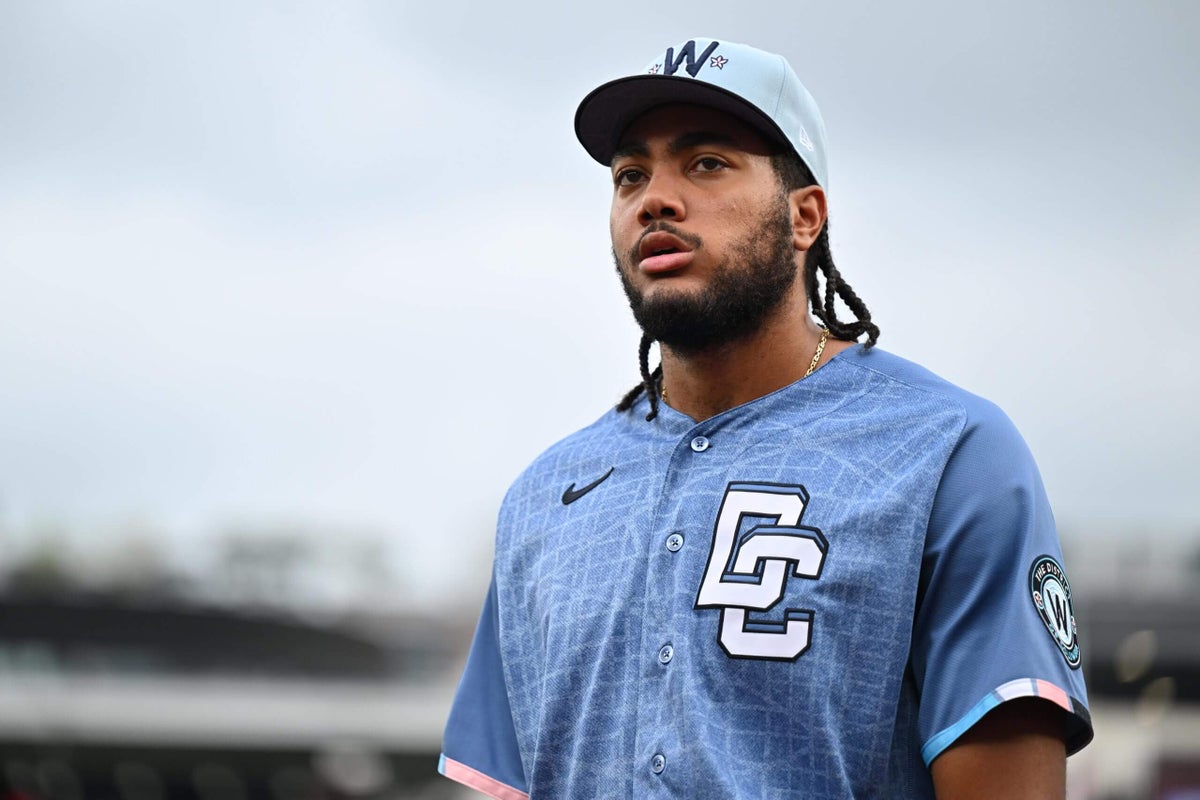
WASHINGTON — On Sunday morning, James Wood sat at his locker and said he understood why the Washington Nationals sold at the trade deadline six weeks ago. They were in the wild-card hunt, but they were also young. He did not want to play GM, but understood that this is the first year of a new regime that is trying to build something more sustainable than a flash in the pan.
“So it’s a tough situation, because you have guys on expiring contracts, you have guys in the minor leagues that you want to give a chance to, and who rightfully deserve that chance,” Wood said. “So you want to try to do what’s best for the team, not necessarily this year, but in the long term.
“I think it was just kind of tough being in the middle of ‘all right, are we ready to push the chips in and contend right now, or do we want to just be patient, stay the course and try and build a sustained winner?’ Yeah, I mean, I can understand it. It’s a business. It’s not really in my control.”
There is some truth to that final sentence. An imagination, too, can run wild after the Nats swept the Los Angeles Angels, who seem bound for 100 losses. But as the Nationals illustrated this weekend, they have gathered enough offensive depth to quell concerns about regression and start spending on pitching this winter.
The Nationals are the third-best offense in baseball and don’t have a single expiring contract in the lineup. Wood and CJ Abrams are stars. Andres Chaparro, Jacob Young, Keibert Ruiz and Daylen Lile have been above-average everyday bats who are finishing strong. Dylan Crews and Brady House are trending in the right direction, while Abimelec Ortiz and Yohandy Morales have flashed upside after mashing in Triple A.
Those are 10 names worth getting excited about, a list about twice as long as it was last September. Infallible? No. Deep enough to stave off backsliding? Maybe.
“(With) how young they are, you feel really good that they’re going to take another step forward next year,” manager Blake Butera said. “It’s not like we should expect regression from this group. I feel like a lot of them are getting into their prime years. So yeah, I think we feel really good about what the future (holds) and with this group we have.”
James Wood is rolling, can he maintain it through the second half?
Derek VanRiper and Stephen J. Nesbitt
The bullpen has an ERA over 8.00 in September, which has pulled attention away from essential steps that the offense has taken this month. They struggled in clutch situations for much of the season — a stat that often oscillates to begin with — then tallied three comeback wins in a row over the Angels, which Young attributed to “seeing one go through the hoop.” They were awfully reliant on platoon hitters, until some of them — Lile, Chaparro and House — started hitting well enough to warrant everyday at-bats.
Then there were concerns about what might happen after the All-Star break. Washington’s four best hitters from the first half have either been hurt (Wood), slumping (Abrams) or sent off to play for other teams (Luis Garcìa Jr. and Curtis Mead). In that span, they look more liable to prolonged slumps — and still have the sixth-best offense in baseball.
“Guys have gotten really comfortable … and understand their roles, even if they’re not starting that game, and that’s been huge,” Young said. “And I think as you get more comfortable with that, I think that could be one of the things that continues to (bring) success in the future.”
Yes, the Nationals appear committed to a long-term plan. Multiple executives around MLB, speaking under condition of anonymity to speak candidly, told The Athletic around the trade deadline that the Nationals seemed far more interested in prospect-for-prospect trades and in selling off big-league pieces than they were in adding big-league talent.
That obviously was borne out by how they operated at the deadline. President of baseball operations Paul Toboni has yet to state how the team will approach this winter, though he recently said the final few weeks of the season will give him and the front office more time to evaluate.
It is possible, of course, to be overconfident in what the future holds. The 2023 Texas Rangers looked too deep to regress in 2024. The 2024 Baltimore Orioles looked too young to stagnate in 2025. The 2025 Toronto Blue Jays were too good at everything to see 2026 coming. But teams this deep sustain their offense more often than they take steps back, especially those who seem to have help on the way in the minor leagues, as the Nationals do.
“I think a lot of people look down on us because we’re young,” Lile said. “But at the end of the day, we can compete with anybody.”