
Here is part three of the 80-minute MinnPost interview with Timberwolves Head Coach Chris Finch from Tuesday, September 8. Part one can be found here, and part two here. The fourth and final part will appear later this week.
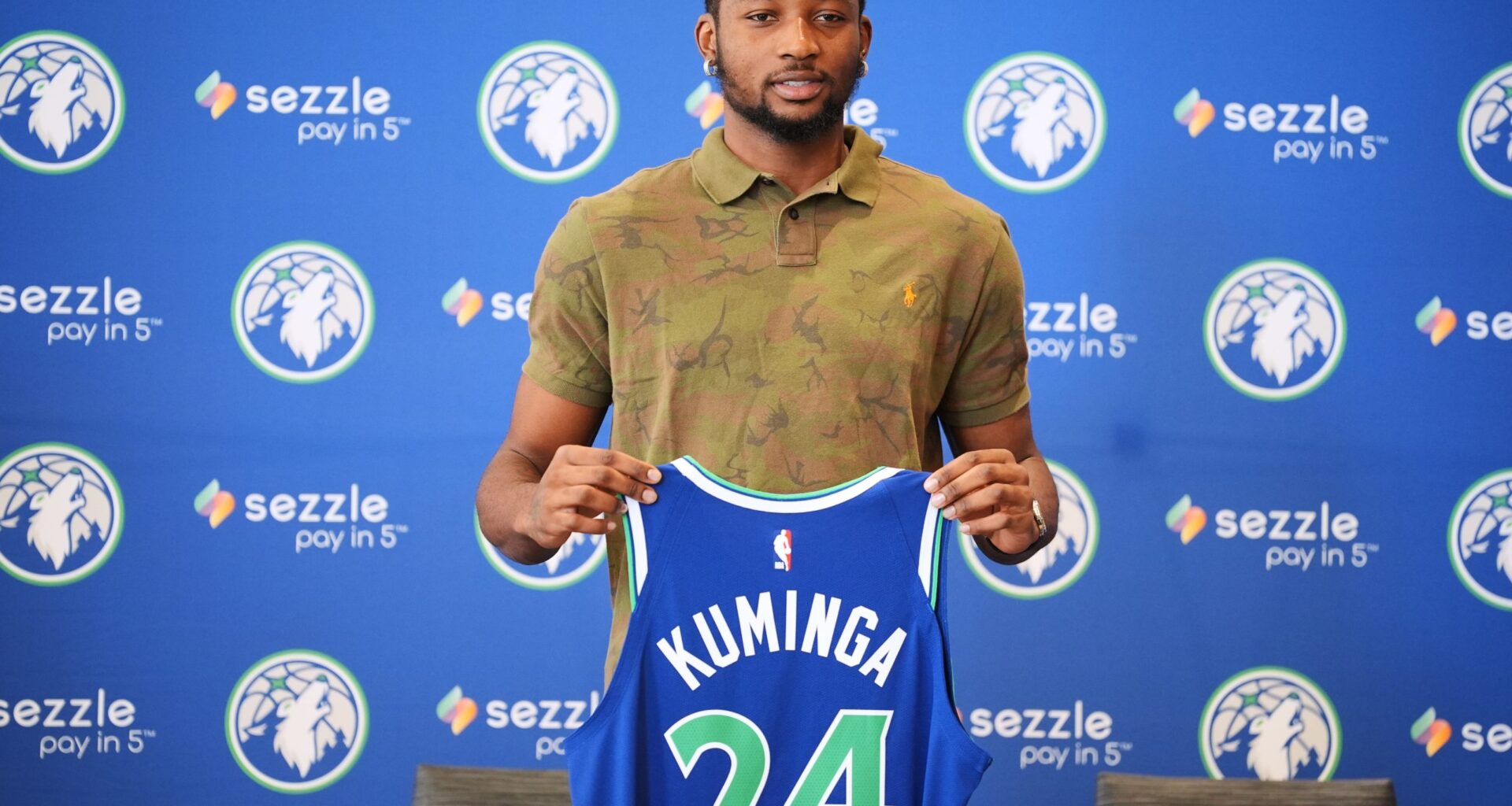
In this segment, Finch goes in-depth on recent free agent acquisition Jonathan Kuminga, penciled in as the team’s new starting power forward. He also offers insights on key personnel off the bench, including TJ Shannon and Ayo Dosunmu, and players fighting for a place in the bench rotation, such as Bones Hyland, Jaylen Clark and Trey Lyles.
MinnPost: Let’s talk about Kuminga for a minute. It wasn’t necessarily a hole in your lineup but if somebody looked at your depth chart, the obvious answer for power forward wasn’t there.
Chris Finch: This summer, you mean. Yeah.
MP: I imagine you are figuring him to be the starter, or at least a predominant factor at the four.
Finch: Yeah. It is his job to lose.
MP: So what are the ways he keeps winning it or loses it most rapidly?
Finch: The way that he wins it most rapidly is by solidifying our defense into elite. Which we feel he has the capability to do.
MP: Agree that his numbers over the past couple years and the eye test, too, have been really good in that regard.
Finch: Really good, yeah. He is going to fit right in because he has the same problem we all have: He fouls too much. So let’s get that under control teamwide, which we haven’t been able to do.
I think the rebounding piece is important. I was just talking to him today: “If you rebound at a high level for us, it is going to be such a shot in the arm.”
And then, offensively, we’re going to have to figure out a good chemistry for him; how all that plays out. I do feel like in transition — whether it be rebound and push, kick-aheads by LaMelo or whoever, or just playing early, TJ-style — there is plenty of room for him there. I think he’s a really good off-ball cutter, so playing opposite LaMelo, or Jaden with more usage, I think there is opportunity for him there.
The shot piece, the shot selection in the flow of our offense, if it is working — well, it is like we said (in previous seasons) about Jaden: He might be our new barometer indicating when our offense is where we want it to be. Is he getting enough touches? And when he does get those touches, does he not feel the need or pressure to do something for himself all the time?
I also feel, like with everything else, blending these lineups is going to be huge. Jonathan has to find chemistry in those blended lineups. When Anthony (Edwards) is not on the floor, how does it look? When he is opposite TJ (Shannon) out there, what does that look like? So for him, I look at it in terms of what can he do across the whole spectrum of the teammates he is playing with? And if I look at it just in terms of the starting lineup, it might be more limiting.
From last season: Injured and adrift, Timberwolves’ season expectations look more like pipe dreams
MP: It is interesting. Kuminga is on a “prove it” contract, but to many people, proving it means high point totals and good counting stats across the board. When in fact, you want him to be, if not a glue guy, somebody who is doing a lot of the little things; things that don’t show up on the “prove it” list.
Finch: Yeah.
MP: And that is a challenge for you as a coach.
Finch: It is a challenge. First of all — and I said this to him and his (business) team — the fact that he chose to come here, we don’t take that decision lightly. We understood what he was giving up to come here. We understood that he was betting on us: our culture, our environment, our superstars who have embraced him and recruited him hard. And seeing the fit, and how it could drive a lot of winning. Through that, he is taking the bet to “prove it.”
When he hits the marketplace — and we have always said, we want all of our guys to be rewarded — that’s what the market is going to want to see. They want to see defense, they want to see these stats that contribute to winning, the winning-DNA plays.
MP: An OG Anunoby type.
Finch: Yeah, absolutely. Like, why not? And as he continues to mature and develop and all these things, he’ll become a better shooter. Can we get him to lean a little bit more toward efficiency? Not with such drastic (demands) as, “You’ve got to get to the rim or shoot a three.” You need to give a player some license to be who they are. Besides, we’ve seen it from him in the playoffs — if he has a matchup he feels like he can take, he can take it. He can make shots. He’s actually played better in the playoffs and has had maybe more inconsistency in regular season basketball. That gives you great hope of what he can do.
We’re not opposed to isolation basketball — you know that because we’ve played it with a bunch of other dudes. But setting up those isolations, whether it be through the flow or by design, I think could help, because it might give him the green light in the context of what we’re doing.
And let’s face it, with respect to where he has been before, it is hard to come into something as a rookie like what was happening in Golden State. I mean, expectations were high and it was an extremely unique brand of basketball.
MP: Everything was already incredibly settled.
Finch: Yeah, and it is hard to navigate that. I don’t blame any of the parties who are kind of scratching their heads about why that did or didn’t work. It makes perfect sense as an outsider. I’m sure it is all true what you’ve heard, on some level, from both sides. I do know that not every player can come in and play in that system.
MP: Let’s get into the bench personnel. Ayo (Dosunmu) and TJ (Shannon) have some distinctions but also some real similarities. How do you view them rotationally and role-wise?
Finch: They are probably going to share the floor a lot together. So they are going to have to develop a fast chemistry. TJ is an underrated passer. And one of the things he can do is get to the heart of the defense, and often makes the right play there. I think at times he gets his engine running so hard that he forgets to kick out and tries to finish, tries to finish, tries to finish. So I think he needs to self-regulate and when we put that ball in his hands more, having the mindset of making the right play.
Ayo, I’m not too worried about. He’s played in enough situations by now, with enough scoring guards next to him, and he always finds his way. He is super-smart, his game is simple and repeatable. He is outstanding in transition, great finisher, his three-point shot has become real. With him, if there is anything we need it is playmaking.
If those two guys develop their playmaking — TJ not forgetting that he’s good at it and Ayo just increasing his reads — I think they could really work well together.
MP: Do you think that Ayo’s playmaking is just rapidly making the simple pass, or do you think —
Finch: You don’t have to say the second one.
MP: [laughs]
Finch: What I love about Ayo’s game is that it is simple.
From last season: No Ant, no Ragu puts Wolves in a tough spot for Game Six — but opportunity still knocks
MP: He makes the assist that many regard as a cheap assist, but the result means it was good, efficient ball movement.
Finch: Yeah. He goes through the traffic and then he throws it to the open guy next to him. For a team that has sometimes struggled to make that play, that goes a long way.
MP: Ayo could be the wing stopper on your second-unit defense. Whereas with Shannon, his growth was mostly on offense last year, so where do you see his defensive role?
Finch: I think TJ’s growth on defense last year was that he managed to regulate his fouling a bit better. I do feel like there is low-hanging fruit there for him in terms of recognition and readiness. He has been such a good, strong, fast athlete his entire career that so many times he has waited too long — he doesn’t play with enough anticipatory skill. And in the NBA he is going against equal athletes at times, and better skills at times, where he can’t close the gap. So I feel like that is the big piece for him. He has got to figure out the rebounding piece as well.
TJ should be a good chase defender and we’ve got to bring him along there because I feel like that is a natural spot for him.
MP: He’s got the body for it.
Finch: He’s got the body for it. But he’s always waited that beat too long and now he’s a step behind and then it doesn’t matter how big and strong you are.
MP: There are two other bench guys who have yo-yo’d in and out of your rotation — Jaylen Clark and Bones Hyland. What do they need to do in this preseason training camp and what are their prospects for this season?
Finch: Well, for me Bones has to continue to lean into defense as best he can. With him it is about him establishing as much of a physical presence as he can. What we see now in the West is physical guards who just put their shoulder down and it doesn’t matter who or how, somebody gets that matchup and you have to show more resilience there. You just have to.
So that’s my number one thing with him. Offensively I thought he spent large parts of games turning down shots. Maybe he did that because he was conscious about trying to create, but I feel like he has got to go somewhere; sometimes he will turn down a shot and not go somewhere. Then his advantage is lost. I know he’s confident. He just has to have more of a let-it-fly mentality. Because when he plays with that sort of mindset those were some of his best games.
And Jaylen, there’s nothing. I’m a huge Jaylen fan. Always have been. And we know what the numbers say when he plays. Jaylen has to continue to improve his defense against number-one options. He’s good, but he has to study a little bit more, learn a little bit more, the nuance — how to guard these guys is not easy. Jaden will tell you — you can’t guard them all the same. And I think that has been a little bit of Jaylen’s kryptonite, he has tried to guard everybody the same. Number two options and on down, you can probably get away with that. Number one options, not so much.
MP: One of the things Jaylen is really good at, is in those areas you stressed when you first came here; that sliver of time when it is uncertain when a possession has ended and another has begun. He’s very good at disruption in that intersection.
Finch: Yeah, he makes a lot of plays out of nothing, momentum plays that can turn a game. He’s got a knack and a feel for that, things that you can’t teach.
MP: And an ability to then get back to his man in time. It is a gamble but a smart gamble.
Finch: Right. Exactly. And you learn with guys like that that you’ve got to let them do those things. You get burned once in a while but over time you are probably going to benefit from it way more.
His offensive development: He goes through periods where he doesn’t trust his three-point shot, but I trust it. And he probably relied a little too much on his floater.
MP: Most of his made floaters were off his missed threes.
Finch: Yeah [laughs]. But I feel like those are kick-out opportunities; particularly if you are playing opposite Anthony. That has got to be something he sees. But he does have a knack for getting fouled.
MP: He always seems like he’s been an extremely coachable player, who learned a lot in college and plays hard.
Finch: Oh, he’s very coachable, very coachable. He knows who he is as a player. He leans into it and it is pretty obvious when he tries to do things beyond that and it doesn’t usually work out.
MP: When it comes to Trey Lyles, the Kuminga signing could dent his minutes significantly.
Finch: Yeah.
MP: But you earlier also talked about his potential to play as a smallball five (center). And also, having a big who can hit a corner three, regardless of whether he is a four or a five, with Naz gone. I’d guess there will probably be a role for him but not a regular role?
Finch: Uh … I don’t see a 22-minute a night role. Too early to say. But one thing I do like about Trey, he is in the skilled big category not just because of his ability to make a three. What I really like is his attacking on close-outs. He can make good decisions out there.
MP: He’s a little faster than he looks.
Finch: Exactly. And a little bigger than he looks. And he has been in the league long enough — and then out of the league (playing in Spain last season) — that he understands who he is as a player and just keeps leaning into that.
Look for the fourth and final part later this week.
This <a target=”_blank” href=”https://www.minnpost.com/news/2026/09/the-chris-finch-interview-part-3-how-does-kuminga-find-his-ceiling/”>article</a> first appeared on <a target=”_blank” href=”https://www.minnpost.com”>MinnPost</a> and is republished here under a <a target=”_blank” href=”https://creativecommons.org/licenses/by-nd/4.0/”>Creative Commons Attribution-NoDerivatives 4.0 International License</a>.<img src=”https://i0.wp.com/www.minnpost.com/wp-content/uploads/2023/12/favicon.png?fit=150%2C150&ssl=1″ style=”width:1em;height:1em;margin-left:10px;”>
<img id=”republication-tracker-tool-source” src=”https://www.minnpost.com/?republication-pixel=true&post=2238007&ga4=3376753669″ style=”width:1px;height:1px;”><script> PARSELY = { autotrack: false, onload: function() { PARSELY.beacon.trackPageView({ url: “https://www.minnpost.com/news/2026/09/the-chris-finch-interview-part-3-how-does-kuminga-find-his-ceiling/”, urlref: window.location.href }); } } </script> <script id=”parsely-cfg” src=”//cdn.parsely.com/keys/minnpost.com/p.js”></script>