
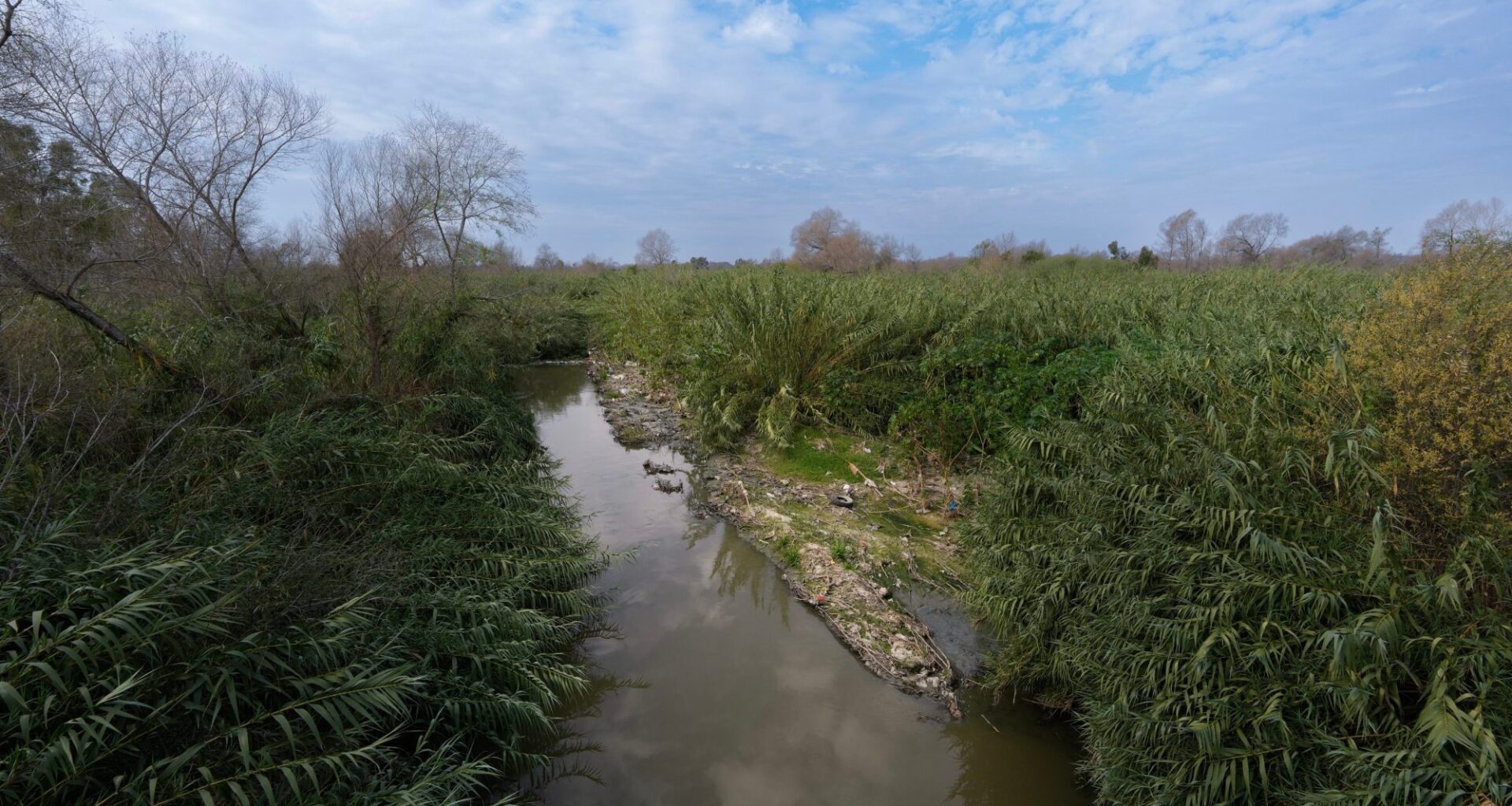
A steady stream of industrial chemicals, heavy metals and pesticides are flowing into the Tijuana River on a regular basis, according to a new water quality report from San Diego Coastkeeper, a pattern the nonprofit’s executive director says points to ongoing, unregulated discharges from manufacturing plants across the border.
“The fact that we’re finding them in the water just on a regular basis and we’re finding a range of different ones suggests that there’s a steady input of these chemicals,” said Phillip Musegaas, Coastkeeper’s executive director. “And that’s a huge cause for concern because we don’t know how long this has been going on.”
The Tijuana River Valley has been the site of a decades-long transboundary pollution crisis, driven by untreated sewage, industrial discharges and stormwater runoff crossing the U.S.-Mexico border. The pollution has caused years of beach closures in Imperial Beach and closures as far north as Coronado, along with chronic public health impacts for South County residents living near the river valley.
The report, released this month, documents a year of monthly sampling at four sites in the lower Tijuana River watershed, tracking sewage contamination, heavy metals, industrial chemicals, pesticides and other pollutants flowing across the border from Mexico into the river, its estuary and the Pacific Ocean.
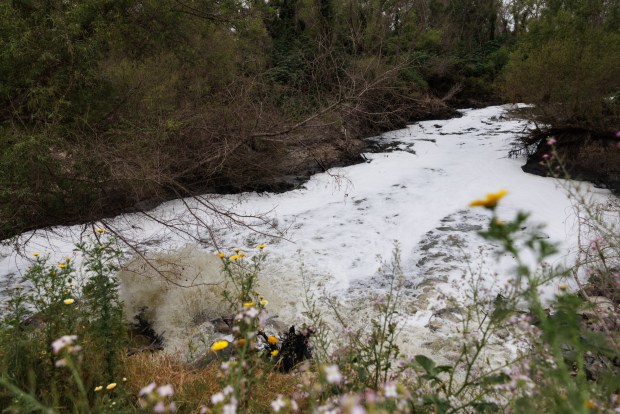 A polluted hotspot along the Tijuana River as seen from Saturn Boulevard at Imperial Beach on Tuesday, March 31, 2026. (Kristian Carreon / The San Diego Union-Tribune)
Musegaas said the sampling locations were chosen to capture different aspects of the pollution. Two sites sit along the river’s main channel — Dairy Mart Road, just after the river crosses the border, and Saturn Boulevard, where the river drops over a feature that aerosolizes sewer gases into nearby neighborhoods. Two additional sites are in canyons that flow into the valley from Mexico only during spills or heavy rain.
Samples were tested for a “baseline” of bacteria, metals, nutrients, dissolved oxygen and turbidity, consistent with Coastkeeper’s monitoring elsewhere in San Diego County. For the Tijuana River, the group also added testing for volatile and semi-volatile organic compounds, as well as permethrin pesticides.
E. coli levels at all four sites exceeded the laboratory’s measurable range for most of the year, according to the report. Dissolved oxygen levels were frequently below thresholds needed to sustain aquatic life, particularly in summer months. No organochlorine pesticides were detected, but pyrethroid pesticides, including cypermethrin and permethrin, exceeded toxicity thresholds when found.
Musegaas said each sampling event typically turned up 10 to 20 different industrial chemicals, though not always the same ones or at the same locations. He said the chemicals can only be tied to industrial manufacturing, not domestic sewage or general runoff.
“That’s really the only place these things can come from,” Musegaas said, adding that Coastkeeper suspects maquiladoras operating in Tijuana are not well regulated.
“Who is operating these maquiladoras, which companies, what are they manufacturing?” he said, describing plans to identify specific industries tied to detected chemicals and press companies to explain their water treatment practices without leveling direct accusations.
The report calls for enforcement action against industrial polluters in Tijuana, accelerated expansion of the South Bay treatment plant, binational investment in wastewater recycling, and improved trash and sediment controls to protect the estuary. Coastkeeper is seeking funding to extend its monitoring program through 2027.
In December 2025, the U.S. and Mexico signed Minute 333, a binational agreement that added new operations and maintenance funding, called for a Tijuana infrastructure master plan, and included a feasibility study to expand the San Antonio de los Buenos wastewater treatment plant from 18.26 million gallons per day to 43.37 million gallons per day.
Asked whether the findings shift the focus of proposed solutions beyond sewage treatment, Musegaas said sewage remains the most urgent issue but that industrial pollution now needs attention as well.
“The report still confirms our concerns, and the community’s concerns, that the Tijuana River is unfortunately an open sewer,” Musegaas said. “Many times of the year when it’s flowing, all of that flow is just untreated sewage.”