
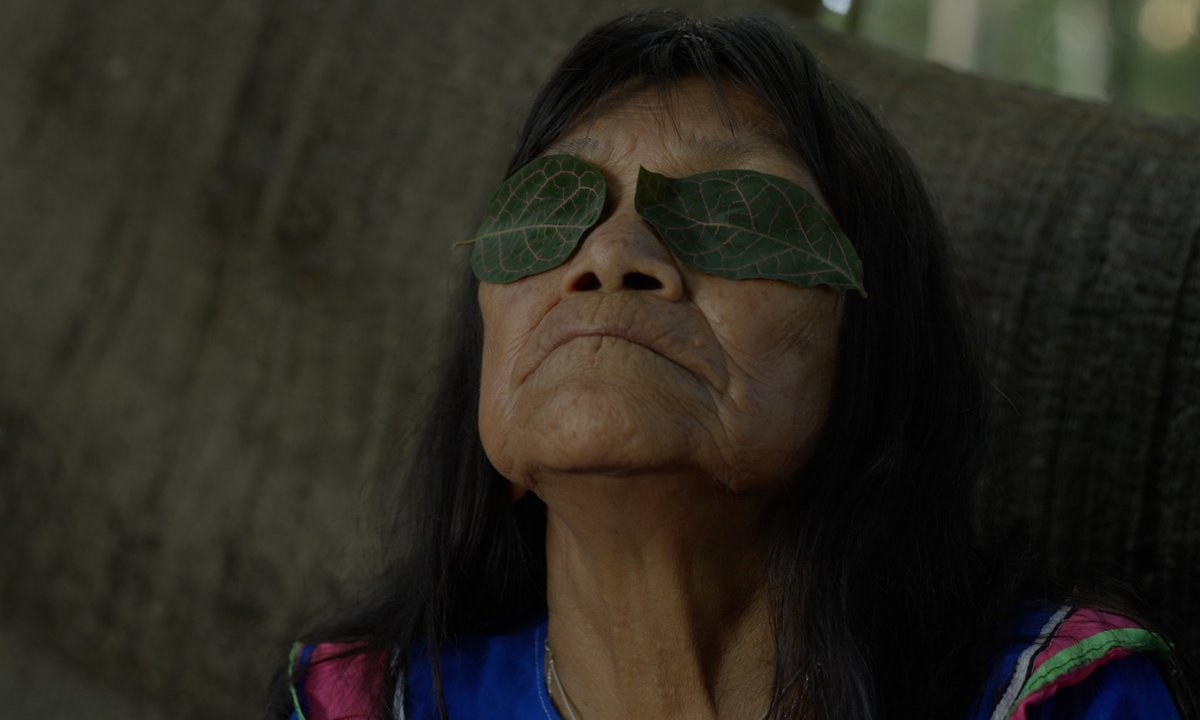
The story of The Hummingbird Paints Fragrant Songs begins, in a way, with ayahuasca. In the early 2010s, the artists Matteo Norzi and Leonor Caraballo travelled to the Peruvian Amazon territory of the Shipibo-Conibo people to participate in shamanic rituals intended to ease the terminally ill Caraballo’s passage out of life, ultimately making a film out of the experience, 2016’s Icaros: A Vision. During this time, Norzi and Caraballo became acquainted with the Shipibo-Conibo art form of kené, intricate hand-drawn geometric patterns said to be induced by ayahuasca visions, and made from natural dyes, historically including some derived from ayahuasca roots.
Norzi continued his involvement with the Shipibo-Conibo as cofounder of the Shipibo-Conibo Center, a nonprofit whose initiatives include legal assistance as well as art curation, particularly in introducing the New York art world to the leading kenéartist Sara Flores. The art word has taken to her: in recent years, in addition to frequent, lauded shows in New York and beyond, Flores has collaborated with Dior on a limited artist’s edition of their Lady Dior bag, and her work is currently featured in the Peruvian pavilion at the Venice Biennale.
That Dior collaboration is among the late-career milestones included in The Hummingbird Paints Fragrant Songs, directed by Norzi and Icaros editor Èlia Gasull Balada, a portrait of the septuagenarian Flores, her art and its roots in her community, which is now threatened by the deforestation of the Amazon. Assembled from footage shot over the last few years, The Hummingbird Paints Fragrant Songs is, on the one hand, practically structureless—it seems to end when Norzi and Balada finished filming, rather than the other way around—but on the other hand, formally uncommon among documentaries about long-overlooked artists. Foregoing talking heads, rote exposition and special pleading in favour of a vérité style, it readily fosters appreciation for an artist’s remarkable practice.
The film begins in the Amazon, with lush nature footage depicting Flores in nature, paddling out into the jungle with a machete and hacking away at the yacushapana bark that will be boiled down into brown dye. Closeups of green leaves veined in hot pink, spiderwebs and the spiky stalks of jungle plants mirror the honeycomb patterns scored by Flores into her raw cotton canvas.
Flores works with her daughters and granddaughters—though she was the first kenéartist to sign her work, beginning in the 1970s, on the advice of a visiting anthropologist, the matrilineal handing-down of the tradition effectively means it is created in a model similar to a workshop. She draws the shapes freehand, expanding outward from the initial marks to create fractalised repeated shapes, like the branching of a tree, even down to the leaves shaded green with pigment extracted from leaves. In folk-art terms, the effect is similar in its organic fastidiousness to mandalas, or to henna or Māori tattooing; or, in Modernist terms, it resembles a cross between an Agnes Martin grid painting and William Morris wallpaper, or perhaps as if Piet Mondrian had been obsessed with the rainforest canopy instead of city streets.
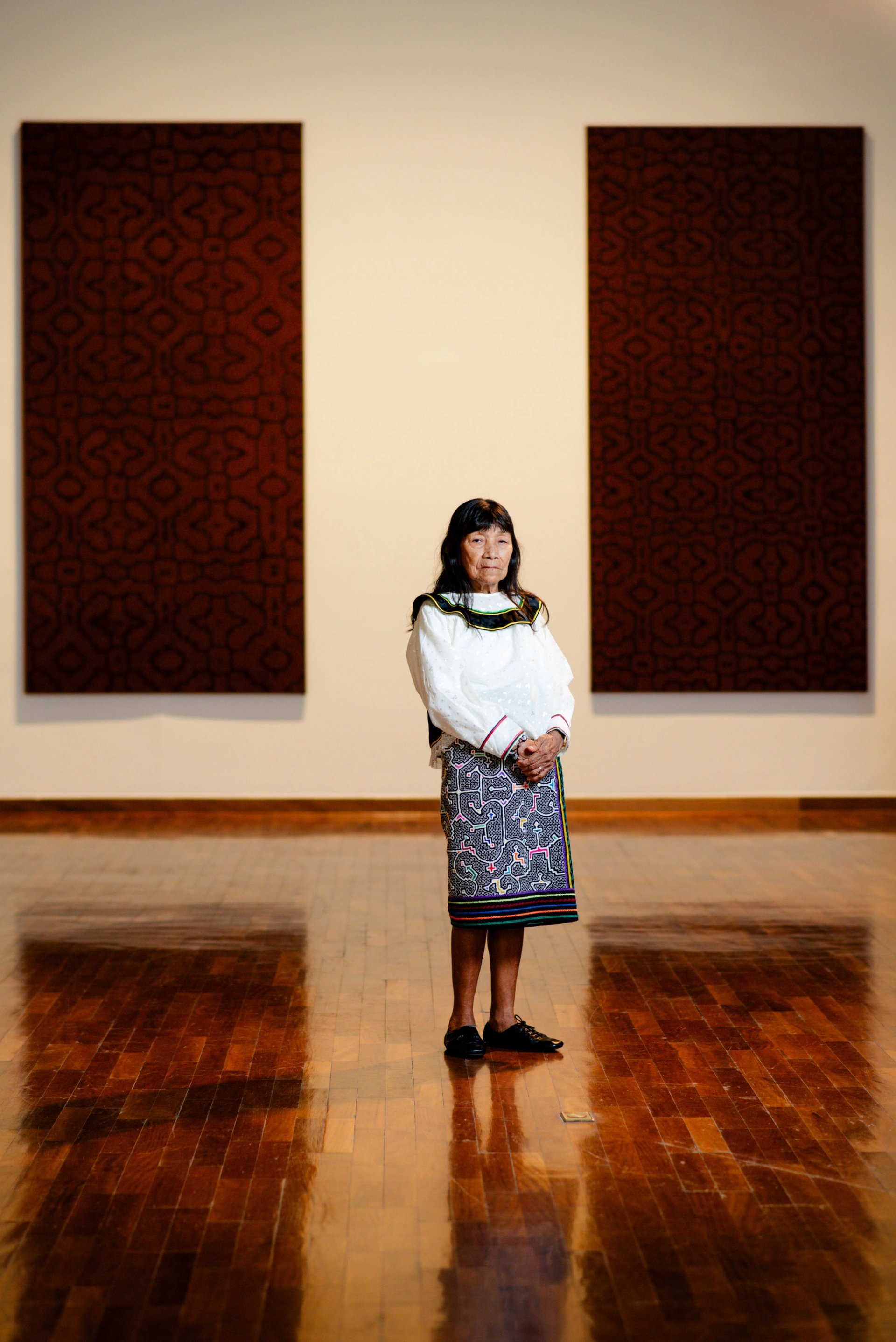
Sara Flores © 2025 Prin Rodriguez, courtesy the Shipibo-Conibo Center
Flores is kené’s ambassador abroad. The film follows her to a number of shows, including at New York’s Clearing in 2023; at White Cube (which now represents her, thanks in part to Norzi’s connections) in London in 2025; and in Paris. She says she is more appreciated abroad than at home in Peru, where her eventual retrospective at Lima’s Museo de Arte—the institution’s first-ever solo exhibition dedicated to an Indigenous artist—forms something close to a climax for the film. The directors pointedly juxtapose kenécanvases with art from the museum’s permanent collection depicting conquest and Christian conversion.
The film somewhat overindexes its New York scenes (the Shipibo-Conibo Center is New York-based). There are only so many times that the filmmakers can depict Flores wandering forlornly at a glamorous art opening, contemplating the canapés or observing the celebrities at Dior’s 2024 runaway show at the Brooklyn Museum, followed by a hard cut back to the Amazon.
In fact, Flores in the film says that she loves to travel, and she enjoys the spoils of her late-in-life fame. Her work takes her away from home—several scenes show Flores in a hotel room, FaceTiming her family and her beloved pet tamarin—but her global visibility is, she makes clear, necessary and political. Proceeds from sales of her work go to her family and to organisations working toward Indigenous self-governance, and throughout the film she is shown accompanying and supporting the Indigenous guards who patrol the Amazon to protect it from settlers and illegal lumber operations destroying the Shipibo-Conibo habitat.
The film demonstrates a common dilemma of the folk artist: the aesthetic tradition practiced by Flores is canonised, even as the way of life from which it is inseparable faces erasure. And to this, there is added another complication: Flores, afflicted with cramping hands and other assorted frailties and indignities of aging, now struggles with the minute details of kené, endangering her work in another way. It is sad to consider, but also moving confirmation of her work’s connection to both the physical body and natural world.
The Hummingbird Paints Fragrant Songs had its world premiere on 12 September at the Toronto International Film Festival and plays again on 19 September