
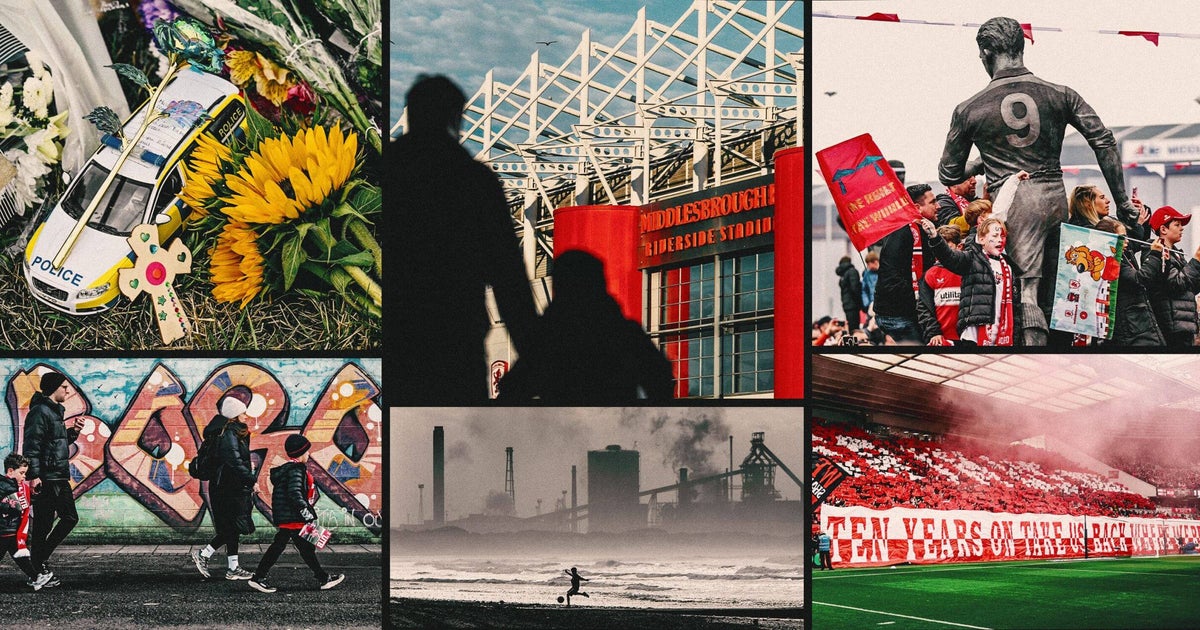
Five o’clock Saturday, the Riverside Stadium and Middlesbrough head coach Kim Hellberg is fist-pumping a half-bewildered but fully enthused home crowd. A helter-skelter 4-3 win against Norwich City has been secured in added time. In the directors’ box, owner-chairman Steve Gibson blows out his cheeks while a euphoric stadium falls over itself with happiness and relief. This really mattered.
Hellberg’s personal animation continues into his post-match media commitments, where he swears joyously in one and calls himself “radge” in another. Radge is a north-east term encapsulating wildness of emotion and behaviour.
Hellberg is an outsider, a Swede who has lived on Teesside less than a year. But he talks about having been a fan himself and, therefore, understanding all the more what a football club can come to mean.
This has not been an easy fortnight for Middlesbrough and the wider Teesside area.
Seven people, including two police officers, were killed in a devastating early-morning car crash a mile from the Riverside on the A66, a major road through the region, on August 22. Four days later, a mother and daughter died in a suspected arson attack — a man has been charged with murder.
Drug-dealing, drug-taking and turf wars are said to be behind rising crime. Twenty-six arrests followed, then a national spotlight zoomed in on criminality and worklessness in the town. It was labelled lawless as footage of anti-social teenagers flooded onto television and mobile screens, and grim statistics flowed confirming Teesside’s poverty relative to the rest of England, and how it has the highest crime rate outside London.
Despite this, as Victoria Fuller, head of Cleveland Police, pointed out, the local force receives £139million ($187m) less funding than, for example, its counterpart in Surrey, south of London, despite a comparable population. Fuller’s force’s budget leads to fewer officers and inevitable consequences. Fuller made pertinent remarks about perception and reputation. “When we talk a place down,” Fuller told The Times newspaper, “all it does is embolden the minority of thugs who want to do this place harm.”
Teesside has long experience of being talked down. The place once stood for steel, iron, coal — industry. Over 40 years, that status has disappeared with the industries themselves. Teesside instead saw itself as half-forgotten by the UK government, then the butt of jokes and disparaging coverage. Recent events only reinforced an impression of a beaten, wild area. But as a name with national recognition, what has endured is Middlesbrough FC.
There was a palpable sense on Saturday that, but for their late winner against Norwich, the mood across the region would have plummeted. It can sound overblown, but what you saw with Ashley Phillips’ 91st-minute goal was just how much Teesside hope, self-esteem and identity are invested in its football club.
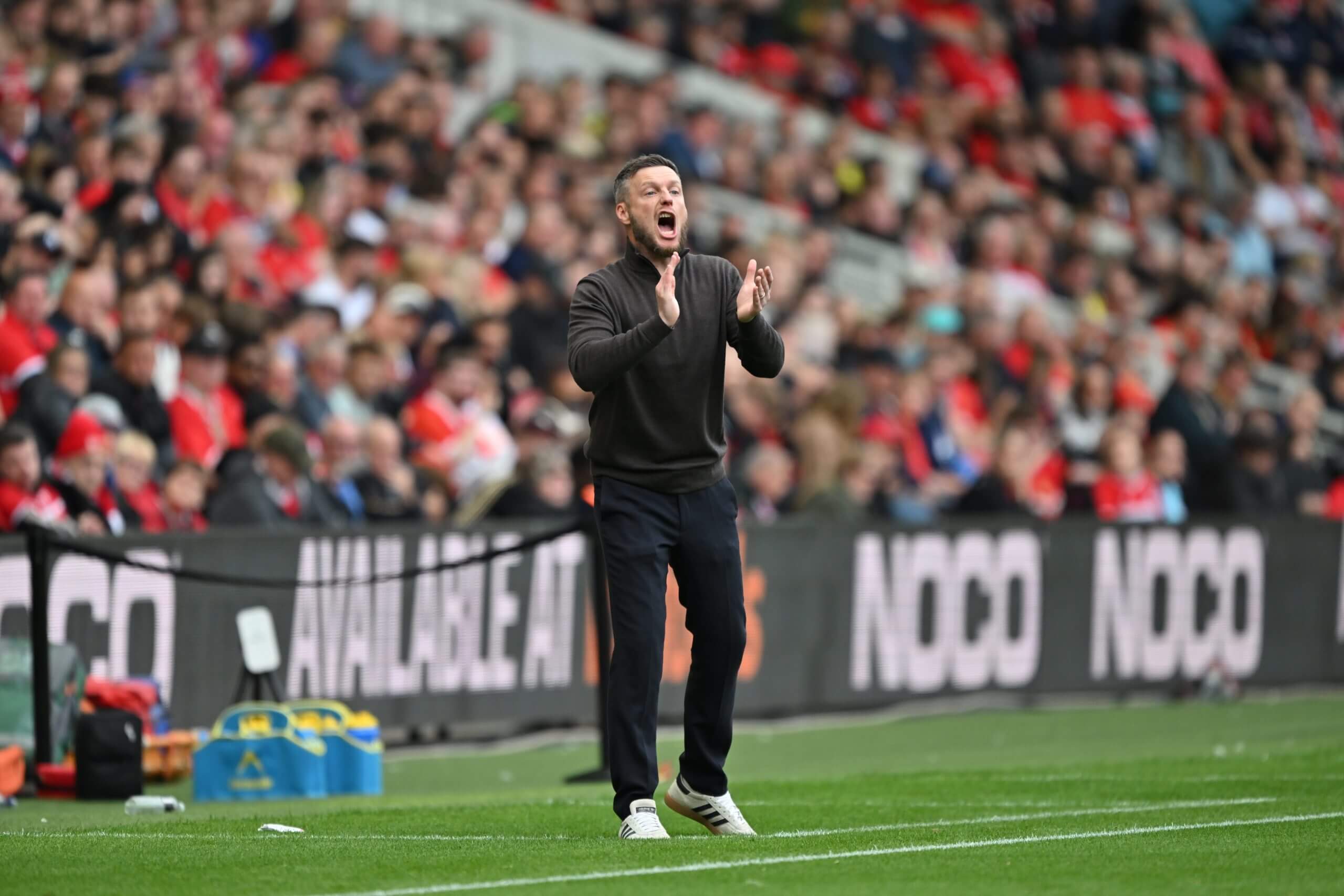
Kim Hellberg, an adopted Teessider, recognises how much Middlesbrough is invested in its football club (Bruce Rollinson/PA Images via Getty Images)
Hellberg applauding supporters is a given, but he could sense it.
“I get the feeling every day how much it means,” he says. “I cannot go out my door without someone saying, ‘Up the Boro’. I can’t go to the supermarket without someone saying, ‘Up the Boro’. It’s everywhere. You don’t have to come here (to the stadium) to see how much it means to the people.
“At the training ground, everyone from the chefs to the groundsman — everyone — shows how much they care, how much they want us to win. … Football is everything here.”
There are no claims that football means more on Teesside, just that, at a time like this, its presence is enhanced.
Middlesbrough are back at the Riverside tonight. They face Millwall. Win and they will go top of the Championship.
Four hours earlier, fans exiting the train station the back way are supping pints and chatting in the sunshine of Bridge Street East. This is old Middlesbrough, red-brick Middlesbrough. Along a low wall, white lettering spells out ‘Ironopolis’.
One hundred yards away on the Cleveland Buildings a blue plaque commemorates the two men who effectively began Teesside as we know it, Henry Bolckow and John Vaughan. In 1860, 10 years after they had discovered iron ore in the nearby Eston Hills, there were 20,000 people in Middlesbrough and the first blast furnaces had been opened; in 1900, the population was 90,000 and there were over six-dozen furnaces. Iron, steel, coal; Middlesbrough had minerals.
Teesside was a start-up. In 1862, future prime minister William Gladstone hailed both Middlesbrough’s newness and productivity, calling it “the youngest child of England’s enterprise … an infant, but an infant Hercules”.
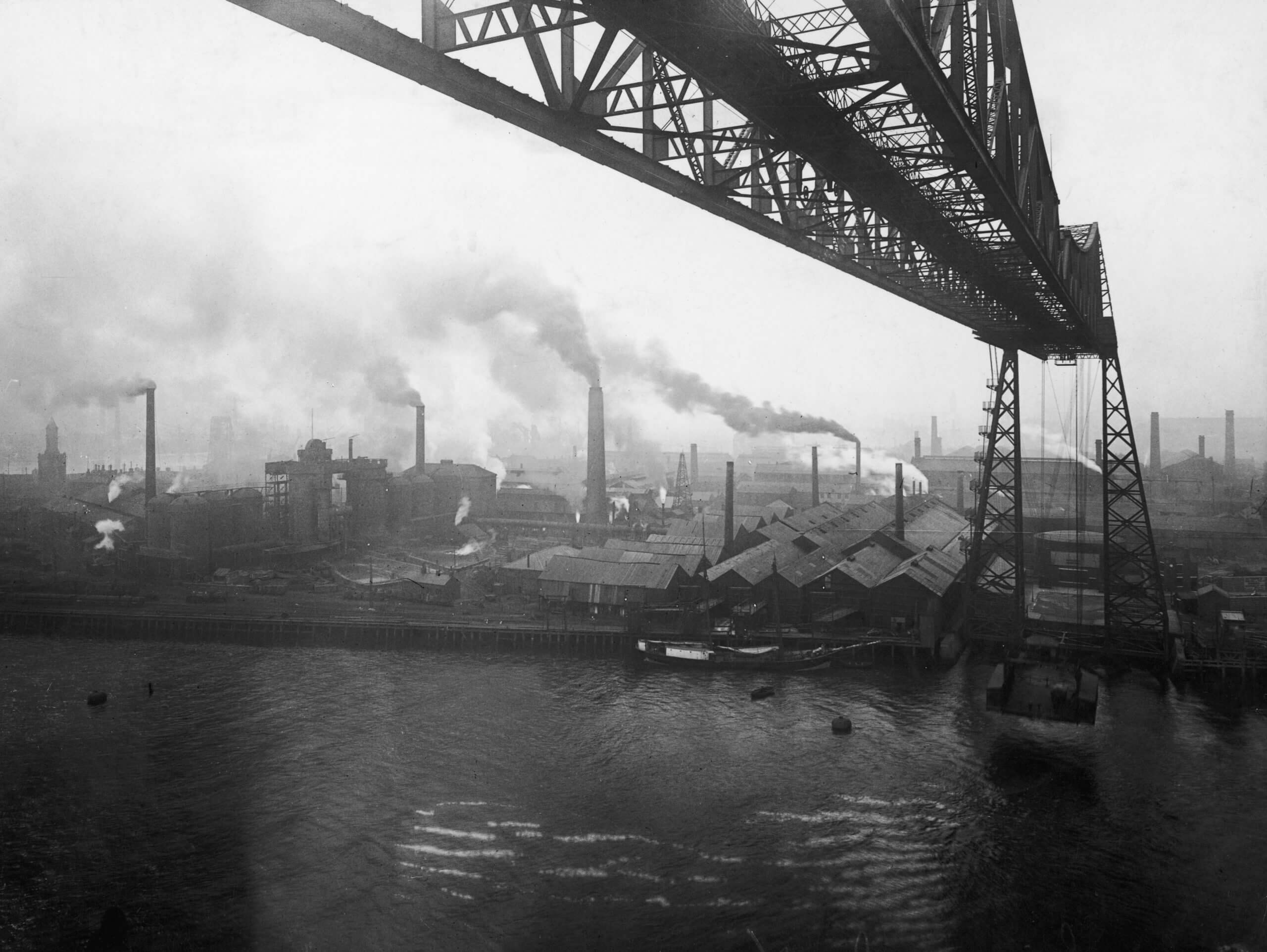
Blast furnaces near the River Tees in 1912 (Topical Press Agency/Hulton Archive/Getty Images)
When, in 1963, the distinguished historian Asa Briggs wrote ‘Victorian Cities’, he selected five in England — London, Manchester, Birmingham, Leeds and Middlesbrough.
Briggs did not mention football’s role in this new society, but he could have. Middlesbrough were formed in 1876 — the 150th anniversary is next month — and in 1905 broke the world transfer record to sign Alf Common from Sunderland. Common was the first £1,000 player.
Football bit deep on the banks of the River Tees, so that in 1951 the huge-selling Picture Post — the British equivalent of Life magazine — carried a feature on the relationship between Middlesbrough’s workforce and its footballers. The headline was: ‘The team’s fate is the town’s first concern’.
It was an exaggeration, but a reflection of feeling. Football, it said, is “the town’s passion, religion, staple diet”.
For good and bad, football and industry are intertwined. Protesting steelworkers walked around the Riverside pitch in 2015, torches lit on their mobile phones. Generations earlier, arguably Middlesbrough’s greatest-ever player, Wilf Mannion, a player Stanley Matthews called “Mozart”, ended up taking a job in a local chemical works, earning buttons.
When, in January this year, Cleveland Police announced — alarmingly — “a significant firearms haul” in the Grangetown area, anyone familiar with Middlesbrough will have noted the name in the news report: Mannion Park.
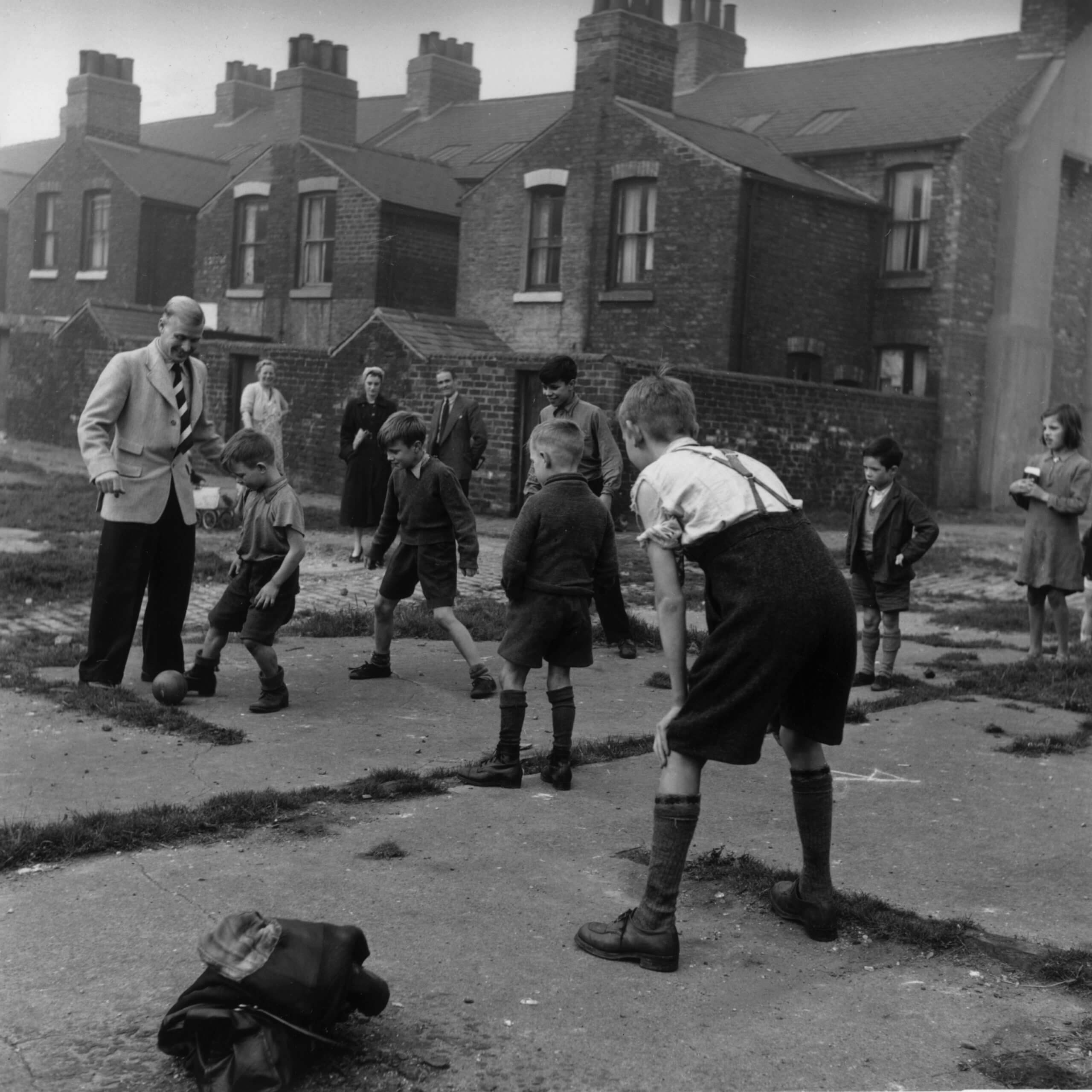
Wilf Mannion joins a group of youngsters to play football in the street in November 1951 (George Douglas/Picture Post/Hulton Archive/Getty Images)
Sporting nourishment from the staple diet has come and gone. Middlesbrough have never been champions of England — they finished third in 1913-14 at the outbreak of the First World War and were fourth in 1938-39 before the start of the Second World War. The club almost folded in the recession-hit 1980s, but in the Premier League era they finished seventh in 2004-05 under Steve McClaren and reached four domestic cup finals between 1997 and 2004, when they won the League Cup. In 2006, Middlesbrough made the UEFA Cup final (today’s Europa League), losing to Sevilla.
There has been no Premier League football for a decade, though, and there was an underwhelming Championship play-off final defeat by Hull City in May.
Still, they come.
Just after 1pm, John, 54, is standing across from the Ironopolis lettering. “We built this world,” it continues. “Every metropolis came from Ironopolis.”
Waymarkers to the Riverside show it was Teesside steel which formed the Sydney Harbour Bridge, the Victoria Falls Bridge in modern Zimbabwe, the railways across the American prairies and much else. Middlesbrough’s “municipal patriotism”, as Prince Albert dubbed it, coiled itself around the globe. Industrial Middlesbrough had a reason to be.
John considers ‘Ironopolis’ and asks: “What is Middlesbrough’s identity now? Who knows? Middlesbrough is famous for steelworks, but they’ve all gone. A lot of my generation moved out, moved on.”
John grew up in nearby Saltburn, played in the amateur leagues and left to find work in 1990. He has made the long journey from Portsmouth, on England’s south coast, to watch the Norwich game. He is part of a large Teesside diaspora, or ‘Diasboro’, the name of one fan forum.
“I worry about my friends and their families who still live here,” he says. “You have to be tough here, hard. ‘Brush it off’. But sometimes you can’t control things around you.”
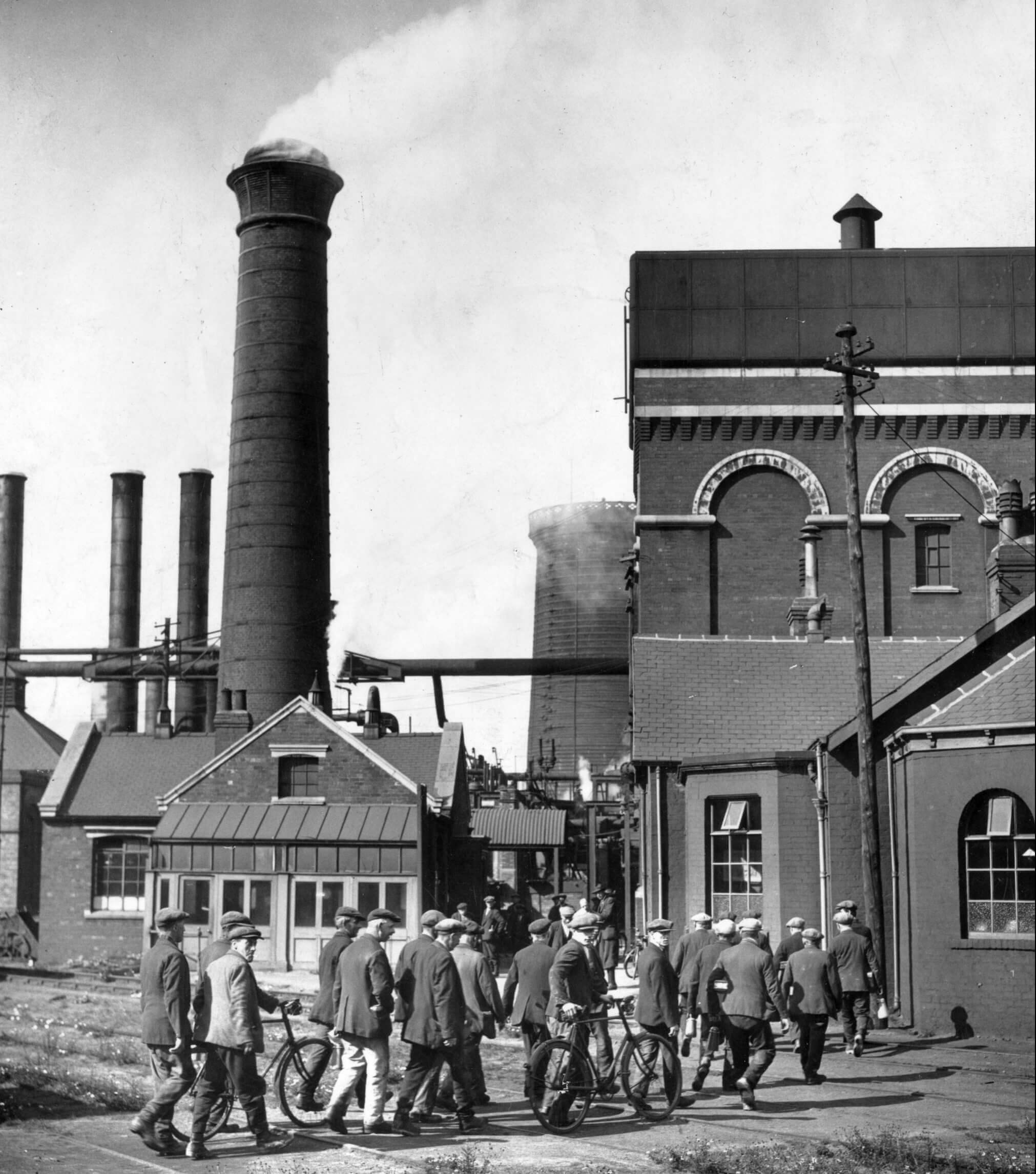
Workers arrive at a Middlesbrough steelworks in 1961 (Fox Photos/Getty Images)
Beside John are three twenty-somethings: Harry 25, Lewis 24 and Cainan, 28. They are all local and all in work, in oil and gas, engineering and law — examples of a less-discussed Teesside. And they are its future.
“Obviously we have a lot of eyes on us,” Lewis says. “Unemployment and a lack of work is not just a Teesside issue, it’s happening everywhere, all over the north of England. But when I work with people from outside the area and they ask where you’re from and you say ‘Middlesbrough’, you can see what people think.”
“The town does struggle,” Cainan says. “It has its problems. But emigrating or going to a big city, if everyone does that, then the area doesn’t have a chance to regenerate.
“Sometimes things like what’s happened in the last couple of weeks shine a light on how underfunded and misrepresented areas like this are.”
They are all adamant that Boro are the “town’s heartbeat” and affects its atmosphere. “Ironopolis and the steelworks used to represent Middlesbrough,” says Harry, “now at the forefront is the football club.”
Thursday night, Middlesbrough Town Hall.
They are known as the ‘Class of 86’, the players who led Boro out of their worst days. At the start of the 1986-87 season, a combination of previous boardroom incompetence and broader economics saw Middlesbrough not just in the Third Division, but with their ground, Ayresome Park, padlocked.
While solutions were sought, Middlesbrough had to play their season opener up the road at Hartlepool United’s Victoria Park — after Hartlepool had played their opening fixture. Boro met Port Vale, drew 2-2 and then Gibson, who was 28, was part of a takeover. By the end of the season, they were promoted, and then went up again the next year.
The Class of 86 are on stage to recount tales and to raise funds. One of their team, Gary Parkinson, had a stroke in 2010 and has suffered from locked-in syndrome ever since. He needs 24-hour care. His team-mates are here to help, as are around 300 fans.
The warmth in the room is clear. A video is played retelling the story of 1986 and the famous padlock on the Ayresome gates, which now stand outside the Riverside, their home since 1995, on the bank of the Tees. The footage is remarkable and features workers at Smith’s Dock fearing its closure, which came in 1987.
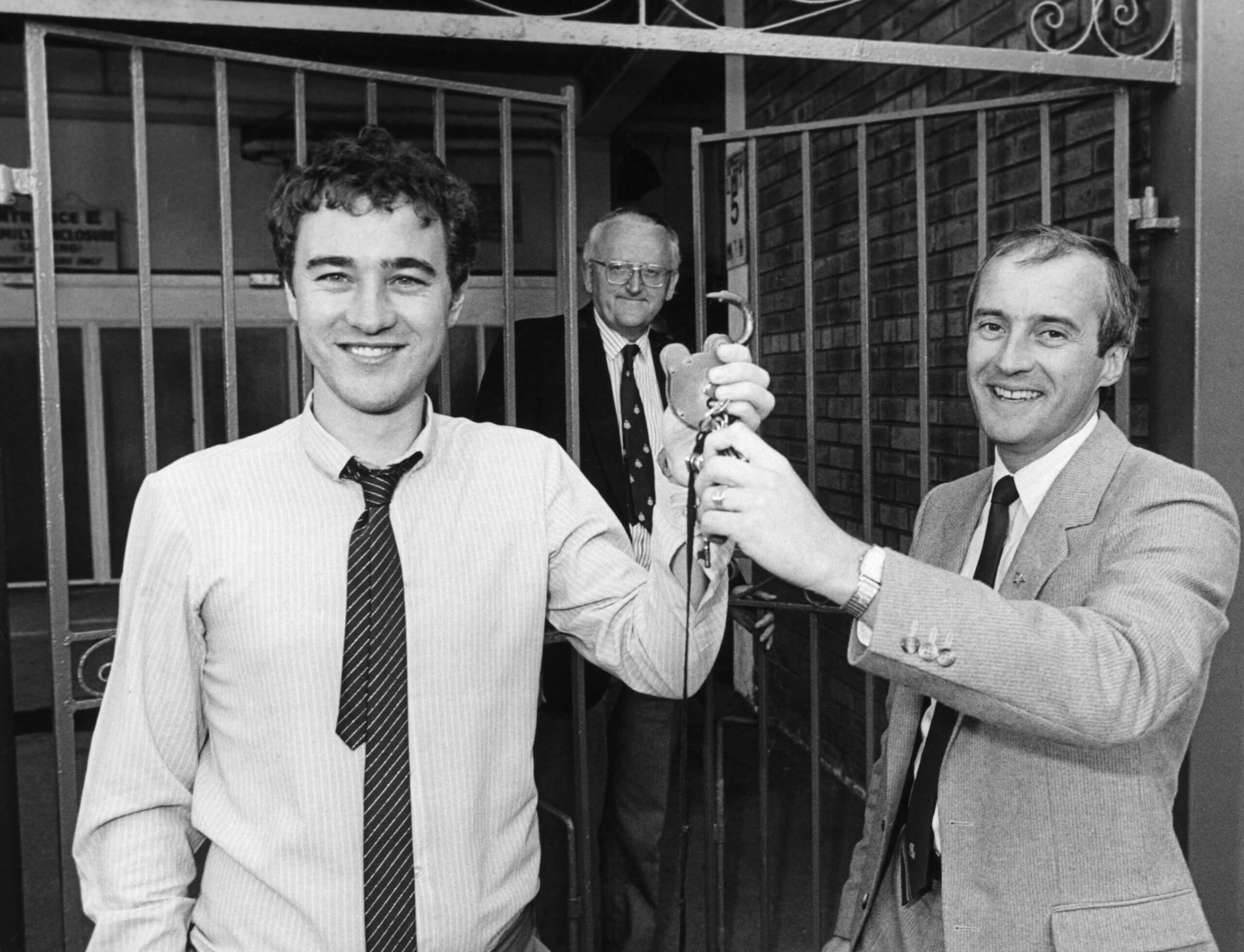
Middlesbrough chairman Steve Gibson (left) celebrates as the padlocks come off Ayresome Park’s gates in August 1986 (Teesside Archive/Mirrorpix/Getty Images)
Gibson looks about 14 but speaks with the forthright manner we have become accustomed to over the intervening years. Another there to help says Middlesbrough without football would be “like a wedding without a bride”.
Gary Hamilton, a goalscorer, has travelled from the United States. He talks football but also says he has seen coverage of the recent trouble — “We’ve got a lot going on here”.
Colin Cooper, who went on to play for England, speaks of the relationship between town and club: “Did we feel the town with us? One hundred per cent.”
They were so young. Bruce Rioch was the manager and Tony Mowbray captain. Mowbray is also here, sitting beside Gary Pallister, who also went on to play for England, as did Stuart Ripley.
Mowbray has embarked on a five-hour round trip from coaching Blackburn Rovers to be present and later tells The Athletic about the Teesside he knew as a boy. The word he repeats is “thriving”.
Mowbray grew up on the Lakes Estate. His father was a foreman in the steelworks. “An honest, hard-working, industrial man,” he says. “Sometimes, he’d take me in. I’d see the blast furnace where the smelting was done and the sparks were flying, molten steel spitting. It was unbelievable, this environment. There were three or four cabins jam-packed with 60 or so men in each, big toolbelts on. It was men grafting.
“They had standards, my dad had standards. He had total respect for the elderly, for women. Other men had respect for him.
“I could feel this thriving environment, the bustling industry, not just in Middlesbrough but in Redcar, Dormanstown, Stockton, all parts of Teesside, working either on the docks or in the steelworks. You could feel the town was buzzing. It felt alive. The nightclub scene was amazing as a young lad.
“Now I hear stories that it’s not that way, of how society’s changed.”
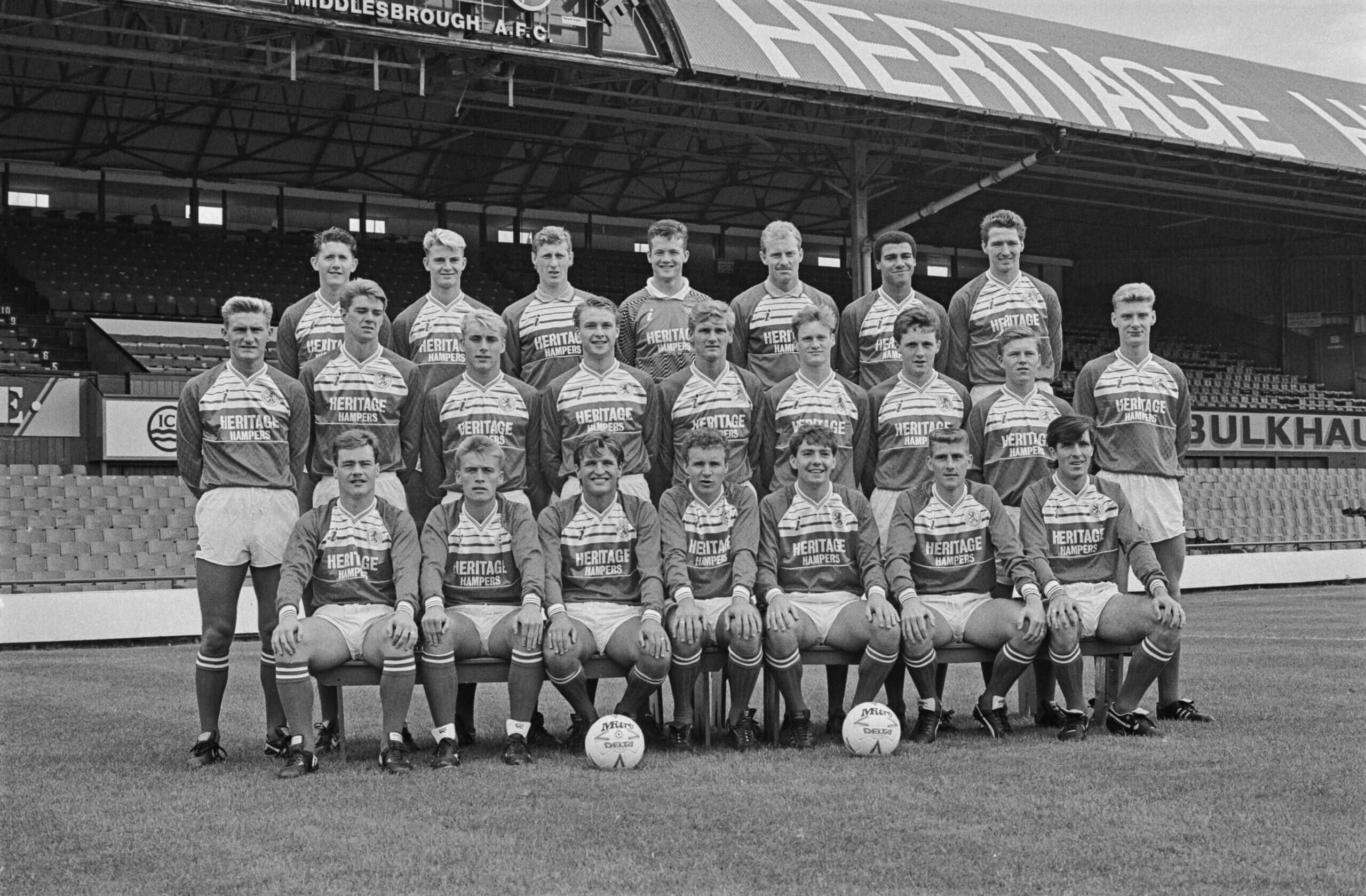
The Middlesbrough squad ahead of their top-flight return in 1988-89, with Tony Mowbray standing furthest on the left (Stu Forster/Hulton Archive)
The Town Hall they are in was opened in 1889 by the Prince and Princess of Wales (later King Edward VII and Queen Alexandra). The prince remarked he had expected to find “a smoky town”, an outsider opinion that morphed into cliche. Middlesbrough’s mayor replied that smoke was a source of pride — “An indication of plenty of work.”
This was an early version of “Smoggies”, a nickname given to the football team by other fans. It is the view that the fiery, chemical plant skyline is somehow gruesome and reveals a lack of knowledge about heavy industry. It, too, can be inspiring. Hollywood film director Ridley Scott grew up in Stockton, and Teesside imagery found its way into his film Blade Runner.
But the Teesside Scott knew has changed. Middlesbrough is not alone in that, but walking to the Town Hall, the streets were ghost-town empty. Closed-down shops are everywhere on UK high streets, but here the main drag, Linthorpe Road, lost its Debenhams department store in 2021, the House of Fraser one the following later and Marks and Spencer in 2023. Vacated buildings, shut-down pubs, the absence of people, it is eerie.
Then again, these have been sombre days. Nine deaths bring nine funerals and the front pages of the two local newspapers, the Middlesbrough Gazette and the Northern Echo, both carry pictures of the previous day’s ceremony for PC Matthew Blades in nearby Hartlepool. Blades was a junior football coach at Seaton Carew. His colleague PC Tom Clough was buried 24 hours later.
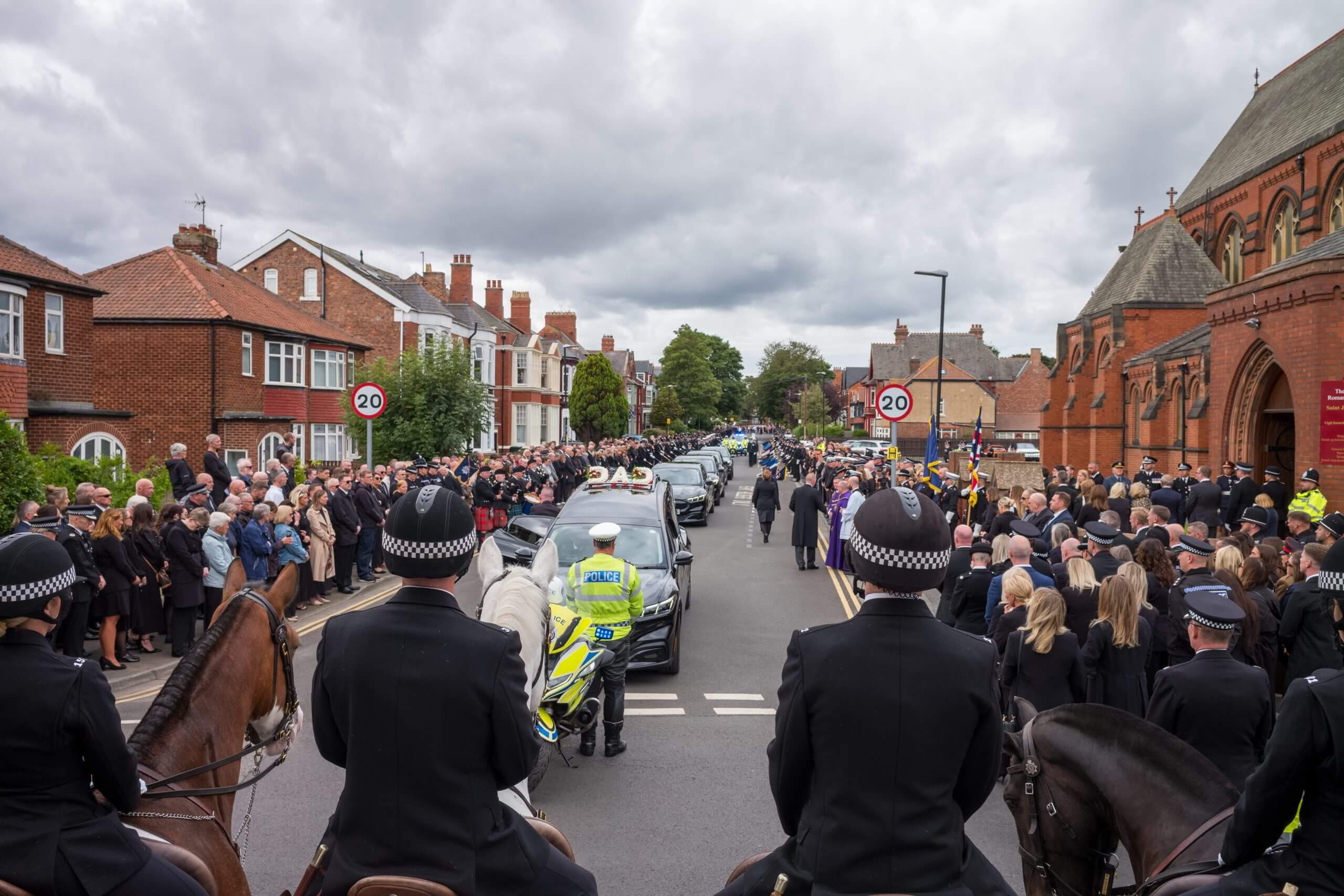
The funeral service for PC Matthew Blades in Hartlepool (Ian Forsyth/Getty Images)
It feels bleak. There is also a level of intimidation — The Athletic encountered a reluctance from individuals and organisations to speak on the record.
Thankfully it was different in the Town Hall. Mowbray praises Gibson’s commitment “to keep the club competitive and prominent” across decades and calls him “iconic”.
And then Mowbray relates some personal evidence of what has not changed — Middlesbrough’s attachment to football.
“I’ve lived the last two months in Blackburn, because of my job,” he says, “but I still go home, still walk the dog, still kick a ball on the beach. And I get stopped 20 times in an hour. I don’t say this with any vanity, I’m not important, but I can’t go out without people wanting to talk to me about football and ‘the Boro’. Everybody wants to talk about the Boro.
“I’m emotional about the story of Middlesbrough because I lived it. I know football is still burning in the people’s hearts.”
Sunday morning, Ormesby Road, inner Middlesbrough. This is in the TS3 postal district, not far from the scene of the car crash and the Riverside. Football cannot be expected to answer societal ills, but this is the sort of area in which the club’s foundation does its invaluable outreach work, a place touched by those statistics about deprivation and crime.
But there are other statistics. The Teesside Junior Football Alliance (TJFA) is one of the largest junior football leagues in Europe. Some have said it is the largest.
North Ormesby FC is one of 108 member clubs, ranging from Whitby in the south to Durham in the north, with the vast majority concentrated on Teesside. Participation numbers hit 10,000 in 2019. Now it’s at 16,000. TJFA secretary Kevin Close supervises the organisation of 550 games on a Sunday.
“It’s the younger age groups driving it,” Close says. “We have 13 divisions for under-nines, -10s and -11s. That’s just in the Sunday boys’ league.
“The facilities at Kader and Marton, to name a couple, are excellent. It’s not just little huts and a few straggly pitches any more. Playing surfaces are top quality. So are changing rooms. There’s cafes. The decline of the youth club has been kind of offset by the rise in these facilities, kind of.”
North Ormesby have approximately 300 registered players, boys and girls, run 18 teams ranging from ages seven to 18, plus a senior men’s side. There is zero tension in the air. The club feels welcoming and inclusive, reliant on volunteers giving their time and energy. And it is effective — they recently supplied Cruz Ibeh, a 17-year-old striker, for Middlesbrough’s first-team squad.
On Saturday, the club were part of the half-time entertainment at the Riverside, youngsters taking penalty kicks. On Sunday, Middlesbrough had 15 scouts out in the league, looking for pre-academy age talent.
Another overlap, a sad one, is that PC Blades should have been coaching in the TJFA on Sunday and the two youngest killed in the A66 crash, Theo Rae and Cole Worthy, both 17, were players in it in the past five years.
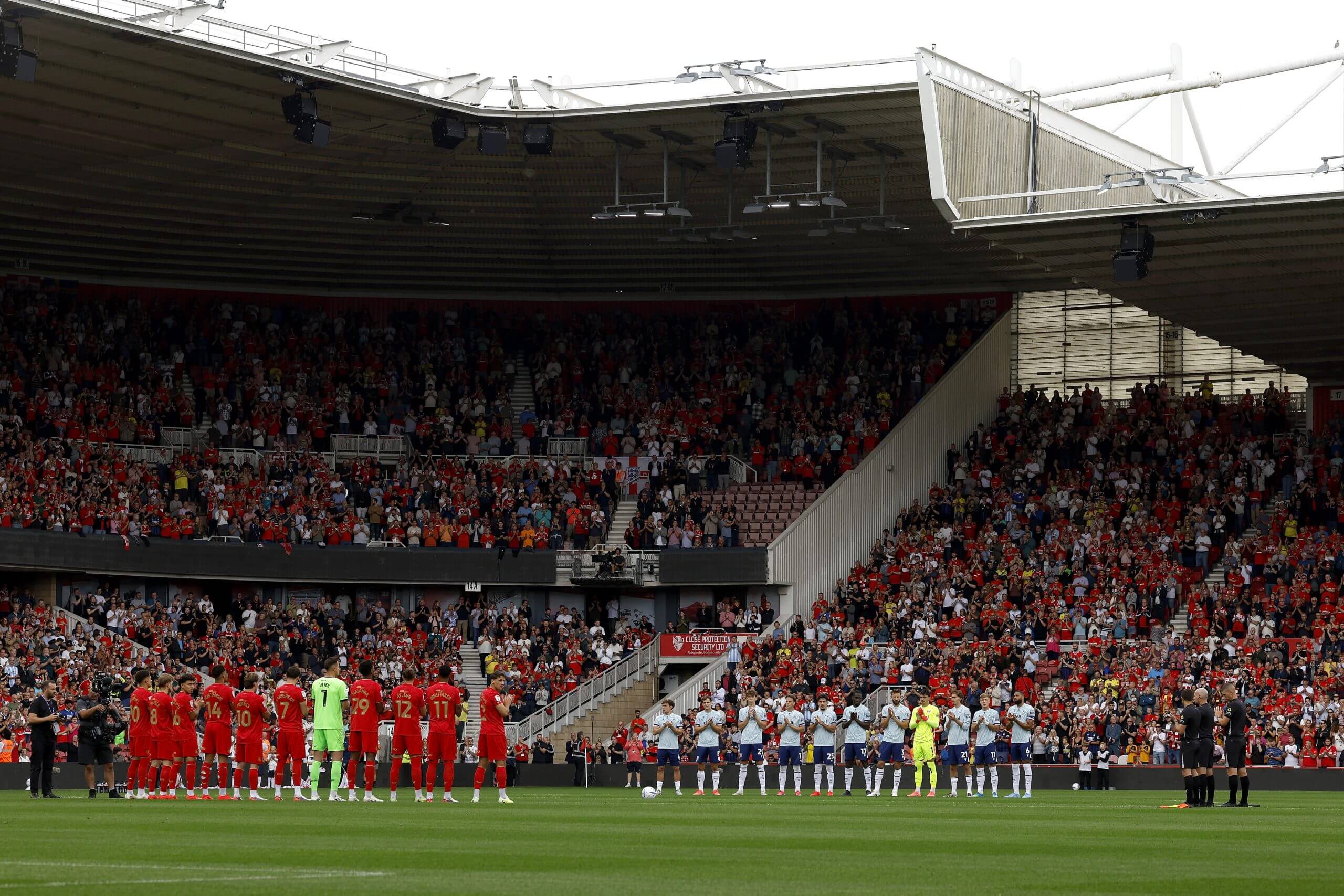
A minute’s applause is held for the victims of the A66 car crash ahead of Middlesbrough’s kick-off against West Brom last month (Adam Fradgley/West Bromwich Albion FC via Getty Images)
Police chief Fuller is correct — talking down a place can be self-fulfilling. Teesside has had more than its share of condescension. The TJFA offers one different picture.
The game is essential to Teesside culture, a fact of Middlesbrough life.
“Football can bring people together,” Close says. “That’s what it does.”