
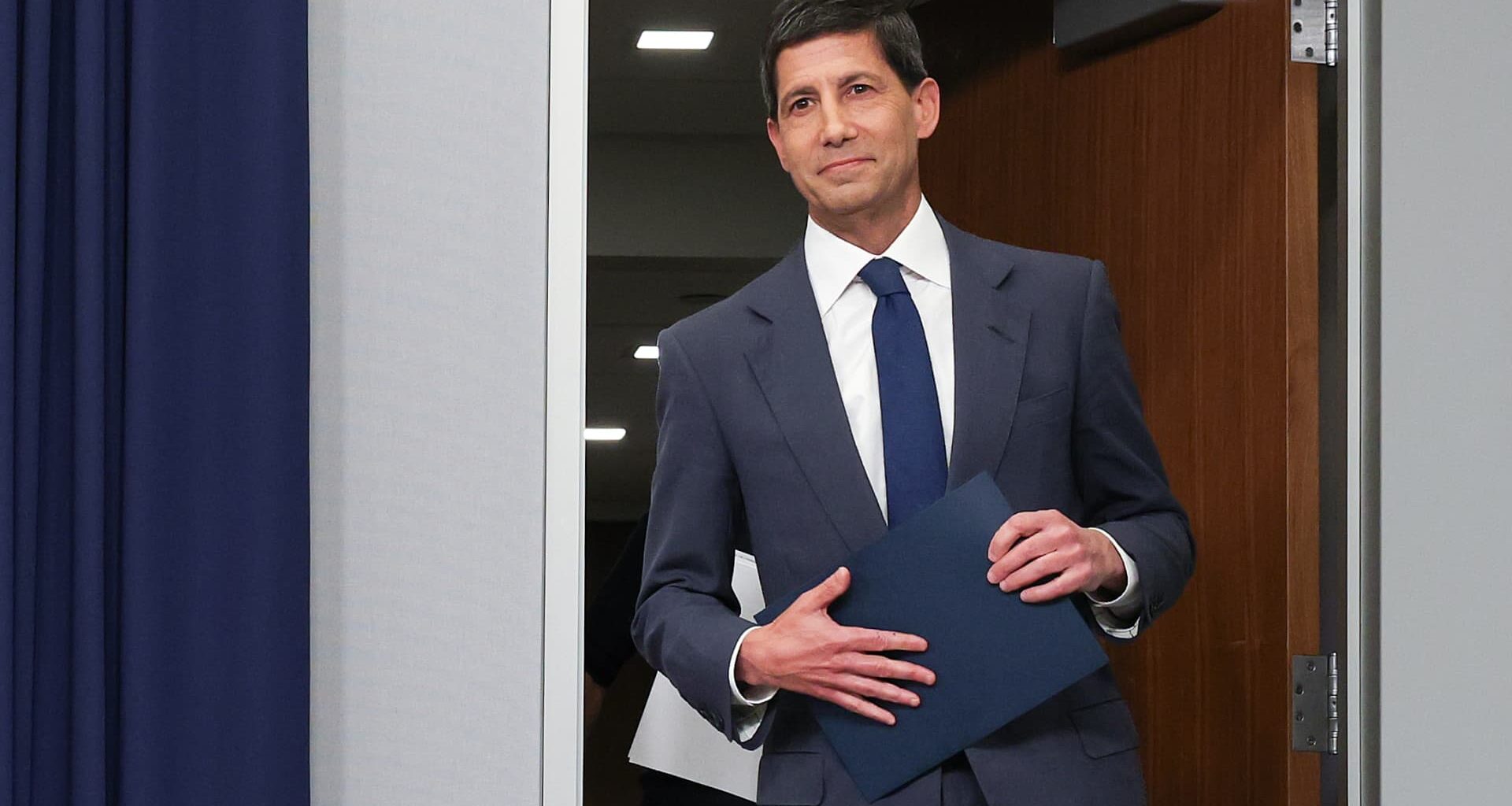
Fed sees another hike as inflation rises slightly by year end
The Federal Reserve’s latest projections pointed to inflation moving slightly higher this year.
Its median projection now calls for core personal consumption expenditures inflation of 3.4% by the end of 2026, up from the 3.3% projection at its June meeting. The latest core PCE index reading in July showed it rose 3.3% annually.
The FOMC members see one more hike this year after Wednesday’s move to end at the median rate of 4.1%. Some 12 members indicated another increase, while four anticipate two more hikes this year. Two signaled that rates should stay at the current levels. Chairman Warsh withheld his rate forecast, as he did during the June release of projections.
— Michelle Fox
How a Fed rate increase could affect your finances
The Fed’s decision to raise its benchmark rate will affect a broad range of consumer borrowing and savings costs, including mortgages, credit cards, auto loans and deposit rates.
In general, this quarter-point increase could make it more expensive to carry credit card debt, finance a new car purchase and access some home loans. On the flipside, interest rates on savings accounts may move higher.
“A rate hike is great news for savers, but it stinks for borrowers. It means that you’ll get better returns on high-yield savings accounts and CDs, but you’ll also see higher interest rates on your credit cards,” said Matt Schulz, LendingTree’s chief consumer finance analyst.
— Jessica Dickler
Where markets stand after the Fed’s rate decision
A television broadcasts the Federal Reserve’s decision to raise rates after a Federal Open Market Committee (FOMC) meeting as traders work on the floor of the New York Stock Exchange (NYSE) in New York, US, on Wednesday, Sept. 16, 2026.
Michael Nagle | Bloomberg | Getty Images
The S&P 500 and the Nasdaq Composite remained in positive territory after the Fed announced a quarter percentage point hike on Wednesday afternoon.
The broad market index was last up 0.4% on the day, while the Nasdaq was up 0.8%. The Dow Industrials were little changed in the session, hovering near the flat line.
The 10-year Treasury yield pulled back and was last down almost 5 basis points at 4.947%.
–Darla Mercado
Federal Reserve hikes rates by a quarter percentage point Possible Fed hike would reinforce central bank’s credibility, DuBravac said
The Federal Open Market Committee’s decision to raise rates would reinforce the Fed’s credibility, said Shawn DuBravac, a chief economist at the Global Electronics Association.
Wall Street widely expects that the Fed will likely raise rates by 25 basis points. If this happens, DuBravac said the hiked rates would be “modest” on inflation, citing the move is unlikely to slowdown AI-related infrastructure demand.
“[A hike] would not necessarily mean increases at consecutive meetings, but it is a shift in policy direction,” DuBravac said. “I would expect Chair Warsh to keep further hikes on the table while avoiding a commitment to a prolonged tightening cycle.”
— Ananya Chetia
Consumers face double-whammy of rising oil, yields
A pipeline runs between oil storage tanks at the Cushing crude oil storage terminal in Cushing, Oklahoma, US, on Thursday, June 18, 2026.
Nick Oxford | Bloomberg | Getty Images
As the Fed is meeting over the fate of monetary policy, consumers are facing a one-two punch of higher oil prices and Treasury yields.
Crude prices reaccelerated in recent weeks as fighting between the U.S. and Iran has ramped back up. On top of that, the 10-year Treasury yield jumped this week to its highest in 19 years, threatening to intensify affordability challenges for consumers as borrowing costs rise.
“Consumers are under a lot of financial pressure,” said Mark Zandi, chief economist at Moody’s Analytics.
— Alex Harring
Rosenberg expects no dissents from Fed over possible hike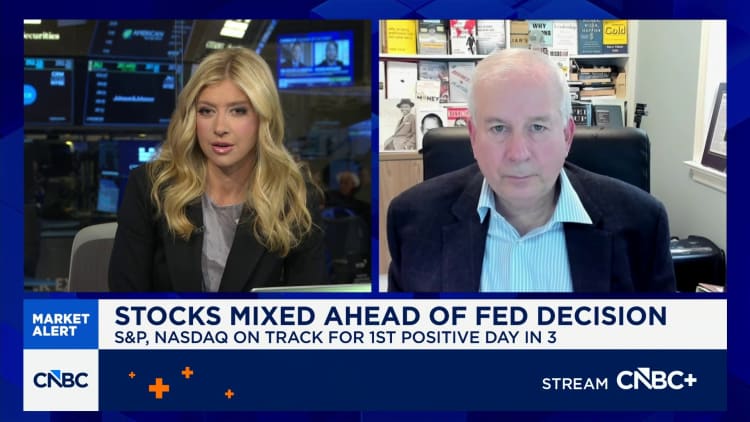
David Rosenberg is not in favor of the Federal Reserve possibly hiking interest rates.
Still, he does expect the central bank’s Federal Open Market Committee will take that route for the first time in three years.
“I think that they will do it, and I don’t think there’ll be any dissents,” Rosenberg, founder and president of Rosenberg Research, said on CNBC’s “Squawk on the Street.”
Rosenberg noted the Fed’s “dot plot” will be an important metric. The grid shows what participants expect future federal funds rates will be.
“I think what’s going to be more important really is what the dot plot shows. They’re going to ratify the aggressive tightening that’s priced in right now into next year,” Rosenberg said. “I’m never really a fan of a central bank tightening into a supply shock because this isn’t about an overheated economy, demand-led inflation.”
— Ananya Chetia
How the market may react to a new rate hike cycle, according to HSBC
The Fed is widely expected to raise rates on Wednesday, and HSBC forecasts that there will be another hike in December. Stocks may decline at first, but don’t expect that to last, strategists at the bank said.
“In historical rate hike cycles, S&P 500 performance typically dips initially but gradually recovers,” wrote HSBC’s head of equity strategy for the Americas, Nicole Inui, in a Tuesday note. “Benign, smaller normalization cycles (1997, 2016) typically saw performance improve at around three to six months after the first hike.”
Inui added that hiking cycles can expose underlying weakness, pointing to the dot-come bubble bursting nine months after rate increases began in June 1999 and the housing slowdown in late 2006 following a rate-hike cycle that started in 2004. But she said HSBC expects both consumer and corporate names to be resilient despite higher rates.
HSBC is also maintaining its year-end target for the S&P of 8,100, despite forecasting 50 basis points worth of rate hikes through the rest of the year.
— Davis Giangiulio
Tech stocks usually take a hit after rate hikes
Rate hikes generally are not kind to technology stocks, though the damage generally doesn’t last long, according to DataTrek Research.
In five of the past six rate-hiking cycles, the Nasdaq, which is comprised about 60% of tech issues, fell in the one-month aftermath, and in four of those cycles the damage got worse three months later. However, in three of the instances the index was positive six months later. The best six-month return was the 50.3% surge in 1999; the worst was a 9.9% plunge in 1994.
“The current setup argues for some caution: elevated oil prices threaten growth, hyperscalers’ cash flows, and AI capex confidence, while also risking the kind of inflation reacceleration Chair Warsh has said he’s committed to fighting regardless of government policy,” DataTrek co-founder Nicholas Colas wrote.
“If oil stays elevated and the Fed is forced into a longer hiking cycle, 1994 is the cautionary tale,” he added.
— Jeff Cox
Fed day stock market losing streak
A television station broadcasts Kevin Warsh, chairman of the US Federal Reserve, speaking after a Federal Open Market Committee (FOMC) meeting as a trader works on the floor of the New York Stock Exchange (NYSE) in New York, US, on Wednesday, July 29, 2026.
Michael Nagle | Bloomberg | Getty Images
Fed days have not been kind to the stock market in 2026.
Bespoke Investment Group pointed out the S&P 500 has fallen in each of the past five decision days this year, averaging a 1.5% drop in those sessions.
“The streak of five straight market declines on Fed days is also a historic run,” the firm noted. “The only stretch that saw the S&P 500 decline on more consecutive FOMC meeting days was the seven ending in 2018.”
— Fred Imbert
Former Treasury advisor LaVorgna sees ‘at least four’ rate hikes
Joe Lavorgna during a Bloomberg Television interview in Washington, DC, US, on Wednesday, Aug. 27, 2025.
Stefani Reynolds | Bloomberg | Getty Images
Economist Joe LaVorgna is breaking with his former boss, Treasury Secretary Scott Bessent, in seeing the need not only for an interest rate increase now, but also several more ahead.
In fact, LaVorgna, who left his Treasury post earlier this year, sees the Fed hiking “at least four” times while inflation stays well above the central bank’s 2% target.
“Ultimately how many depends on a couple of factors: When is the war in the Middle East going to end? When is the inflation dividend from the supply-side capital spending splurge going to be paid?” the chief economist at SMBC Americas said in a note Tuesday.
“The answers to both are unknowable in the short term but should become manifest in the months ahead,” he added. “In the interim, the Fed will not be dissuaded from hiking more than once. We are unlikely to get answers soon enough to prevent a series of interest rate hikes.”
While Bessent and other White House officials have said they respect the independence of the Fed and its chairman, Kevin Warsh, they have generally said they don’t see the need for rate increases. President Donald Trump has been more explicit, going so far as to threaten to sever trade ties with some nations if the Fed doesn’t cut.
— Jeff Cox
Fed decision looms with 10-year Treasury yield reaching 19-year high
The Fed is set to deliver its latest policy decision at 2 p.m. ET, with the consensus looking for a quarter-point rate hike from the central bank.
The move would come after the 10-year Treasury note yield scaled this week to its highest levels since 2007, as investors fear high energy prices will keep inflation elevated.
The benchmark yield hit a high of 5.041% on Tuesday. It has, however, pulled back from that mark. As of 7:38 a.m. ET, it hovered around 4.96%.
Stock Chart IconStock chart icon
US10Y in 2026
Fed hikes are rarely one and done
The Marriner S. Eccles Federal Reserve Board Building is seen under construction in Washington, D.C., on September 15, 2026.
Mehmet Eser | Anadolu | Getty Images
The Federal Reserve rarely hikes or cuts in a vacuum. The last clear example of a one-and-done hike came in March 1997, when the Fed raised rates, but then stood pat as the Asian financial crisis unfolded.
Michael Gapen, chief U.S. economist for Morgan Stanley, believes the central bank will hike Wednesday and more could be ahead.
“The first – and primary reason – is that disinflation is not fast enough to give the committee confidence that inflation will return to 2%, and within a suitable amount of time,” Gapen wrote in a note. “We based our previous no-hike Fed forecast on the assumption that inflation would show enough progress for the committee and keep them from raising rates. While we see plenty of evidence in favor of disinflation, we are not sure it is fast enough, or clear enough, to please the committee.”
— Jeff Cox