
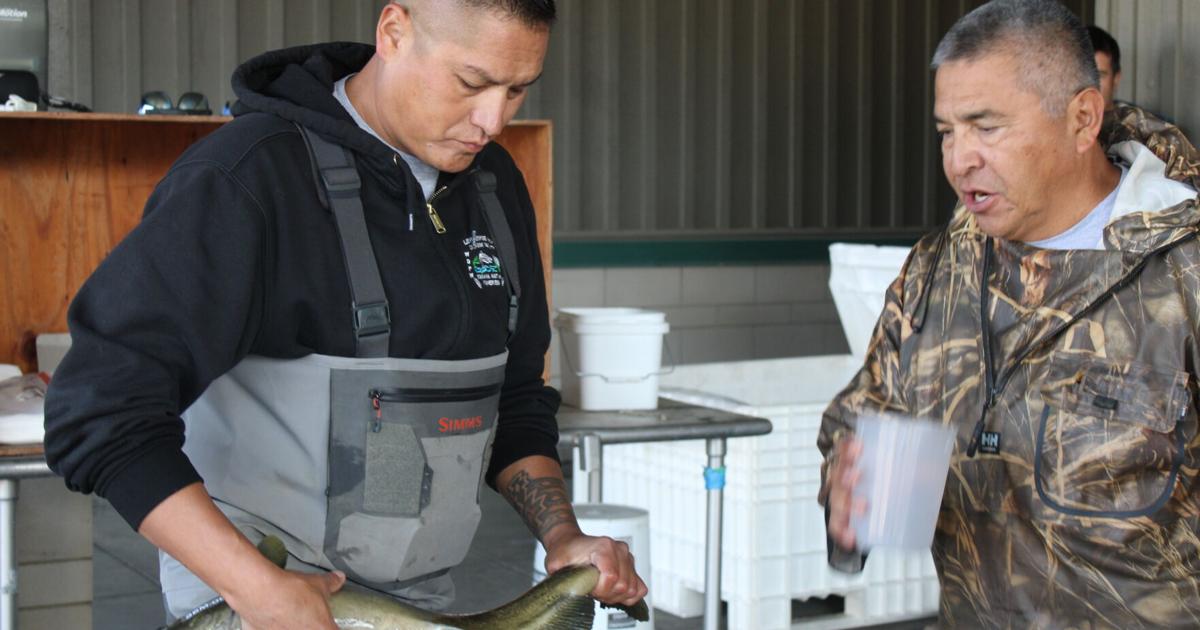
CLE ELUM — The music of AC/DC was playing as fish hatchery workers took their stations last week to artificially spawn spring chinook salmon.
“We’ve got No. 1, at 8:45,” yelled Charlie Strom, who is the Yakima Basin production manager for the Yakima Klickitat Fisheries Project.
The salmon were from holding tanks at the Levi George Supplementation and Research Facility in Cle Elum after being trucked from the adult trapping facility at the Roza Dam on the Yakima River earlier this year.
The first step was to kill the fish with an aluminum bat, and cut the gills. The milt was extracted from the males and the eggs from the females.
The eggs are fertilized, and a thus, a new generation of salmon started.
It was a short show on Wednesday. Only five females and five males were “ripe” enough. They were sorted from the Yakima Klickitat Fisheries Project’s holding pool of 428 spring chinook that were captured this year at Roza. The YKFP is a collaboration between Yakama Nation Fisheries and WDFW.
This effort to supplement numbers has become more important as salmon runs along the Yakima River have been depressed by four years of drought, according to state and tribal officials.
The forecast for fall chinook was low compared to recent poor years, said Trevor Hutton, fish program manager for the Washington Department of Fish and Wildlife.
The forecast for fall chinook in the Yakima River this year is low – about 1,300 fish. The forecast based on how chinook are doing along the Columbia at Hanford Reach. The fall chinook will continue to come in, typically spawning in October and early November.
That’s less than half of recent years, which have seen anywhere from 3,500 to 5,000 fall chinook.
“Right now, things are about tracking with the Hanford Reach return, but it’s pretty early still,” Hutton said.
Particular challenges
Four years of drought can affect salmonids like chinook in a few different ways.
“Like all biological systems, we expect that there’s going to be fluctuation. That being said, we’ve had four years of drought in the basin,” Hutton said.
Adults coming back would have been produced around the first year of the drought. He expects depressed numbers this year and years going forward because of it.
Less water in the river because of the snowpack drought leads to lower survival rates, due to impacted outmigration, higher predation rates and higher temperatures, Hutton said.
The temperature of the water could start impacting fish in June, Hutton said. Less flow means warmer water, presenting a “thermal barrier” to the migrating fish.
Salmon prefer colder water. Hot water has less oxygen and also changes the pH level, which the fish sense and try to avoid.
“Salmon, a lot of times, will get to the mouth of the Yakima River, and as they start to move up realize it is too hot, they’ll fall back and hang out in the Columbia River … sometimes for weeks or months until river temperatures cool,” Hutton said.
The river flow is also impacted by dams and the explosion of stargrass in the river, Hutton said.
Conservation projects have worked to add woody debris to parts of the Upper Yakima to create spawning and rearing habitat. In the Lower Yakima, the conservation goal is to provide a quick and smooth passage, the conduit to the Columbia River and eventually the ocean.
Because fall chinook come in late and leave for the ocean in the spring, they are not as impacted by the hotter summer temperatures.
A lot of recent years, the temperature was a thermal barrier for salmon. But this summer there were a lot of ups and downs in terms of passage, and the Bateman Causeway removal may have helped, though data in coming years will be able to more clearly determine that. The 500-foot earthen land bridge near Richland was removed over the winter in an effort to help fish passage where the Yakima River feeds into the Columbia River.
The Yakama Nation wasn’t able to relocate sockeye from Priest Rapids Dam to Cle Elum Reservoir this year because of low Columbia River numbers.
“One encouraging thing that we saw is that even with a hot summer and thermal issues, we had about 530 sockeye able to enter the Yakima,” Hutton said. All of those returning fish were naturally spawned.
Artificial spawning of spring chinook begins
Back at the Cle Elum hatchery, Strom said more chinook will be ripe in the coming weeks. He said that due to low returns at the Roza Dam, the hatchery is 88 females short of where they’d like to be. That represents roughly up to 300,000 eggs they don’t have this fall to fertilize.
Dr. Shubha Pandit, a data analyst for Yakama Nation Fisheries, said that the facility’s smolt releases vary from between 370,000 to 860,000, with an average of about 700,000. It sounds like a lot, but less than 5%, and often less than 1%, make it to adulthood.
“The decline of adult returns appears to have been greater for natural-origin fish than for hatchery-origin fish,” Pandit said.
The facility has been operating since 1997 and its first fish returned 25 years ago in 2001. It selects its broodstock from natural origin chinook, and allows its released fish to breed naturally. The smolts are released in creeks and tributaries near Easton, Clark Flat and Jack Creek in Kittitas County. They make their way to the Pacific Ocean and stay a few years, before coming back home to spawn. These adults are collected and sorted at the adult trapping facility at Roza Dam, in the Yakima River Canyon.
Anywhere from 2,000 to 12,000 adults have returned to Roza Dam each year in the past 20 years, with an average of 6,000. About half of those fish come from the hatchery, Pandit said.
After the operation was cleaned up, Strom and other members of the team went to conference room, where data from the day was already uploaded into a chart. They have been tracking the fecundity, the rough number of eggs taken from each female. Today, the average is 2,800 eggs per female.
“Geez, that’s low,” Strom said. That number is usually around 3,500.
The females were on the smaller side, so it wasn’t a total surprise. But does the drought have any impact?
“It can’t help,” Strom said. “They get stressed.”
Drought has meant a lower number of adults returning to the Yakima River, adults they need to keep their production at full capacity. “I would say there’s at least a hundred females that we’re missing.”
Drought also stresses the fish, and stress can bring out the bacterial kidney disease that they screen for, Strom said.
All salmon carry the bacteria, but stress brings on the disease more, Strom said. The eggs that have the disease are culled, as the fish wouldn’t survive the transition between fresh and salt water.
At one of the work stations was Tim Bundy, a U.S. Fish and Wildlife fish health technician, who took organ samples from the fish to test for the disease.
One million eggs, with over 800,000 smolts is an ideal production per year, what that is hit good majority of the time, Strom estimated. Approximately 11,293 eggs were spawned that morning.
The facility will continue the spawning process through September with what they’ve got.
“The drought definitely isn’t doing us favors,” he said.