
New BOMA study quantifies the economic activity, jobs and GDP contribution tied to the nation’s commercial building inventory.
Published:
September 16, 2026 at 5:16 PM ET
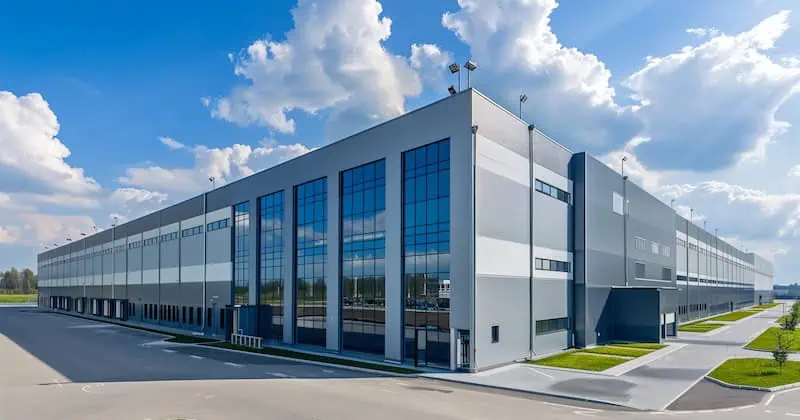 (Image: Adobe Stock / Generated with AI by Wolfilser)
America’s commercial buildings are generating substantial economic value in markets across the country, according to a new study from Building Owners and Managers Association (BOMA) International. The report finds that commercial building operations and maintenance generate nearly $610 billion in annual economic activity, support 3.9 million jobs, and contribute $344.4 billion to U.S. GDP.
BOMA’s 2026 Market Study: The Economic Impact of U.S. Commercial Real Estate found that for every $1 spent on building operations, $2.22 in total economic output is generated through direct, indirect and induced economic activity.
Spanning 79 U.S. markets and 35.4 billion square feet of commercial real estate, the study represents the most comprehensive analysis of its kind examining the economic impact of commercial building operations in the United States. Conducted by BOMA every three to four years, the research provides a recurring benchmark for measuring the industry’s economic impact and trends across the commercial real estate landscape.

“Commercial buildings are economic engines, supporting businesses, jobs and communities across the country,” said Kjersten Jaeb, BOMA Fellow, RPA®, LEED GA, Chair and Chief Elected Officer of BOMA International. “Every building relies on an extensive network of professionals, service providers and businesses to keep it running safely and efficiently, from building managers, contractors and suppliers to maintenance and repair companies, utilities, insurers and security providers. Technology is also transforming how we manage energy, water, security, access and overall building performance. This study shows just how significant that entire ecosystem is to the U.S. economy.”
Commercial Buildings In A Changing Real Estate Landscape
In addition to measuring the economic impact of operating and maintaining commercial buildings, the study examines construction trends across the office, retail and industrial sectors, providing a broader look at how the U.S. commercial real estate landscape is evolving.
One notable shift is the rapid growth of data center development. Federal construction statistics classify data centers as private office construction, meaning their rapid growth is increasingly shaping overall office construction figures. In 2025, data centers accounted for approximately $41.2 billion, or nearly 46%, of the more than $90 billion in private office construction nationally, compared with less than 5% a decade earlier. Traditional office construction excluding data centers totaled approximately $48.4 billion in 2025.
Industrial construction also remains at historically high levels. Warehouse and manufacturing construction totaled approximately $274.2 billion in 2025. While down 7.9% from the previous year, investment remained more than twice its 2020 level and represented the third-highest annual total on record. Retail construction totaled approximately $47.1 billion in 2025, with activity increasing during the first three months of 2026. In addition, the U.S. life sciences real estate market is normalizing following several years of rapid expansion.
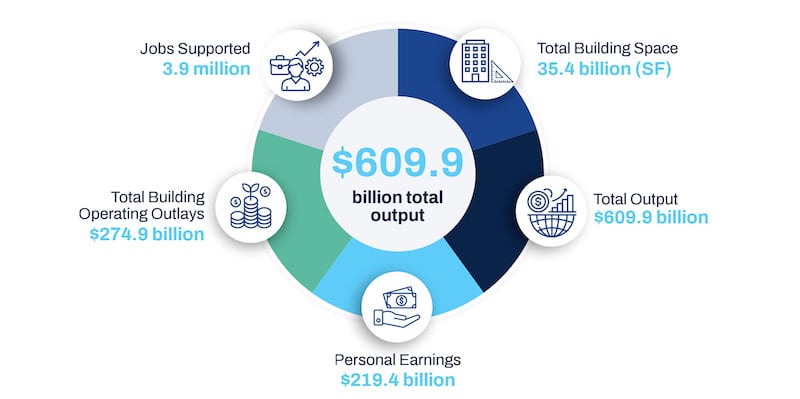 The 35.4 billion square feet of office, retail, and industrial properties across BOMA’s 79 markets support 3.9 million jobs, contribute $344.4 billion to GDP, and generate $609.9 billion in economic output. (Source: BOMA)
Economic Impact Across The Country
The economic impact of building operations is not limited to the country’s largest commercial real estate markets. BOMA’s 79 markets span 38 states, with building operations supporting local jobs, businesses and economic activity in communities of varying sizes across the country.
“The economic impact of commercial real estate is not a one-time event,” said Mary Lue Peck, President and COO, of BOMA International. “Ongoing investments in the operation, maintenance and improvement of our buildings generate economic activity that supports businesses, jobs and wages across the country creating an impact that lasts well into the future.”
The study was conducted by the Business Research Division at the Leeds School of Business at the University of Colorado Boulder on behalf of BOMA International. The full report and state economic impact profiles are available here.