
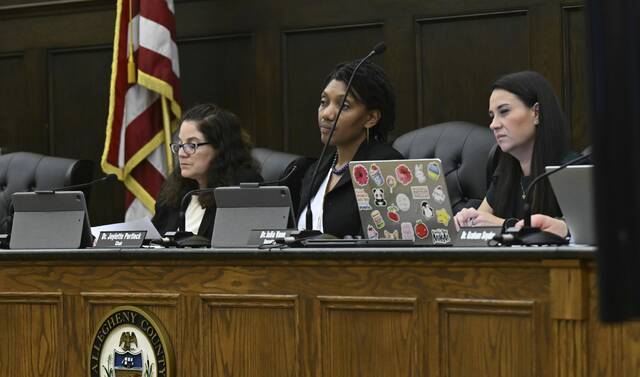
The Allegheny County Board of Health pared its controversial paid parental leave proposal Wednesday, shaving six weeks off the proposed benefit and loosening requirements after weeks of intense public feedback.
The revised proposal would cut paid leave from 18 weeks to 12 and apply only to Allegheny County businesses with 15 or more employees. Workers would have to be employed for at least six months to qualify, and part-time employees would need to have logged 625 hours.
The new version introduced Wednesday at a health board meeting also adds provisions for unforeseen health circumstances, including stillbirths.
“Access to paid leave is associated with reduction in infant hospitalizations, particularly for conditions such as respiratory infections, as well as improvements in breastfeeding duration (and) maternal recovery following childbirth,” said Dr. Iulia Vann, director of public health for the Allegheny County Health Department.
“It also increases the likelihood that individuals with access will access postpartum and preventive care services, which are critical to reducing complications and promoting long-term health,” Vann said.
The board proposed the first draft of the parental leave policy in May.
The proposed policy was the first of its kind by an individual municipality without a state mandate. It required businesses of all sizes, with no minimum employee threshold, to provide 18 weeks of paid parental leave. All employees would have become eligible after working for an employer for 30 days.
Heavy debate from the public spanned May through early September, with the months peppered by additional demonstrations of support from union nurses and the release of numerous economic and health studies.
The original proposal quickly grabbed the public’s interest, drawing vast support from labor, healthcare and family advocates and strong skepticism from business groups concerned about potential financial strain for employers.
The Board of Health received more than 1,500 comments about the proposed leave, with 56% of the comments in total support of the legislation.
“However, we did hear the folks that had mixed reviews, and we did hear the folks that had opposition, and we understand, and it’s our obligation to take all of those comments into consideration,” said Kim Joyce, COO of the Allegheny County Health Department.
100% of wages would be paid
Under the new policy, eligible employees would receive 100% of their wages during leave, up to a maximum paid parental benefit of $4,200 per week. Stillbirth also has been added as a qualifying event, subject to specified requirements and provisions.
During the meeting, Board of Health member Dr. Khlood Salman asked why the partners of an individual who experiences a stillbirth should be allocated leave.
“I know the woman will go through so many changes and grieving and all that. And at the end, women deserve to have a sick leave or parental leave,” Salman said. “Why should the man have it also?”
Vann said that although only one parent experiences the childbirth, both parents may experience a significant psychological trauma, grief, anxiety, depression and any other adverse health effects that are related to that loss.
Allegheny County has infant mortality rates that exceed state and national levels, with significant racial disparities. Black infants are nearly five times as likely to die within their first year of life, and Black infant mortality remains particularly high in the county.
The state Family and Medical Leave Act provides job protection for eligible employees who need family or medical leave, but, Vann noted, it does not guarantee the leave will be paid. Eligibility requirements also mean that not all workers qualify.
As a result, families who may benefit most from paid leave are often the least likely to have access to it.
Vann said the benefits of paid parental leave extend beyond individual families to the healthcare system and local economy.
“Studies have documented reductions in emergency department utilization, increases in preventive care, and potential cost savings associated with improved health outcomes,” Vann said. “Additionally, evidence suggests that paid leave policies do not produce negative impacts on employers.”
Employers would have the option to self-insure or purchase private insurance to provide the required benefit. The proposal anticipates that broad participation across Allegheny County would create a sizable private insurance pool and help make coverage more affordable.
Research cited from the Keystone Research Center estimates that less than 2% of Allegheny County’s workforce would be eligible to use the benefit in any given year.
The policy points to data from paid parental leave insurance provider Parento, which says coverage for an employee earning $15 per hour would cost an employer about $13 per month, while coverage for an employee earning the county’s stated median annual wage of $66,000 would cost about $30 per month.
Keystone Research Center said states with well-established paid parental leave programs — where roughly 40% of eligible workers participated — suggested that actual utilization could be substantially lower than the total number of workers eligible for the benefit.
6 months to implement
The new proposal includes a six-month implementation period after the legislation is signed into law. Employers that need additional time to align implementation with their fiscal year or budget cycle could receive up to an additional six months, meaning all covered employers would be required to implement the policy within one year of enactment.
Allegheny County Executive Sara Innamorato, who is expecting her first child in November, has been a strong proponent of adopting a countywide paid parental leave policy.
Innamorato did not attend Wednesday’s meeting. However, the county executive’s office indicated it supports the new policy proposal.
The board is made up of 10 members appointed by the county executive and confirmed by county council. The board is currently chaired by Dr. Joylette Portlock, the former executive director of Sustainable Pittsburgh and associate director of Science and Research at the Carnegie Museum of Natural History.
Other members have backgrounds that are a mix of medicine, science, community advocacy and public policy.
“It’s important to remember that today is not a final decision,” Vann said, “but an opportunity to share the revised proposal, which reflects community input.”
Community development group blasts proposal
The Allegheny Conference on Community Development released a statement via email Wednesday night blasting the proposal, even in its revised form.
“Mandating a 100% employer-paid requirement — rather than utilizing a state-level, insurance-based funding model common in other jurisdictions — places an uncompetitive financial and administrative burden directly on local employers.
“As Allegheny County competes regionally and nationally for investment and workforce growth, establishing a localized benefit mandate risks putting our region at a distinct economic disadvantage,” the statement continues. “We urge county leadership to pursue data-driven, employer-informed policy solutions that foster both family well-being and regional competitiveness.”
The organization touts itself as “improving the Pittsburgh region’s economy and quality of life.”
What’s next
As of Wednesday, there were several steps the policy still had to undergo before being implemented.
Once the Board of Health votes in favor of the policy, it would need to go before county council for a vote.
If approved by council, the bill would move on to be signed by Innamorato.
The Board of Health will hold a special meeting at noon Sept. 28 about the new policy proposal, Portlock said.