
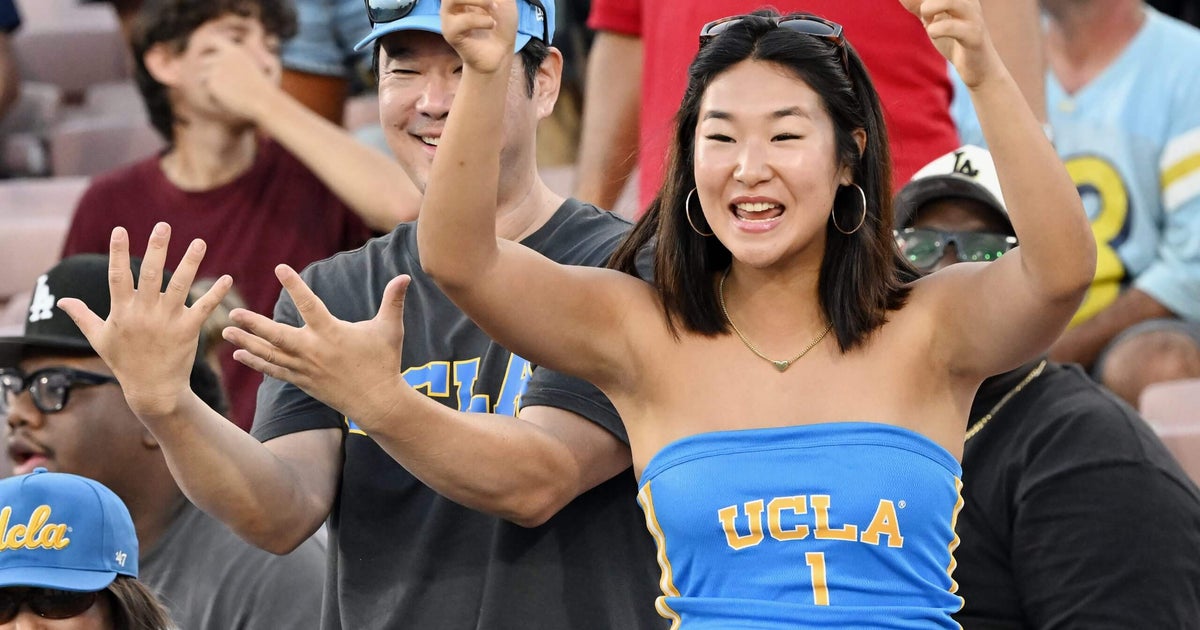
UCLA students will get into football and men’s and women’s basketball games for free, the latest and most aggressive step in new CEO and athletic director Tim Harris’ push to rebuild the Bruins’ home crowds.
Beginning with Saturday’s Big Ten home opener against Purdue, all eligible UCLA undergraduate and graduate students can claim complimentary tickets to regular-season home games in all three sports, the athletic department announced Wednesday morning.
“Our students are the heartbeat of UCLA,” Harris said in a statement. “Their passion, energy and pride create an atmosphere that makes a difference for our student-athletes and coaches. We want as many students as possible experiencing UCLA athletics.”
Students who already purchased a 2026-27 Den Pass — UCLA’s student season-ticket package for football and men’s basketball, which cost $199 for the 2026-27 school year — will receive automatic refunds by Sept. 25. The annual pass cost $165 in 2022, while UCLA also offered incoming students a four-year version for $495 at the time.
Students will now claim home football tickets through their student ticket accounts beginning the Monday of each game week. They can also purchase up to eight guest tickets for nearly all home football games besides the annual USC rivalry game. Transportation remains a separate fee, with the Rooter Bus to and from the Rose Bowl costing $15 per game or $60 for the season.
The move addresses an issue Harris identified almost immediately after taking over UCLA athletics: students face an unusual collection of obstacles to attending football games, starting with the Rose Bowl sitting roughly 26 miles east of the Westwood campus.
AP Top 25: How far does Ohio State fall?
Ralph D. Russo and Johnny Sweet
On a recent podcast with Bruin Report Online (BRO), Harris described those obstacles as “barriers for entry” and said UCLA needed to strip away as many reasons as possible for students to stay home. Harris said he wants UCLA games to become a destination students feel they need to attend because everyone else is there.
“I view the students not as a revenue source, but as a marketing platform,” Harris said on the podcast. “I view the students as part of the entire experience.”
Once that demand exists, he said, UCLA must make the logistics — and the cost — easier. Otherwise, he said, it provides students with too many excuses to not attend.
That philosophy makes the timing notable. UCLA athletics is hardly in a position where revenue does not matter.
The department has accumulated a $222.27 million deficit in the last six years and reported another operating loss of $21.6 million in fiscal 2025, despite the increased conference revenue that accompanied UCLA’s move to the Big Ten.
But Harris has distinguished students and UCLA’s other paying customers. In the interview with BRO, Harris argued that making every Rose Bowl ticket extraordinarily cheap might help fill seats but would do little to address the department’s financial problems. Students, he said, serve a different purpose: creating an atmosphere that makes UCLA football more attractive to everyone else.
That atmosphere has historically been difficult to create. UCLA averaged 37,282 fans at the approximately 90,000-seat Rose Bowl in 2025, its lowest full-season home attendance since moving there in 1982. The Bruins have not averaged 60,000 fans at home since 2016.
The problem has quickly become one of Harris’ most visible priorities since replacing Martin Jarmond last month.
After UCLA kickstarted the Bob Chesney era with a road win over Cal, Harris himself purchased 300 tickets to the Bruins’ home opener against San Diego State and distributed them to fans. Champion of Westwood CEO Ken Graiwer then equalled the deed with another 300.
Harris said he made the gesture because he wanted fans to know he had “skin in the game too,” while acknowledging that giveaways alone could not solve UCLA’s attendance problem.
“We’re not going to 300-ticket this thing to where we get a big number,” Harris told BRO. “There has to be critical mass of the fan base buying in too and literally buying in.”
UCLA has since rolled out a broader “Fours Up, Fans First” initiative with cheaper entry-level tickets, $5 youth tickets, fan rewards and changes designed to improve the Rose Bowl game-day experience.
Harris has also said UCLA needs significantly more season-ticket holders, with a longer-term goal of removing the tarps covering portions of the Rose Bowl’s unused seating.
“You can’t have a big-time football program unless you have a bunch of students out there,” he told BRO.
Saturday will provide the first test of UCLA’s newest attempt to make that happen. With students returning to campus for the fall quarter, getting into the Rose Bowl will no longer cost them anything.
“We have an exciting team led by Bob Chesney and a lot of momentum surrounding UCLA athletics,” Harris said in a statement. “Now it’s time for our students to help set the standard.
“Arrive early. Be loud. Be relentless. We can’t wait to see a sea of Bruin Blue at the Rose Bowl this Saturday.”