
ORCHARD PARK, N.Y. — Michael Hoecht was born in Canada on the shore of Lake Ontario, which President Trump recently ordered U.S. federal agencies to call Lake America.
About 90 miles southeast of Oakville, Ontario, Hoecht will play for what he considers his hometown team on Thursday night. He’s an outside linebacker for the Buffalo Bills, who will open Highmark Stadium against another border team, the Detroit Lions.
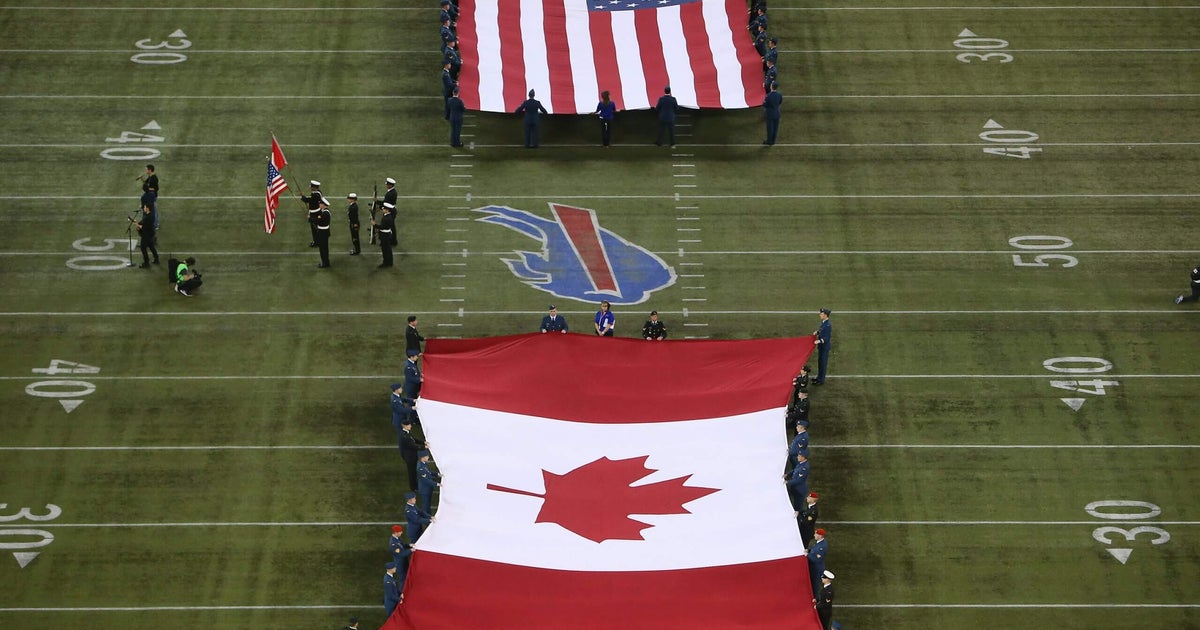
As part of the pregame festivities, the Bills decided to stage the U.S. and Canadian anthems. The one-off decision has confused some fans and drawn criticism from commentators who questioned why a U.S.-based team would perform Canada’s anthem amid the countries’ trade dispute.
“Not everything,” Hoecht said this week in the Bills’ locker room, “has to be a thing.”
The Bills’ front office finds itself in a weird place.
Sports teams frequently frame financial decisions as goodwill. In this case, however, one person’s kind gesture can be interpreted as a political provocation.
No, inviting Canadian rock band Barenaked Ladies to perform their national anthem in a stadium visible from across Lake Erie wasn’t about social or geopolitical harmony, the Bills insist. (“Moana” star Auliʻi Cravalho will follow with “The Star-Spangled Banner.”)
“For us, it’s all about the business,” said Pete Guelli, Bills president of business operations. “This is part of a broader marketing effort into Southern Ontario and Toronto. It’s been a critical part of our business model, and it’s going to continue to be. This has been in the works prior to anything that’s come up on the (geopolitical) front.”
At a time of great rancor, the Bills want to remind a large fraction of their fans that they’re welcome.
But the expected side effect can be soothing too.
“The Bills have already acknowledged the fanbase is important and that they’re trying to grow the fanbase,” said Andrew Nicholls, a Midland, Ontario, native who teaches British, Canadian and European history at Buffalo State.
“Nothing wrong with that. And if you tie it to the fact so many of your fans cross the border to see your team in your new stadium, making them feel at home is nice. I can see both scenarios being true at once.”
Trade talks between the U.S. and Canada collapsed last month. Trump imposed 50 percent tariffs on about $20 billion worth of Canadian imports. Prime Minister Mark Carney enacted retaliatory tariffs. The U.S. will ban imports of certain Canadian goods outright beginning Sept. 29.
Since late 2024, Trump has repeatedly suggested Canada could become the 51st state and referred to then-Prime Minister Justin Trudeau as “Governor Trudeau.”
“This destruction of our historic alliance has made Canadians really, really mad and also scared as a country,” Toronto Star columnist Bruce Arthur said. “I don’t know that there’s ever any coming back from that because it has been such an eruption. But this kind of gesture still matters.
“The more points of light we see like this in what we feel as an emerging and terrifying darkness, the more we are reminded that one day this can be repaired, we view it with fondness.”
The Bills’ campaign into Canada has been years in the making.
NFL bylaws define a club’s territory as everything within a 75-mile radius around its stadium. That includes Toronto, Canada’s largest city. About 21 percent of Canada’s population lives within Buffalo’s designated market.
From 2008 through 2013, the Bills Toronto Series relocated eight Buffalo home games — six regular season, two preseason — to the Rogers Centre. The experiment was a PR disaster, but after a hiatus that included Terry Pegula buying the club after Ralph Wilson’s death, the Bills started courting Canadians again.
“Buffalo’s a small market,” Guelli said, “but when you combine it with the Greater Toronto Area, it’s a top-five NFL market. Somewhere in the neighborhood of 12 percent of our PSL holders are Canadian. Our waiting list is closer to 20 percent.
“We’ve built a multibillion-dollar stadium and firmed up this team in our market for the next 30-plus years; Canada was an important part of that and always will be.”
In December 2024, the Bills sold minority stakes to Toronto Raptors legends Vince Carter and Tracy McGrady and former Toronto FC star Jozy Altidore.
Last year, the NFL awarded Buffalo marketing rights to all of Canada through the league’s Global Markets Program. The Bills also partnered with Maple Leaf Sports and Entertainment to grow youth football, including joint camps with the CFL’s Toronto Argonauts.
Canada’s pull is obvious to Western New Yorkers. This season, the Bills expanded their radio network to TSN affiliates in Toronto, Ottawa and Montreal, with national availability through iHeartRadio Canada.
In a team-sponsored stunt Wednesday morning on the Niagara River, former Bills quarterback Ryan Fitzpatrick made a “cross-border completion” to old mate Stevie Johnson from one boat to another.
“A lot of Canadians make up a large portion of our fans,” Bills receiver and Brampton, Ontario, native Joshua Palmer said. “The anthem is a nice gesture. It only makes sense to show your gratitude.”
Five months ago, a previous Buffalo rendition of “O Canada” made international headlines.
Before a playoff game between the Boston Bruins and Buffalo Sabres in KeyBank Center, singer Cami Clune’s microphone died. Sabres fans, who have heard dual national anthems since the team’s inception in 1970, finished the song for her, word for word.
“I don’t think the Bills are trying to change humanity,” Arthur said. “Even if they’re doing this to make money, that doesn’t mean it also can’t be something bigger. What has a great chance of taking us back to where we were is a shared humanity.
“It’s a football game on a Thursday. It’s not the beginning, end or apex of the world, but it’s something.”