
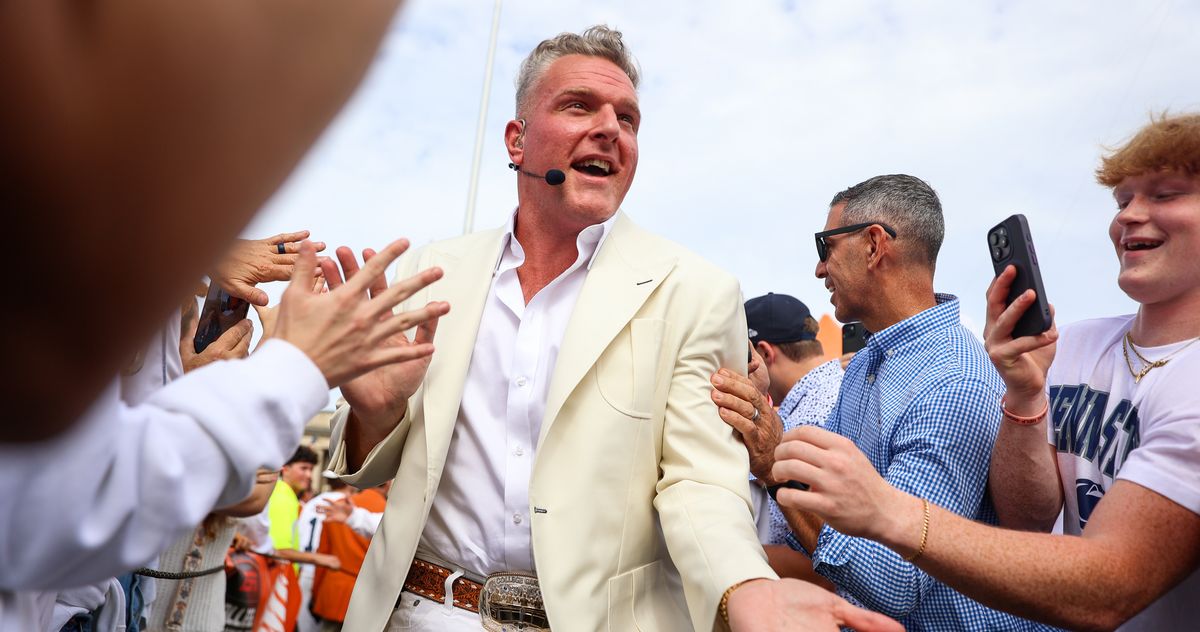

Photo: Isaiah Vazquez/Getty Images
On Saturday morning, ahead of the second college-football weekend of the new season, Pat McAfee was up to his old tricks behind ESPN’s College GameDay desk. He delivered a typically long WWE-style soliloquy gassing up the home team and the town they were broadcasting from (Austin, Texas, in this case). Next was a drawn-out a cappella song — The Eyes of Texas, to no one’s surprise — as his co-hosts, reasonable, suited-down, fully sleeved setup men whom McAfee can play foil to, smiled nervously and looked on. McAfee then delivered several head-fakes about which team he predicted to win, riling up the hometown crowd. At one point, he cut the sleeves off his button-front shirt, returning to the tank-top look that was his trademark for years. Finally, McAfee’s actual game prediction was timed to coincide with four T-38 Air Force jets flying overhead.
McAfee is the obvious star of the show. But now, ESPN wants him to be the star of seemingly every show it can fit him into. His podcast, The Pat McAfee Show, in which he stands and breathlessly expounds on the sports issues of the day inside his DraftKings ThunderDome studio, airs for two hours every weekday. On Monday, he began appearing on the network’s Monday Night Countdown, which airs just ahead of Monday Night Football, as well as at halftime. For those who want even more McAfee on Monday nights, he’ll be hosting his own alt-cast commenting on the game during the weeks Peyton and Eli Manning’s popular alt-cast is on break, according to reporting from “The Athletic.”
McAfee, a retired NFL punter, is very much a man of his time. Though he’s 39 years old, he often acts like a big kid. He’s got loose-cannon charisma; more opinions than he has airtime for; a masculine, retired-football-player vibe with insider insight; and a heartland-coded sensibility. He’s prone to standing on his desk before a crowd: an example of his seemingly limitless energy. He had a prominent role in WWE for several years. He feels like an important pillar of the conservative cultural shift that crested with Trump’s second election — the 2020s Sun Belt–ification of America. McAfee has a Joe Rogan–like openness to conspiracy theories (he gives the cantankerous QB Aaron Rodgers time to air thoughts on Anthony Fauci, Dianna Russini, media coverage, and whatever else rankles him) and intermittent regard for journalistic ethics. But his main-character energy makes for engaging if divisive — and, either way, lucrative — television. ESPN is widely rumored to be offering McAfee a new contract worth up to $65 million per year.
In his few waking hours off the ESPN airwaves, he finds novel ways to remain at the center of culture. In mid-August, McAfee appeared as Trump’s companion at the Patriot Games, a high-school sporting event founded by the president. With the help of Jelly Roll, McAfee released a country-music album last month, The Diary of a Polarizing Figure (the reviews of which were also polarizing, except from ESPN co-workers, who unanimously lauded it online). He co-owns a brand of frozen PB&J sandwiches. Next month, he’ll have a cameo role in the film The Mosquito Bowl, playing a World War II drill sergeant who whips Marines into football shape. His talent agent is none other than Ari Emanuel. McAfee, in other words, is even more ubiquitous than ESPN.
Or at least the ESPN of old. For decades, the network offered a predictable and reliable formula. It had rights to the top sports leagues and events; a cast of quick-witted anchors on its flagship shows, especially SportsCenter; dogged journalists who held leagues, athletes, and owners to account; daytime sports-talk shows that were lower budget and higher margin than the other programming. The network has had stars come and go over the years, and more recently it created elevated platforms for Scott Van Pelt and Stephen A. Smith, who rose from the traditional ranks of broadcast and print journalism. But the streaming era has caused the network’s cash cow — the cable bundle — to collapse slowly. By 2023, ESPN had lost more than 25 percent of its audience over the previous decade and more since. The younger generation has been flocking to content creators for sports (and betting) content.
To leagues such as the NFL, “the cost of sports rights has increased, while the number of cable subscribers have decreased, and the streaming business hasn’t yet made up for these losses,” according to Ben Shields, a professor at MIT who is ESPN’s former director of marketing and social media.
The Worldwide Leader in Sports no longer dominates the airwaves, and its grasp on journalism is slipping, too.
In late August, one of ESPN’s former stars, Pablo Torre (now affiliated with “The Athletic”), was vindicated when the NBA fined and suspended L.A. Clippers owner Steve Ballmer for circumventing the league’s salary cap — an explosive story that Torre broke, won a Pulitzer Prize for, and stuck to for a year under pressure, while ESPN’s own reporting had claimed a lack of evidence. Even the NBA called out ESPN for “numerous and significant inaccuracies” in its version of events.
The debacle unintentionally put ESPN’s current strategy in perspective. The network has been increasingly rewarding and carving out space for stars while laying off or not renewing lower-profile journalists and on-air talent. The shift was captured poetically on August 18 on live television when a solemn, on-air tribute to the passing of ESPN founder Bill Rasmussen (tacked on at the end of the two-hour talking-heads show Get Up) was unintentionally interrupted by a smash cut to the intro of The Pat McAfee Show.
ESPN’s tribute to Bill Rasmussen at the end of ‘First Take’ was cut off by the beginning of ‘The Pat McAfee Show’: pic.twitter.com/uM2oVNywXj
— Sports TV News & Updates (@TVSportsUpdates) August 18, 2026
Beyond the questions about ESPN’s strategy, there’s the guy himself. McAfee, to put it mildly, rubs a lot of people the wrong way. Over several editions of “The Athletic”’s annual media survey, close to 50 percent of respondents stated they “don’t like” his presence on College GameDay (the show’s star entertainingly responded one year by calling their humanity into question). Podcasters and YouTubers regularly churn out anti-McAfee and anti-ESPN content. Yet there’s more McAfee than ever. So why does the Pat McAfee multiverse keep expanding? And how much Pat is too much, even for ESPN?
“I cannot tell you the number of people that approach me and say, ‘What happened to the ESPN I grew up with? It isn’t what it used to be,’” says Bob Ley, the legendary retired ESPN anchor who joined the network in 1979 on its third day. “You want to throttle these people and say, ‘Of course it’s not!’ The whole flipping media landscape has changed, and ESPN would be criminally insane not to adapt to the times.”
But the people who long for the old days aren’t part of the audience ESPN covets. The audience ESPN is now chasing hasn’t automatically gravitated to the network in years.
“ESPN has had a mission, especially in the past five-to-ten years, of attracting a younger audience,” says Linda Cohn, the recently retired SportsCenter anchor of 34 years who currently hosts her own podcast.
McAfee was the guy already on many of their screens. He began podcasting in earnest in 2017 (though he seemed to be workshopping it in college, nine years earlier), building up a vast audience as he hopped around various podcast and radio networks. ESPN took notice and put him on Get Up and College GameDay; then, in 2023, ESPN began licensing and airing the first two hours of his three-hour weekday video podcast, centering McAfee and his audience and taking in stride the opinions, attention, and controversies surrounding the show.
“ESPN’s business case for Pat is trying to reach, engage, and convert people to ESPN Unlimited” — its all-access, stand-alone app — “or a live-TV streaming service,” in lieu of an old-fashioned cable subscription, Shields of MIT says. “That’s the McAfee proposition: When you license my show, you get me plus my audience.”
In exchange for his audience, ESPN is trading its reputation of airing authoritative, tightly produced shows with respected journalists for the shabbier aesthetics and ethics of podcasting: in-show advertising, rambling conversations, softball interviews with powerful people. (McAfee and his cast have gotten in trouble for failing to restrain themselves on live TV on several occasions — the lowest moment being speculative chatter about a fired NFL coach in 2023 that went from zero to child-porn rumors in under five minutes, none of which were true.)
But trust in the media has tanked, and the look of a newsperson behind a desk just doesn’t play to the younger generation. Those viewers tend to see creators as more authentic and are more prone to develop parasocial relationships with them nowadays than with a SportsCenter anchor. “ESPN’s model just doesn’t work anymore in this day and age, and they know it,” according to Justine Gubar, a former ESPN producer who’s currently a professor at New York University and St. John’s University. “When you see someone sitting in what looks like their basement, it feels like one step from the corner bar. Viewers can develop trust in an environment like that.” McAfee also frequently donates to various causes, which cultivates his persona as a generous Everyman. For his kicking-contest segment on College GameDay, a highlight of the show that benefits local charities, McAfee pays hundreds of thousands of dollars out of his own pocket. And Brett Favre once sued McAfee (but later dropped the suit) after McAfee accused the retired quarterback of “stealing from poor people in Mississippi” amid a state welfare-fund scandal.
Gubar says ESPN’s current business model practically demands this kind of star power. “Streaming subscribers make an active monthly decision to keep paying,” she points out. “Back in the days of cable, you just got all these channels and didn’t think much of it. But streaming is so intentional that you need big personalities to drive it.”
According to Shields, the company is intimately aware of all this and measures it against McAfee’s ROI — which is especially large considering talk shows, which are vastly cheaper to produce and air than live sports, have high margins. “ESPN has historically had an excellent research department — I believe they’re the best in the business,” he says. “And I can only imagine that they are studying McAfee’s impact rigorously.”
And nobody doubts that McAfee is a master of the attention economy. Look at his diversification into pro wrestling, country music, and now Hollywood. He’s made his grievances with ESPN producers ugly and public — he famously once said of them, “I don’t got a motherfucking boss” — which must be intentional: No doubt McAfee is smart enough to realize that such moves align with his brand of rebelliousness and will endear his fans to him even more. He’s also more aware than most of today’s golden rules of publicity: Everything is content, and controversy often makes the best content of all. Last month, College GameDay’s producer was moved off the show and unnamed sources blamed McAfee for it. McAfee clearly has enough clout at ESPN to drive out top producers or have them reassigned for the most elemental reason of all in television: He brings the audience and the advertising. And the more airtime McAfee gets, the more advertising revenue ESPN gets.
“Nothing succeeds like success,” Ley says. “And right now, he’s Secretariat at the Belmont and everyone’s eating his dust.”
The recent timing of all this McAfee news is no accident: ESPN will be broadcasting the Super Bowl in February, the first for a dedicated sports network, and will want McAfee to bring his audience to the game as well as all the wraparound programming. It has the entire 2026–27 football season, plus all of McAfee’s would-be viral moments that ESPN can clip, as a long lead-in. But how many hours a day do viewers — even those who enjoy his antics — actually want to see him? On certain Mondays this fall, McAfee will be on air for five or more, which seems like a lot for a self-proclaimed polarizing figure.
“This is how sports broadcasting has changed,” Cohn says. “Even if you don’t like Pat McAfee, you’re going to be curious about what he’s going to say on that panel with Monday Night Countdown, where maybe normally you wouldn’t be watching a two-hour pregame show. These aren’t the same people who watch Pat’s three-hour show. It’s a different audience.”
That’s classic ESPN strategy, says Shields, who refers to it as the ESPN flywheel: Flood the zone with talent on different shows at different hours of the day. This intentional overexposure has been baked into ESPN’s strategy for years. The in-house company term is “the car wash,” in which an athlete or celebrity on a press tour will drop into the Bristol, Connecticut, headquarters and appear on numerous ESPN TV and radio shows over the course of a full day. ESPN has simply decided to send its own star through it on a daily basis.
Will ESPN soon resemble MTV, which now broadcasts Ridiculousness up to 19 hours per day and seems thoroughly out of new ideas? This can’t be a good strategy for anyone, can it?
“Look, Pat is the latest bright and shiny object,” according to an ESPN staffer who wished to remain anonymous. “Look at how Hollywood works now, making sequels upon sequels: If it worked, it’ll work again a second time, and it’ll work until it stops working. Then when it stops working, you get thrown overboard for the next bright and shiny object.”
ESPN may be foolish not to ride with McAfee as far as he can take the network. But McAfee would definitely be foolish not to take every opportunity possible while he’s hot and diversify as much as he can while he still can. Gubar, the former producer, points out that even though McAfee’s on top of the world right now, ESPN is likely drawing up plans for a post-McAfee future for when all the juice has been squeezed out. Just as the star is currently integral to the network’s survival, ESPN’s next move will be too. “That’s why the major leagues have triple-A, double-A, and single-A,” Gubar explains.
It’s easy to assume that a legend such as Ley would have unprintable thoughts on ESPN’s current iteration. In fact, though he winces at McAfee’s occasional ethics breach, soft-touch interviews, and treatment of longtime producer colleagues of his, Ley respects his work in building and growing his brand to where it is now.
“As I’ve said for years, the two most important words in the English language are stock price,” Ley says. “It’s everyone’s job at ESPN to make money for the shareholders of the Walt Disney Company. That’s the absolute, God’s honest truth. And if you’re not comfortable with that, go work for the Little Sisters of the Poor. If I owned stock in the Walt Disney Company, I’d be rooting for [McAfee] like a son of a gun.”
McAfee has already won over ESPN. And his persona on College GameDay seems to fit the ostentatious pageantry, chaos, and nihilism of college football now. But with even more on-air time and a new contract on the way, there is at least some pressure on him to win over, or at least not repel, fans who aren’t there for the factory-settings McAfee routine: the carnival barking, the monologues, the giant belt buckles, the crowdwork, the grievances. This is where the going could get tough for a polarizing figure who just arrived at the summit of the sports world — the last remaining unifier in American culture. It’s tiring to see someone continually insist that they’re not being serious, then crash out when people duly treat them unseriously. Not everyone has a bottomless well of sympathy for a rich, famous, successful, highly visible-by-choice person who frequently claims to be a victim, even if it’s all just content. Is there more to McAfee than this? We might be about to find out; one of Sports Twitter’s emerging trends this football season is sarcastic surprise and fanning out on McAfee’s now entirely predictable party-guy antics.
In order to keep the throne, McAfee, who was smart and talented enough to reach it in the first place, may have to adapt. That’s because it’s easier than ever nowadays to fill your screen with someone else by changing the channel, cutting the cord, opening a different app, or simply scrolling down. That’s how McAfee got there in the first place.