
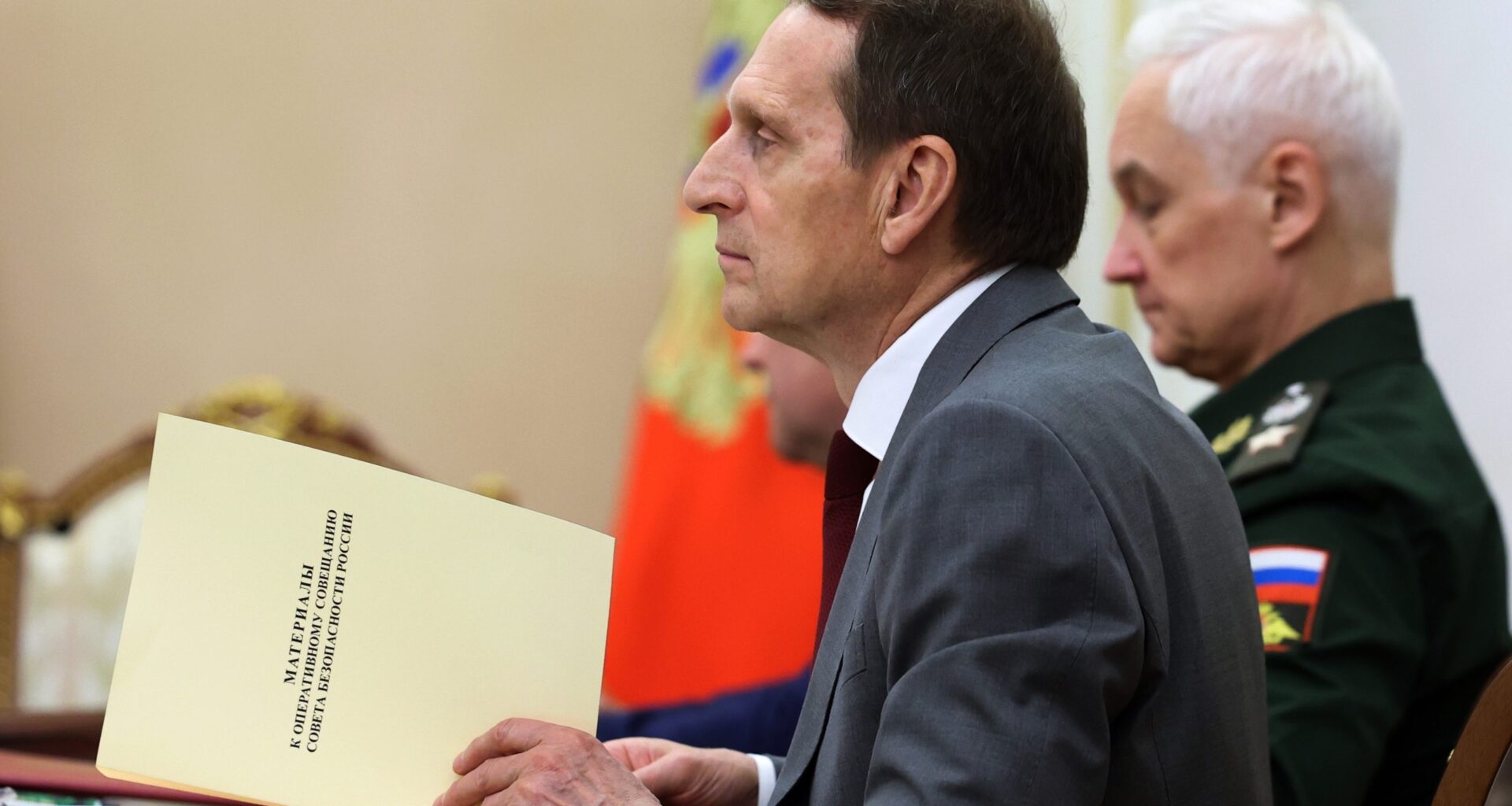
Alexander Kazakov, Sputnik, Kremlin Pool Photo via AP
Bottom Line Up Front
The U.S. Department of Justice (DOJ) has unsealed charges against five individuals connected to Russian intelligence services for conspiracy to finance terrorism, and for some, conspiracy to commit murder on U.S. soil.
Russia likely calculates that NATO cohesion is best strained by pairing brazen operations in Western Europe with information operations against the U.S. ahead of midterm elections that boost candidates who are more hesitant to support Ukraine and more interested in shifting the burden of European defense.
There is a clear risk for Russia in its escalation against the U.S.: attempted state-sponsored murder plots could serve to mobilize Washington against Moscow and bring the U.S. closer to Western Europe.
However, as Ukraine continues to advance its war effort, Russia will continue to escalate and advance its tactics against Europe, and now, seemingly, against the U.S.
The U.S. Department of Justice (DOJ) has unsealed charges against five individuals connected to Russian intelligence services for conspiracy to finance terrorism and, for some, conspiracy to commit murder. According to the DOJ, the five allegedly recruited U.S. citizens to surveil and murder Russian dissidents in the United States and Europe who had criticized the war in Ukraine. In one case, Russian nationals Yuri and Kirill Khrameev allegedly paid a U.S. citizen, identified as “U.S. Citizen-1,” $200 to surveil a dissident in Lithuania whom the indictment refers to as “Victim-2.” They later offered him $25,000 to kill the dissident, which he declined. He was subsequently asked to set fire to a warehouse. The most striking conspiracy in the DOJ’s press release, however, was an attempted assassination on U.S. soil. In this plot, alleged Russian agent Yaidel Delgado Suarez tasked “U.S. Resident-1” with surveilling a Russian dissident for $1,000 to $1,500. Suarez later offered “U.S. Resident-1” $40,000 to “eliminate” or “disappear” the victim, which “U.S. Resident-1” also declined.
The tactics employed by the Russian agents in the indictment are not novel. Russia has long utilized so-called “disposable agents” for operations across Europe. These operatives, often young people or petty criminals, are typically recruited online by Russian intelligence officers and offered small sums of cash to commit acts of vandalism or sabotage. In some cases, they are asked to carry out more serious operations in exchange for larger payments. These operations are typically quite brazen. Although Russia usually tries to maintain some air of plausible deniability, it makes little effort to hide its role in recruiting disposable agents. The goal is often to test boundaries while reminding target countries of their vulnerability to Russian covert operations. Yet while such operations have become commonplace across Europe, recruiting disposable agents for a murder plot on U.S. soil is unprecedented and marks a clear escalation in Russia’s activity against the United States.
It is not clear why Russia has escalated its tactics against the U.S. at this time. Russia’s main foreign policy goals as they relate to the West are twofold: to disrupt and undermine support for Ukraine’s war effort, and to cause fissures among the North Atlantic Treaty Organization (NATO) alliance. Russia’s strategy in recent years has been to markedly escalate its external operations against Europe (via the use of disposable agents, disinformation campaigns, territorial drone incursions, and attacks against infrastructure, to name a few) while remaining below the threshold of all-out open conflict.
Yet its strategy in the U.S. has always differed. Moscow sees the U.S. as the great power which underpins and directs NATO’s strategy and strength. It, therefore, postures itself differently towards the U.S. than it does towards Western Europe, which it views as a ‘satellite’ of the U.S. Russia targets the U.S. itself through much more plausibly deniable means, such as influence and disinformation campaigns online. The calculation has likely been that NATO cohesion is best strained by pairing brazen operations in Western Europe with information operations against the U.S. that boost candidates who are more hesitant to support Ukraine and more interested in shifting the burden of European defense back to Europe. Whether those campaigns have actually swayed an election is contested; their aim has not been. The U.S. intelligence community concluded in 2017 that Moscow sought to help Donald Trump’s candidacy, and Russian operations have continued to amplify messaging favorable to him since. To the extent Moscow was betting on Washington being more sympathetic under a Trump presidency, the bet has partly paid off. Trump has repeatedly criticized European states for their dependence on U.S. security guarantees.
There is a clear danger for Russia in its escalation against the U.S. Attempted state-sponsored murder plots could serve to mobilize Washington against Moscow and bring the U.S. closer to Western Europe. However, there are likely many reasons behind such an escalation in tactics. One may lie in the changing relationship between President Trump and Ukrainian President Volodymyr Zelenskyy. Once openly acrimonious, it has since thawed, most visibly over Ukraine’s bid to produce its own Patriot interceptors — a license Trump publicly promised at July’s NATO summit in Ankara, which he later walked back, and is still negotiating. If Moscow had indeed been counting on a friendlier White House to deliver what it wanted in Ukraine, the improving Zelenskyy–Trump relationship may have led the Kremlin to calculate that it needed to demonstrate its reach on U.S. soil.
At the same time, the news of the unsealed charges comes amid increasingly frosty relations between the U.S. and Russia. The charges were announced the same week the Lindsey O. Graham Sanctioning Russia and Iran Act of 2026 passed the House of Representatives, sending it to President Trump’s desk. The sanctions package allows the president to impose tariffs of up to 100 percent on the top five purchasers of Russian crude oil or gas. Kremlin Spokesperson Dmitry Peskov called the sanctions “hellish” and “an unfriendly act that would certainly complicate peace efforts in Ukraine.” Days before the House vote, retired General David Petraeus, the former director of the Central Intelligence Agency (CIA), was evacuated from a train leaving Ukraine as a Russian drone struck a train next to his at Yahodyn station near the Polish border. A diplomatic train carrying former British Prime Minister Boris Johnson and former Swedish Prime Minister Carl Bildt had departed the same station earlier than scheduled. Ukraine’s state railway operator said it was “entirely possible” that the diplomatic train had been the drone’s intended target. These incidents also coincide with multiple reports pointing to the level of intelligence sharing between Russia and Iran, which is currently in open conflict with the U.S. A recent CNN investigation found that 14 Russian spy satellites passed over a U.S. military base in Saudi Arabia, the Prince Sultan Air Base, two days before the site was struck by Iran on March 27.
It is clear that the DOJ’s unsealing of the charges is meant to send a message to the Kremlin, and to U.S. citizens ahead of national elections, that the U.S. will not tolerate such brazen tactics on its soil. However, as Ukraine continues to advance its war effort, Russia will continue to escalate and advance its tactics against Europe, and now, seemingly, against the U.S. Moscow has spent years probing where the threshold sits in Europe and finding that it moves. Recent events suggest that Moscow has begun to ramp up this exercise in the United States, and the U.S. has far less experience than its European allies in absorbing that kind of pressure without either overreacting or growing accustomed to it.