
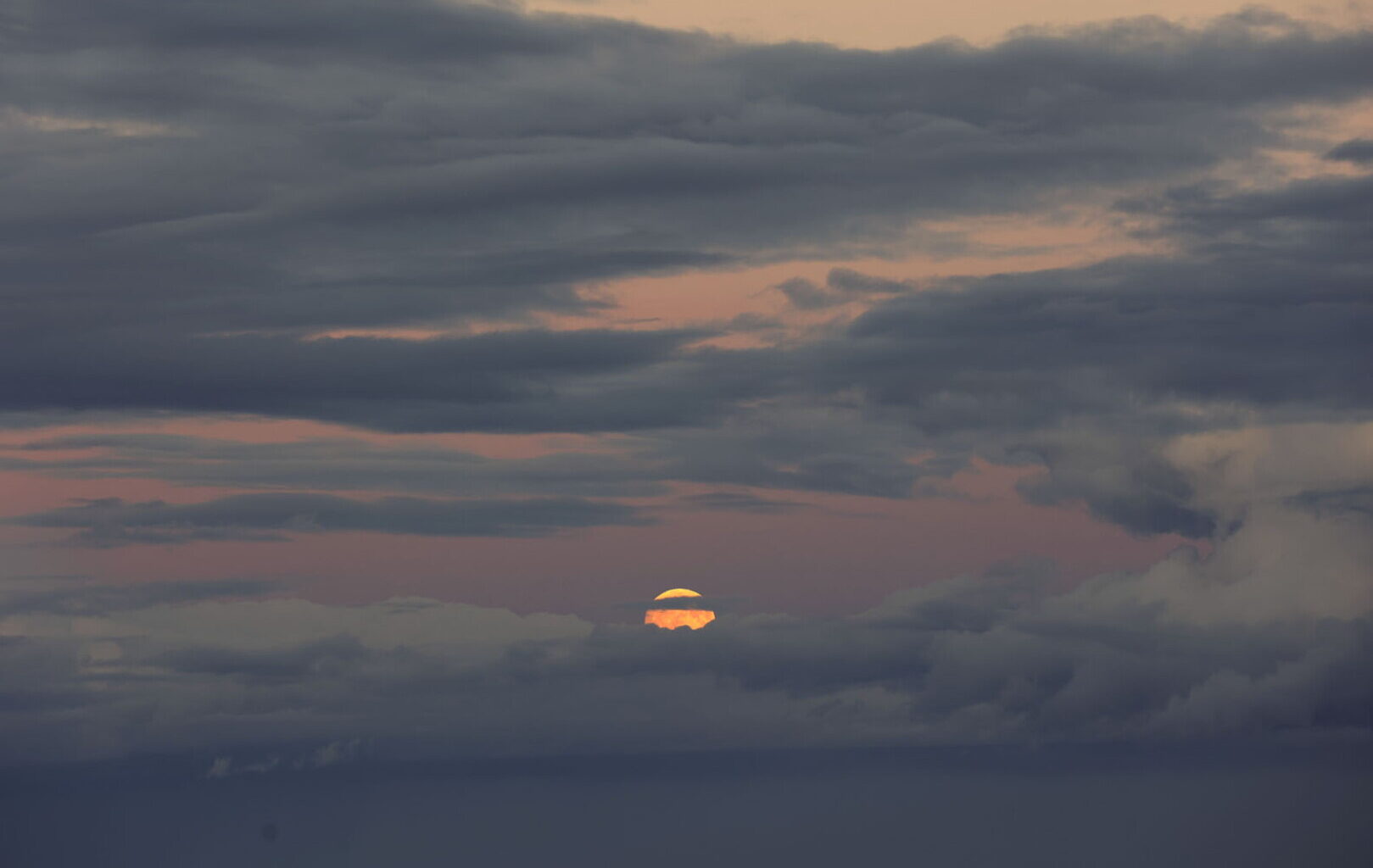
Fall begins on Tuesday, Sept. 22 at 7:05 p.m., followed by the Harvest Moon — the full moon that falls closest to the fall equinox — on Saturday night. For many of us, the first official day of fall means a change in outlook. We put our summer things away and break out the sweaters and down coats. As daylight dwindles we feel a quiet urgency to prepare for the winter ahead. The signs are all around us. Shorter days, cooler temperatures, falling leaves. Time to pay attention again after a summer of hanging loose.
When it comes to stargazing, mosquitoes are finally history. What a blessing. But now you need a hat and coat at night to keep warm, even gloves when it drops into the 40s. The biggest change is the early arrival of darkness and how long it lasts. In our region it’s fully dark by 9 o’clock and remains so until 5 a.m. Add in twilight on either end and it adds up to about 12 hours of daylight and 12 hours of nights. That equality is where the autumnal equinox gets its name.
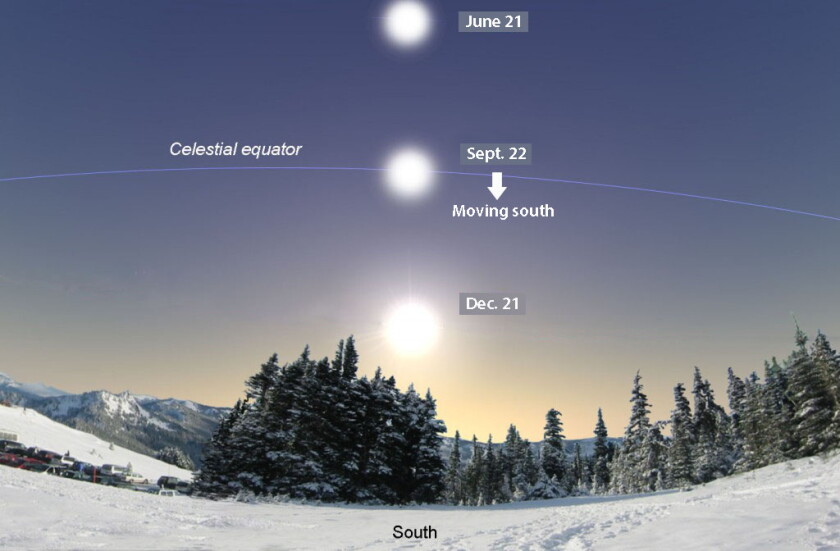
At 7:05 p.m. on Sept. 22, the sun crosses the celestial equator moving south (lower in the sky). The celestial equator is an extension of Earth’s equator into the sky as an imaginary circle. On that day the sun shines directly overhead at noon on the equator. From the north pole the celestial equator rings the horizon, so the sun circles the horizon on Sept. 22. Thereafter, it dips below the horizon and out of view for about six months.
Contributed / Stellarium with additions by Bob King
On the first day of spring, night and day are also equal, but the sun is moving north (up) in the sky. As it climbs higher and higher, days get longer and temperatures rise. On Sept. 22, the sun’s heading south to its winter haven in the “basement” of the heavens. Nights lengthen and temperatures drop. You know the drill.
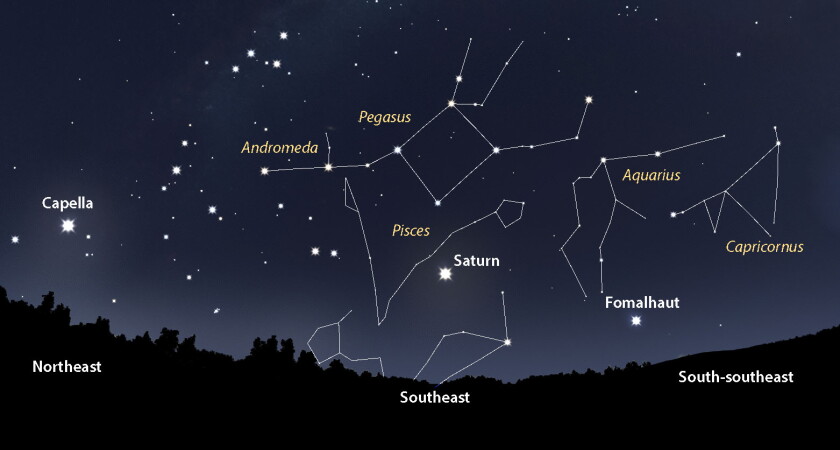
Many of the fall constellations, which shine in the eastern sky in late September, are on the faint side. Standout objects include Fomalhaut, Saturn, Capella and the W of Cassiopeia, at top. The view shows the sky around 10 p.m.
Contributed / Stellarium
The constellations also change with the seasons. As if in harmony with the diminishing daylight, the early autumn constellations are fainter than their summer and winter counterparts. These are the groups that currently reside in the eastern half of the sky. None have a bright star to their name. They include Aquarius, Capricornus, Cetus and Pisces. Pegasus and Andromeda are overall brighter and easier to see, but neither has a first-magnitude-class star like Orion’s Betelgeuse. For a time, we still hang on to the Milky Way and the Summer Triangle’s trio of bright stars. But these warm-weather sights are turning westward and will soon slip away.
Just three bright objects stand out among the fall stars — Fomalhaut in Piscis Austrinus the southern fish, located very low in the southeastern sky around 10-11 p.m., Saturn, also in the southeast but higher up, and bright Capella low in the northeast. If you want more luminaries you’ll have to wait until after 2 a.m., when Orion and his winter reinforcements arrive.
Fall also brings the Harvest Moon on Sept. 26, which rises for the Duluth area at 6:43 p.m., 15 minutes before sunset. After shedding its orange skin it dazzles all night in the company of Saturn, located one balled fist to the moon’s left. On successive nights just before and after full phase, the moon rises only 15-20 minutes later instead of its usual hour. Even a casual observer will notice that the moon shows up in the east at nearly the same time each night as if stuck in idle.
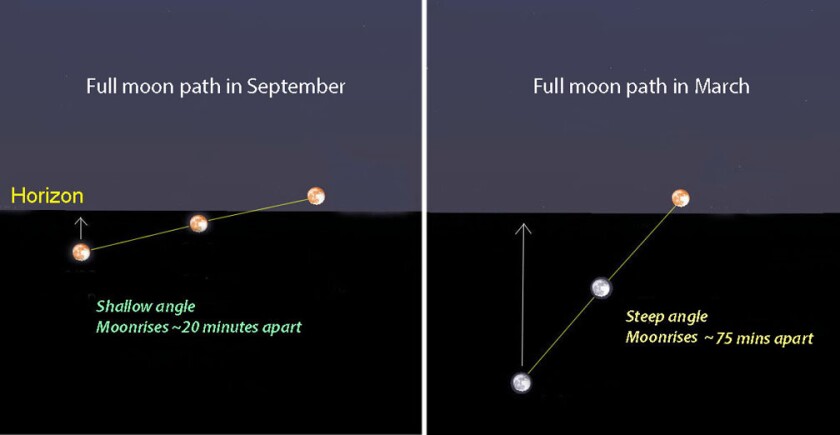
In late summer and early fall the full moon’s path lies at a shallow angle to the horizon. For several nights in a row it never dips very far below the horizon, so moonrise times are under 20 minutes apart. The opposite occurs in spring when the path slants at a steep angle, delaying successive moonrises by more than an hour.
Contributed / Bob King
As the moon orbits Earth it moves to the east (left when facing south) about one outstretched fist each night. A full moon rises around sunset. One day after full it typically rises about an hour after sunset. Two days after full it rises 2 hours after sunset and so on. However, around the fall equinox, the full moon’s path makes a very shallow angle to the horizon. While it keeps moving east a fist a night, most of that movement is along the horizon. Very little of it makes the moon dip below the horizon. So it comes up at nearly the same time on successive nights.
Here are the Duluth moonrise times around Harvest Moon:
Sept. 22 at 5:32 p.m.
Sept. 23 at 5:51 p.m.
Sept. 24 at 6:09 p.m.
Sept. 25 at 6:26 p.m.
Sept. 26 at 6:43 p.m.
Sept. 27 at 7:02 p.m.
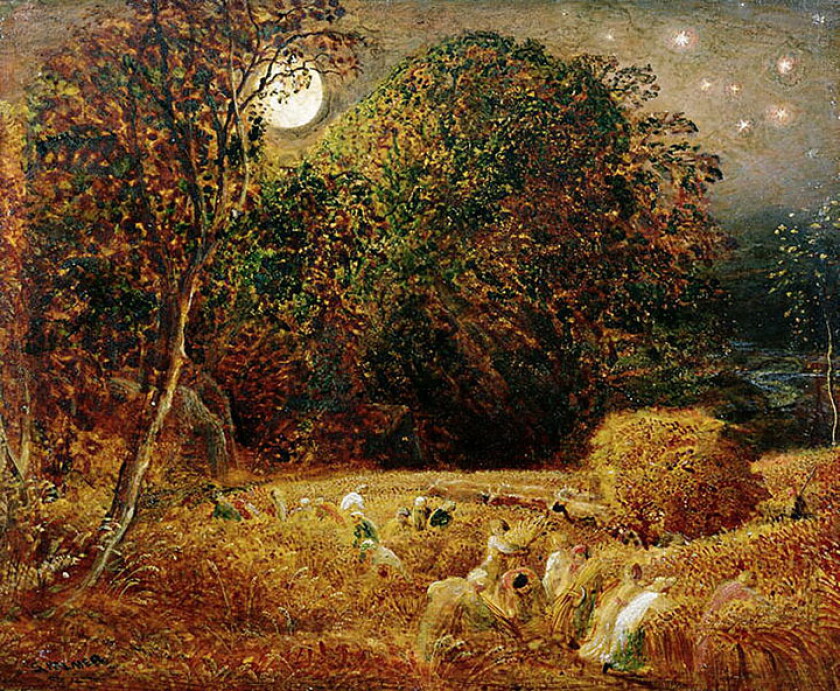
Farm workers bundle sheaves of corn in “The Harvest Moon” (circa 1833) by British painter Samuel Palmer.
Contributed / Public domain
The difference between successive moonrises varies from just 17 to 19 minutes! This “stalling” of the moon provided additional moonlight for our ancestors to harvest crops through the night, hence the Harvest Moon. For most of human history electric lighting was nonexistent and using torches around dried grain would have been a fire hazard. These days we gaze at the sky to appreciate and learn. But there was a time when the moon and stars set the rhythm of daily life.

“Astro” Bob King is a freelance writer and retired photographer for the Duluth News Tribune. You can reach him at nightsky55@gmail.com.