
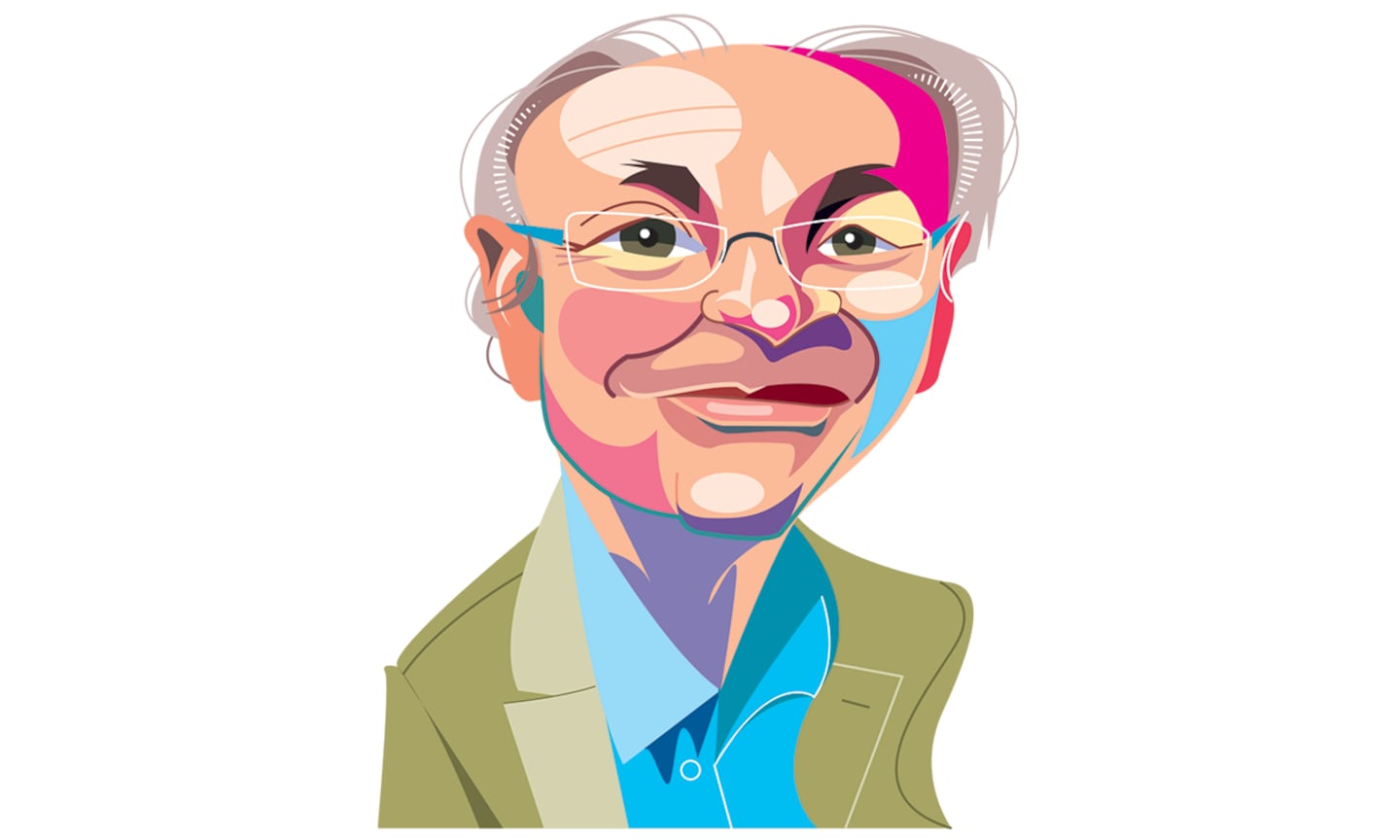
One of the main reasons Krieger started writing the memoir was the increasing demonization of immigrants that he’s witnessed in recent years. “The distance we’ve come from being an accepting immigrant’s nation versus now actually motivated me as much as anything else,” Krieger said.
The book does cover Krieger’s storied career, ranging from neophyte architect working on the Red Line extension to Alewife to sage adviser for Harvard as it developed ambitious plans for its Allston real estate.
Krieger launched a small boutique architectural firm with cofounder Lawrence Chan in the 1980s. Around 15 years ago, they merged the business, then called Chan Krieger Sieniewicz, with the much larger NBBJ out of Seattle. He also maintained a long teaching career at Harvard’s Graduate School of Design.
At 75, he’s essentially retired now, though he still teaches at Northeastern University and Wentworth Institute of Technology. Among other contributions, Krieger was an organizer behind building the New England Holocaust Memorial along Congress Street in the 1990s.
“My involvement as an architect and my involvement as a teacher were responses to thanking America for providing these opportunities,” Krieger said. “That’s an immigrant’s instinct. That’s what’s so strange today — that they’re being perceived as takers, rather than contributors.”
Wu chats housing at Chamber
Mayor Michelle Wu told Boston’s business community last week that the city should use every tool at its disposal to address the housing crisis.
Well, maybe not every tool. She’s not ready to embrace the idea of lowering the city’s affordable housing mandate.
Speaking to the Greater Boston Chamber of Commerce, Wu rattled off accomplishments such as a downtown revival and hosting recent World Cup activities. She also announced the hiring of her new economic chief, Emily Knight, from The Engine, the MIT-affiliated tech accelerator, and the launch of a new fund to prepare for the city’s 400th anniversary celebrations, seeded by $4 million from Rob Waldron and Jen Waldron.
Wu highlighted two businesses — Moderna and Commonwealth Fusion Systems — that aren’t even in Boston, plus she heralded the opening of Singapore’s new “enterprise hub” in Cambridge. That’s all part of a message she has been trying to convey lately: The local economy doesn’t stop at city lines.
Much of her speech focused on what City Hall is doing to spur housing construction — a sore spot for many in the room who believe she isn’t doing enough to usher in more building.
Wu just started offering property tax abatements to help apartment developers, she’s meeting with reps from union pension funds to encourage them to invest, and she promised a new streamlined permitting process starting Oct. 1.
But chamber chief executive Jim Rooney brought up the city’s inclusionary zoning policy, which essentially requires 20 percent of units in larger projects be set aside for affordable purposes. The chamber wants a statewide cap on such policies at 10 percent. While saying her administration has studied the idea of lowering it, Wu downplayed the impact it could have, and didn’t seem ready to budge.
“She’s a very smart mayor,” Rooney said afterward. “Like the rest of us, she sees there are no cranes in the sky.”
Banking on C-suite change
The first chief executive of the newly created Beacon Bank came from one of its predecessor banks, Brookline Bank. Now, his successor will be from the other one, Berkshire Bank.
On Monday, Beacon announced that chief executive Paul Perrault had retired, though he’ll stick around with a $120,000-per-month consulting contract for the next year.
The board named Sean Gray, 50, as Perrault’s replacement as chief executive of Beacon Bank and its holding company, Beacon Financial. Gray had been the chief operating officer since the merger took effect a year ago, and had been president and COO at Berkshire before the merger.
When the merger happened, an even number of board members came from each of the predecessor banks. Now, the chairman, David Brunelle, and its chief executive, Gray, are both Berkshire alums. The bank, based in the Back Bay, recently reported $22 billion in assets, and roughly 2,000 full-time employees.
In a prepared statement, Gray emphasized how Beacon is well positioned to grow under his leadership, but promised (in bank marketing-speak) that Beacon won’t lose its personal touch in the process: “We will continue to support our regional operating model, local decision-making and market-centered leadership.”
T.A. Demoulas has remained out of the public eye since the board that oversees Market Basket suspended him, his father Arthur T. Demoulas, and his sister Madeline Demoulas in May of 2025.
Now, though, he’s set to enter the spotlight as he gets recognized by the Alpha Omega Council. The Greek-American organization is honoring him on Oct. 2 with its Emerging Leader Award as part of its 50th anniversary celebration. Journalist Nancy Agris Savage will also be honored.
In case you missed the most recent Demoulas family saga, Arthur T. Demoulas, the longtime Market Basket chief executive, argued that he and his kids were pushed out because of a feud with Arthur’s three sisters, who together own a majority of the company. Arthur wanted T.A. or Madeline to succeed him, but his sisters disagreed, and the board eventually fired him. A Delaware Chancery Court judge ended up ruling that the board was within its rights to do so. (The Tewksbury-based supermarket chain is currently led by president Chuck Casassa.)
The announcement about T.A.’s award makes no mention of this imbroglio, and instead focuses on his leadership at the company, which he joined full time in 2014, and his “commitment to family and community.”
“I’m proud of the contributions my family has made over many generations,” T.A. said in a prepared statement, “and I look forward to continuing that legacy.”
Waltham attorney Harry Vlachos, the council’s president, singled out T.A.’s grocery prowess. “He knows that business,” Vlachos said in an interview. “When you get to the third generation, . . . that’s when the empire usually starts crumbling. He’s brought it on to the fourth. He has a remarkable history, and we wanted to recognize him.”
Last year, Staples brought back the Easy Button.
Now, the Framingham-based office supplier is rolling out a counterpart: the Hard Button.
In a new ad campaign, Staples contrasts its red “Easy Button” and its black “Hard Button” to underscore why customers should choose Staples over its competitors. The slogan: “Don’t choose hard. Choose Staples.”
The videos highlight somewhat farfetched scenarios such as one bedraggled worker at a sporting goods store handing someone a toilet paper roll under a bathroom stall, or confronting a comatose colleague seemingly done in by an empty coffee pot. Then, the contrast with situations that go almost too smoothly: a Staples delivery person magically appears to install new bathroom soap, or accept a hug for stocking the java.
Bob Sherwin, the company’s chief marketing officer, says the hope is to inform viewers that Staples offers more than a place to stock up on pens and paper or pick up new printer cartridges. Think: breakroom supplies, sign printing, or laptop procurement.
To pull it off, the internal marketing team of the Sycamore Partners-owned company received help from agency Bandits & Friends to work on the concept, and Monks for the ad production.
“We’ve never told the story of what makes working with Staples easy,” Sherwin said. “Let’s juxtapose working with Staples versus the alternatives, and let’s do it in a way that’s fun, and a little bit hyperbolic.”
Jon Chesto can be reached at jon.chesto@globe.com. Follow him @jonchesto.