
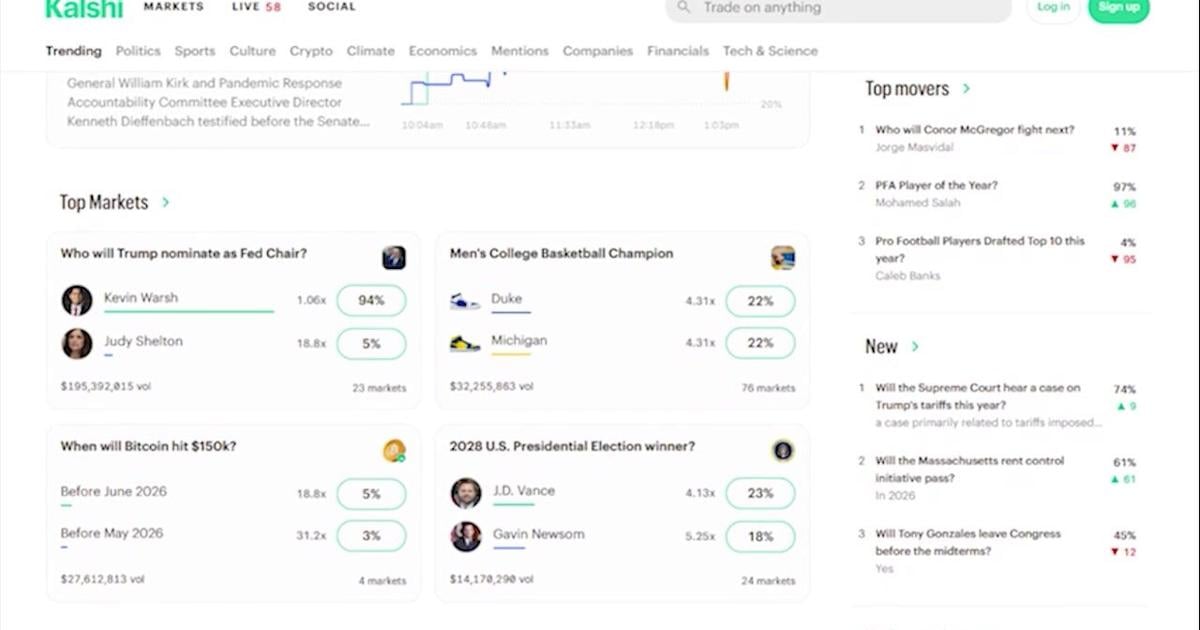
Kalshi and the state of Montana have jointly agreed to dismiss a lawsuit challenging the state’s authority to regulate them under Montana’s gambling laws. While the decision cools tensions, the dispute could flare up again depending on what happens in the future.
Montana was one of 19 states that had issued direct enforcement or legal actions against the multi-billion-dollar prediction market in the past year. The actions came after Kalshi added sports outcomes to its offerings.
“Once Kalshi introduced this product in early 2025, sports prediction markets, it was a game changer,” said Michael McCann, who has been closely tracking the Kalshi lawsuits.
McCann has two decades of legal experience. He is Associate Dean for Academic Administration and Intellectual Life and Founding Director of the Sports and Entertainment Law Institute at the University of New Hampshire Franklin Pierce School of Law. He is also currently a visiting professor at Harvard Law and a Senior Sports Legal Reporter for Sportico.
Kalshi operates nationwide as a “CFTC-regulated exchange.” Their prediction-market app offers “event contracts” that users buy with money based on whether a predicted future event happens. Those who predict correctly get paid out; those who get it wrong lose that money.
Some have argued it is essentially gambling, while Kalshi says it is more like a stock market.
In 2018, the United States Supreme Court struck down a federal ban on sports wagering. That ruling paved the way for 39 states to create and regulate some form of sports betting. In Montana, the Montana Lottery manages sports betting.
When Kalshi offered its sports-based option last year, Montana issued a cease-and-desist, seeing it as a form of sports betting.
“I mean, it certainly seems a lot like betting,” McCann said. “And because at the end of the day, it’s about making a prediction, which is a bet as well, right, that we’re predicting on the outcome of a game or whether a player will do well or not do well in a particular game or within a game. So they’re similar in that regard.”
McCann noted a big difference between what prediction markets are doing and what states have been doing. No sportsbook sets the odds for prediction markets; users determine them.
“With sports betting, there’s a house; there’s setting the line by the sportsbook. With Kalshi, it’s different,” he explained. “The company itself doesn’t set the line. It’s based on a market. It’s arguably more like buying a stock in that regard, that the market is set by people who are entering into these prediction market contracts.”
Kalshi has seen success and setbacks in its legal challenges over the last year.
Most recently, the 9th U.S. Circuit Court of Appeals – the circuit Montana is located in – ruled against Kalshi in two key cases, KalshiEX, LLC v. Assad involving the State of Nevada and Blue Lake Rancheria v. Kalshi involving two California tribes. The three-judge panel ruled unanimously that states and tribes had the authority to regulate Kalshi under local gambling laws.
However, Kalshi also saw the 3rd U.S. Circuit Court of Appeals rule in favor of the prediction market regarding the State of New Jersey lawsuit, KalshiEX, LLC v. Flaherty. The judges were split 2-1, saying the state had no authority to regulate Kalshi. The state of New Jersey is not calling on the United States Supreme Court to take up the matter.
“So that at least creates the possibility that the US Supreme Court will intervene and weigh in on this,” McCann said. “And it would be really interesting because this is not like some topics are kind of like conservative or liberal. This isn’t like that. This is about how do you interpret federal law? What powers should states have? When can state law be preempted? What exactly is this product? Is it sports betting or is it something sufficiently distinct?”
Waiting to see what happens with the higher courts has been one of the defining factors of the lawsuit Kalshi brought against the State of Montana back in April. The case consistently stalled, with Kalshi filing for extensions while the Nevada case played out.
This past week, all parties involved filed a joint stipulation for dismissal. Under the agreement, Kalshi drops its claims against Montana, and the state’s gambling enforcement will not take action to regulate it.
The Montana Lottery Commission side of the lawsuit was dismissed with prejudice, meaning it cannot be brought again before the court. The Department of Justice side was dismissed without prejudice, meaning they could bring legal action against Kalshi at a later date.
“We are pleased Kalshi agreed to dismiss the lawsuit while we wait on a decision from the Ninth Circuit Court of Appeals in the related case,” Montana DOJ spokesperson Amanda Braynack said in a statement.
Nonstop Local reached out to the Montana Lottery and Kalshi for comment. The Lottery said it did not have comment at this time, and Kalshi did not return requests for comment.
For now, Kalshi’s sports products are legal in Montana and not regulated by state law. But that could change depending on what happens in other courts; then Big Sky Country will have to weigh the odds of taking it up again.