
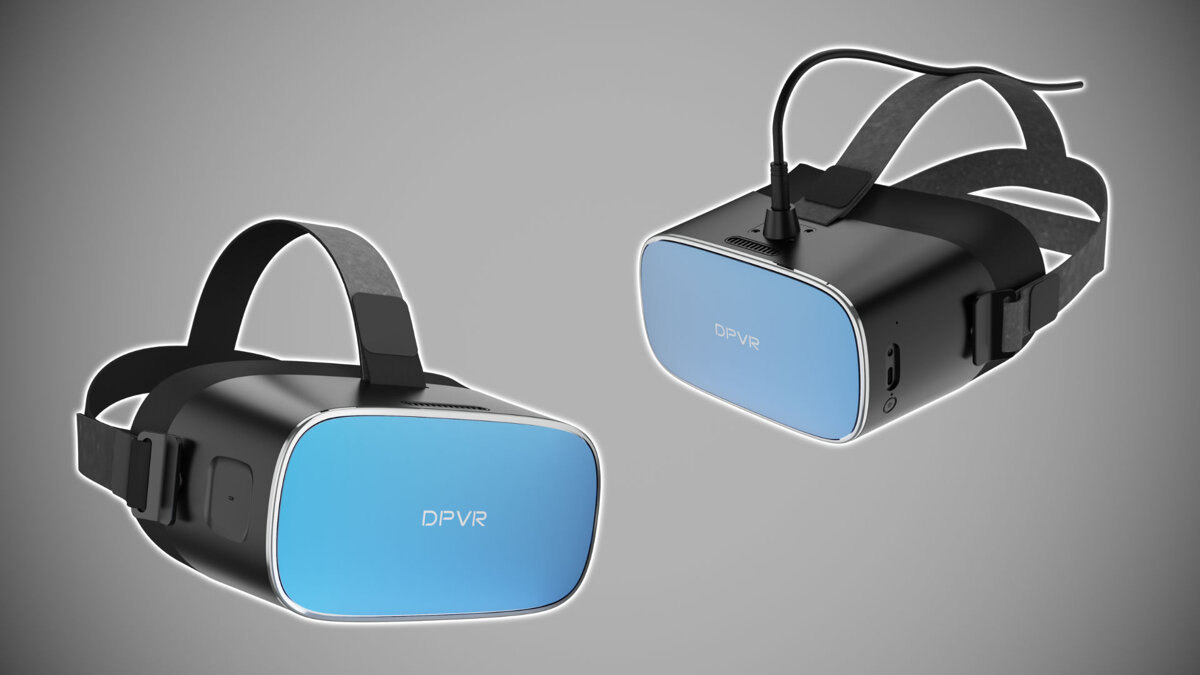
The Chinese VR manufacturer DPVR first presented the P1 Max VR headset in August last year in Shanghai. Now the release in Europe and specifically in Germany is set to follow. Three versions are planned, which are primarily intended for use in education, medical facilities, industry, simulations, culture, and location-based VR arcades.
All P1 Max models feature Qualcomm’s Snapdragon XR2 chip, complemented by 8 GB of RAM, 128 GB of internal storage, and an SD card slot for up to 2 TB. The XR2 is Qualcomm’s first XR chip generation from 2020. Current VR headsets like the Meta Quest 3 use the newer XR2 Gen 2, which is significantly more powerful in terms of graphics performance. With the Snapdragon Reality Elite, the next generation is already in the pipeline. However, for B2B use of the P1 Max, the older chip should be sufficiently efficient and significantly more cost-effective.
Three models for different use cases
The display of the P1 Max reaches 3664 × 1920 pixels across both eyes, and videos can be decoded up to 8K. Wi-Fi 6, USB-C, and a separate Type-C interfaces for additional modules are also included. The standard version of the P1 Max is a standalone VR headset, similar to the Meta Quest 3 or Pico 4 Ultra, with an integrated 4000-mAh battery. DPVR does not provide any information on battery life. Comparable devices with similar batteries and chips typically last about two to three hours, depending on the application.
Read alsoMehr anzeigenWeniger anzeigen
For those who need longer runtimes, there is a variant with an external power supply. The connection is at the top of the device, which is intended to simplify cable management in training facilities, exhibition halls, or VR arcades. In addition, the housing features active cooling with two air channels and openings at the top and bottom. According to DPVR, the third version is still in development. It is said to feature an eye-tracking module that captures eye movements 120 times per second. The company names eye tests, ophthalmology, visual training, research, reaction analysis, and fixation point evaluation as areas of application.
German launch from 549 Euros
DPVR has also confirmed the German launch of the P1 Max series to heise online. Companies, research, and educational institutions can already register for test samples. The battery version is expected to cost 549 Euros, the wired model 649 to 749 Euros depending on the cable (plastic or steel sheathing). For eye tracking, DPVR quotes a target price of under 1,000 euros. Final terms and availability are expected to follow at the official launch.
Companies can have hardware, firmware, interfaces, housing, and branding customized as an OEM order. In the B2B VR market, DPVR primarily competes with HTC Vive and Pico, which also offer OEM and enterprise versions of their headsets. Meta discontinued the B2B program for Quest headsets at the beginning of the year.
(joe)
Don’t miss any news – follow us on
Facebook,
LinkedIn or
Mastodon.
This article was originally published in
It was translated with technical assistance and editorially reviewed before publication.
Dieser Link ist leider nicht mehr gültig.
Links zu verschenkten Artikeln werden ungültig,
wenn diese älter als 7 Tage sind oder zu oft aufgerufen wurden.
Sie benötigen ein heise+ Paket, um diesen Artikel zu lesen. Jetzt eine Woche unverbindlich testen – ohne Verpflichtung!