
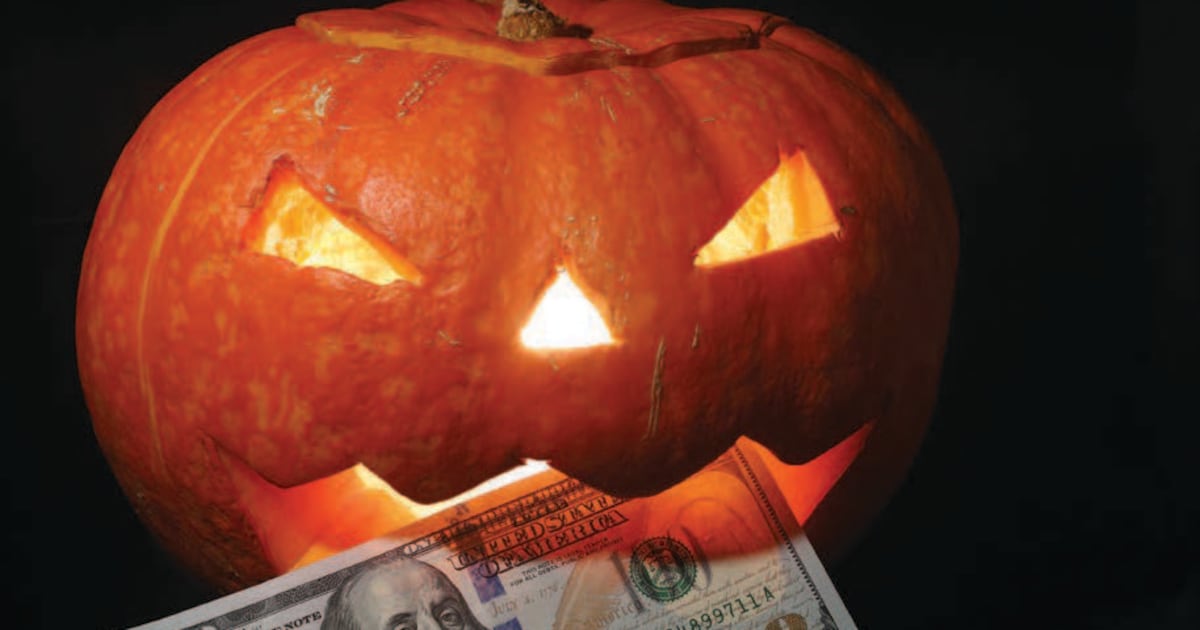
Every October, as porch lights glow orange and plastic skeletons take up residence on front lawns, people become fond of stories designed to unsettle the spirit. This is perfectly understandable. Human beings have always enjoyed a good fright, provided they knew the monster was wearing makeup and would be put back in a storage bin by Thanksgiving.
The trouble begins when investors start treating the stock market as though it were one of those haunted houses.
Our team has discovered that the financial world has its own collection of ghosts, goblins and creatures of the night. There is the Phantom Recession that is said to be hiding around every corner. There is the Headless Market Correction, which appears suddenly and leaves perfectly sensible people galloping about without the use of reason. Then there is the Werewolf of Volatility, who visits every so often and convinces investors that civilization itself is in jeopardy because the market declined 3 percent before lunch.
The peculiar thing is that these specters are often less dangerous than the fear they inspire. Fear is one of the oldest residents of the human heart. It moved in long before air conditioning and has shown no inclination to leave. As a wealth manager, I have observed that investors usually suffer more from their reactions to frightening events than from the events themselves.
The market falls. Headlines become dramatic. Predictions become theatrical. A gentleman who ignored financial news for six months suddenly becomes an expert in economic catastrophe and feels compelled to inform everyone at the coffee shop that the end is imminent.
Yet history reveals an inconvenient fact. The market has survived wars, recessions, inflation, political quarrels, technological revolutions, banking crises, pandemics and a remarkable number of experts predicting its demise. Like an old riverboat captain, it has encountered nearly every sort of storm imaginable and still found its way downstream. That does not mean every voyage is smooth. It merely means that turbulence is the fare paid for passage.
Many people imagine successful investing to be a matter of perfect timing. They hope to board the train moments before it departs and disembark moments before trouble arrives. This ambition is understandable, but it reminds me of a fellow trying to predict the exact location where lightning will strike next Thursday.
The world has never produced a reliable method for consistently forecasting short-term market movements. If one existed, Wall Street would be populated exclusively by trillionaires and fortune tellers.
What has worked, however, is remarkably unexciting.
• Invest regularly.
• Stay diversified.
• Remain patient.
• Avoid panic.
These principles are so boring that they rarely make the evening news. Nobody interrupts a television broadcast to announce that disciplined investors calmly followed their long-term plans. There is simply no drama in common sense.
And yet common sense has built more wealth than excitement ever has.
Consider Halloween itself. A child wearing a vampire costume may appear terrifying in the twilight. By daylight, however, the vampire is revealed to be a third-grader named Tyler who still needs help tying his shoes.
Market fears often behave the same way.
When uncertainty first appears, it seems enormous. Headlines magnify it. Conversations repeat it. Social media decorates it with flashing lights and ominous music.
Given enough time, many of those fears turn out to have been temporary visitors rather than permanent residents.
That is why long-term investors must occasionally resist the temptation to treat every spooky headline as a prophecy. The financial press is in the business of reporting events. Your retirement account is in the business of benefiting from decades of human innovation, productivity, and economic growth. These objectives are not always synchronized.
The newspaper focuses on this afternoon.
Your financial future may depend on the next 20 years.
I often tell clients that the stock market is a device that transfers wealth from the impatient to the patient. Admittedly, I did not invent that observation, but I have seen enough evidence to become one of its enthusiastic believers.
The greatest rewards in investing rarely belong to those who were fearless. They belong to those who felt fear and continued forward anyway. Courage is not the absence of anxiety. It is the decision that anxiety will not be permitted to drive the wagon.
So as Halloween approaches, enjoy the haunted houses. Carve the pumpkins. Hand out candy. Tell ghost stories to your grandchildren. Participate in every seasonal superstition that brings a smile.
But when it comes to your investments, do not allow imaginary monsters to occupy the driver’s seat. The market will continue doing what it has always done. Some days it will delight us. Some days it will test our patience. Occasionally it will behave in a manner that appears to have been designed by a committee of caffeinated raccoons.
Nevertheless, the long arc of investing has rewarded those who remained committed to a sound plan. In the end, the scariest investment story is usually not the market decline that happened. It is the opportunity that was abandoned because fear convinced someone to stop believing in the future.
And that, unlike Halloween, is a ghost worth avoiding.