
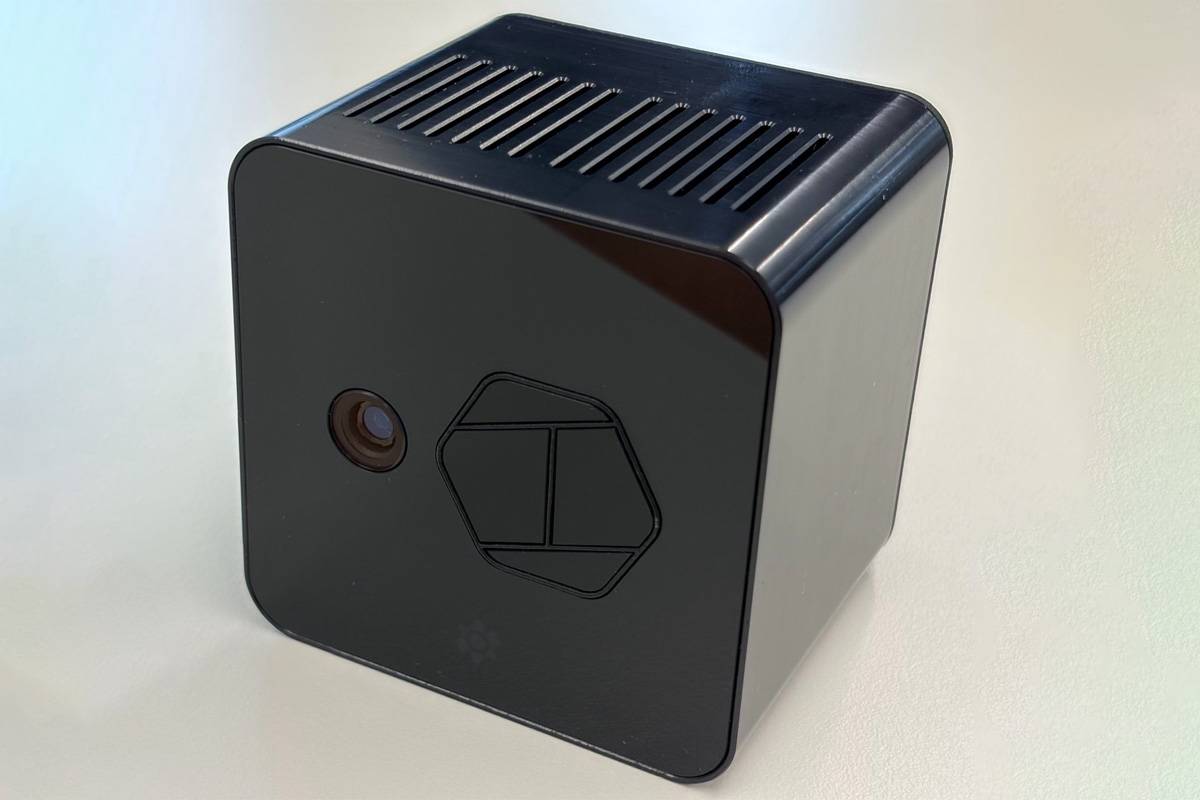
South Korean startup Soulart has launched the Soulart Station, a markerless full-body motion tracker for VR, VTubing, and motion capture. The device uses a Time-of-Flight (ToF) sensor and an onboard Neural Processing Unit (NPU) to capture 3D point cloud data and process motion tracking on the device.
By running machine learning models locally, it avoids expensive PC-side GPU computation or cloud processing, delivering 23-joint 6DoF motion data with a claimed ML latency under 10 milliseconds.

Soulart Station specifications:
SoC – TBD; They only mention
Onboard dual-core NPU and built-in graphics processor
Fully on-device processing (no PC GPU or cloud required; only motion data is transmitted for privacy)
Connectivity – Wi-Fi
Sensors
Custom Time-of-Flight (ToF) module (940 nm IR)
4K RGB + NIR cameras
Tracking
Method – Markerless 3D scan + on-device ML pose (no wearables, suits, or pucks required)
Point cloud – ~300,000 points (millimeter-scale) with sub-1% error
Scan Rate – Up to 120 Hz / 120 FPS
Pose accuracy – < 20 mm error per station (improves with multi-unit setups)
Output data – 23-joint 6DoF motion data
ML latency – < 10 ms (on-device model only)
Supports single or multiple Stations with ToF interference cancellation and up to 120 Hz capture across 50 m²
USB – 1x USB Type-C port for power and data
Misc
1/4″ camera threads on back and bottom for mounting
Rear power button
Power – 12V DC, 2A via a rear charging port
Dimensions (W x D x H) – 75 x 75 x 70 mm
Weight – 280g
Mounting – 2 x 1/4″-20 UNC threaded mounting holes (1 rear, 1 bottom)
Certification – IEC 60825-1 Class 1 Eye-Safe (underway)
 Soulart Station dimensions and connectivity options. Image Enhanced with Grok
 Soulart Station all-side view. Image Enhanced with Grok
On the software side, the cross-platform Soulart App manages the Stations and routes motion-tracking data to supported applications across Windows, Meta Quest, and Android XR, with a SteamVR driver for SteamVR. It supports features like Live Preview and Automatic Avatar Retargeting, as well as VMC, OSC, and BVH streaming, along with BVH/FBX export and integrations with VTube Studio, Warudo, VBridger, Unity, Unreal Engine, Blender, Maya, MotionBuilder, and ROS2.
The system also features a “Hub Mode,” where one Station can combine data from other Stations and handle additional ML processing locally, reducing the need for PC-side processing. Soulart plans to open-source the app and plugins in early 2027, but the Station firmware will remain closed source. The team also plans to roll out free OTA updates to add facial tracking in H1 2027 and hand tracking in H2 2027.
 Soulart App running across Windows, Meta Quest, Pico, macOS, Android, and iOS
Previously, we covered full-body tracking systems like the open-source SlimeVR Butterfly Trackers, which use wearable IMU sensors but can experience drift and require sensors to be attached to the body. In contrast, the Soulart Station uses ToF-based markerless tracking with interference cancellation for multi-Station setups and an onboard NPU for motion processing.
 Multiple Stations reduce blind spots and cover up to 50 m² at 120 Hz
Soulart Station is currently on Kickstarter, where it has raised over $450,000 so far, surpassing its $300,000 goal. Pledges start at $419 for a single Station, while the two-Station and eight-Station packages cost $799 and $2,850, respectively. Shipping is extra and is estimated at around $50 for the US. The first units are expected to ship in June 2027.

Debashis Das is a technical content writer and embedded engineer with over five years of experience in the industry. With expertise in Embedded C, PCB Design, and SEO optimization, he effectively blends difficult technical topics with clear communication
Support CNX Software! Donate via cryptocurrencies, become a Patron on Patreon, or purchase goods on Amazon or Aliexpress. We also use affiliate links in articles to earn commissions if you make a purchase after clicking on those links.