
Edge Computing In Healthcare Market
The healthcare industry is witnessing a transformative shift with the rise of edge computing technologies. As digital tools become more integral to medical operations, edge computing is playing an increasingly vital role in enhancing patient care and clinical efficiency. Let’s explore the current market size, key drivers, leading companies, emerging trends, and market segmentation shaping the future of edge computing in healthcare.
Projected Expansion and Market Size of Edge Computing in Healthcare
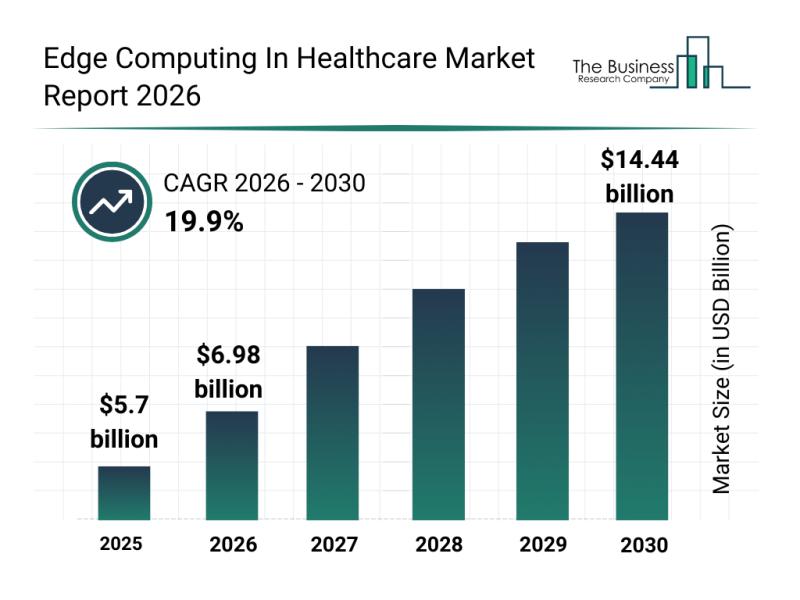
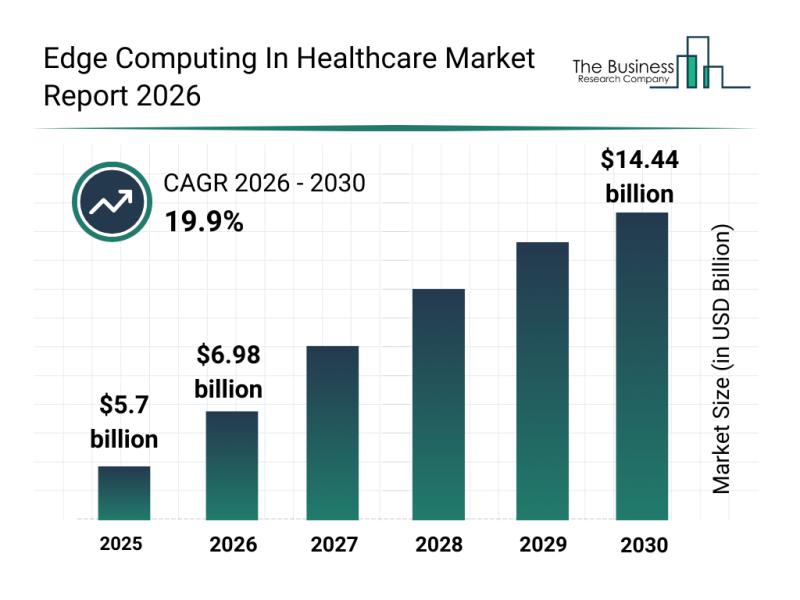
The edge computing in healthcare market has experienced significant growth recently and is expected to continue this trend. From $5.7 billion in 2025, the market is projected to increase to $6.98 billion in 2026, growing at an impressive compound annual growth rate (CAGR) of 22.5%. This growth during the historical period stems from factors such as the digital transformation of healthcare processes, increased adoption of connected medical devices, rising demand for remote patient monitoring, expanding hospital IT infrastructure, and wider use of electronic health records.
Looking ahead, the market is predicted to expand rapidly, reaching $14.44 billion by 2030 with a CAGR of 19.9%. This forecasted growth is driven by rising investments in telehealth infrastructure, increasing demand for AI-powered diagnostics performed at the edge, growth in wearable healthcare technology, a stronger focus on real-time clinical decision support, and heightened regulatory attention on data sovereignty. Key trends expected to influence the market include greater use of edge analytics in clinical environments, broader adoption of real-time patient monitoring systems, enhanced integration of edge devices with medical IoT, more deployment of low-latency healthcare applications, and an amplified emphasis on data privacy and security at the edge.
Download a free sample of the edge computing in healthcare market report:
https://thebusinessresearchcompany.com/sample_request?id=55722124&type=smp&name=Edge%20Computing%20In%20Healthcare%20Market%20Report%202026&utm_source=OpenPR&utm_medium=paid&utm_campaign=Sep_PR
Factors Propelling Growth in Edge Computing for Healthcare
One primary factor accelerating the market is the extensive digitalization of healthcare workflows. The integration of connected medical devices and growing hospital IT infrastructure are revolutionizing how care is delivered and monitored. This transformation enables more efficient patient management and data-driven clinical decisions.
Additionally, the rising need for remote patient monitoring is significantly influencing market expansion. With more healthcare providers adopting electronic health records and telehealth solutions, edge computing helps process data closer to the source, facilitating faster and more reliable healthcare services.
View the full edge computing in healthcare market report:
https://thebusinessresearchcompany.com/report/edge-computing-in-healthcare-global-market-report?utm_source=OpenPR&utm_medium=paid&utm_campaign=Sep_PR
Key Players Leading the Edge Computing in Healthcare Market
The competitive landscape of the edge computing in healthcare market features several influential corporations, including Google LLC, Samsung Electronics Co., Microsoft Corporation, Verizon Communications Inc., Dell Technologies Inc., Amazon Web Services (AWS) Inc., Lenovo Group Limited, General Electric Company, Intel Corporation, IBM Corporation, Cisco Systems Inc., Qualcomm Incorporated, Hewlett Packard Enterprise Company, Fujitsu Limited, NVIDIA Corporation, Nokia Corporation, Siemens Healthineers AG, Koninklijke Philips NV, VMware Inc., Advantech Co. Ltd., Aruba Networks Inc., ADLINK Technology Inc., Huawei Technologies Co. Ltd., Litmus Automation Inc., Veea Inc., and FogHorn Systems Pvt Ltd.
In a notable move in January 2023, Dell Inc., a US-based technology services and computer developer, acquired Cloudify, a company specializing in edge computing for healthcare based in Israel. This acquisition aims to enhance Dell’s cloud service offerings, particularly in DevOps, by integrating Cloudify’s cloud orchestration and infrastructure automation platform, thereby broadening Dell’s edge computing capabilities.
Emerging Trends Shaping the Future of Edge Computing in Healthcare
Industry leaders are prioritizing the development of innovative technologies such as edge-processed computer vision intelligence solutions. These tools use on-device artificial intelligence to provide faster clinical insights, improve the accuracy of patient monitoring, and support real-time decision-making at the point of care. By processing visual data locally, healthcare providers can detect patient conditions, issue alerts, and monitor continuously with reduced latency and enhanced data security.
For example, in August 2024, Caregility Corp., a US-based telehealth company, launched its first edge-based computer vision AI specifically designed for healthcare settings. This solution offers on-device AI processing to support applications like continuous patient observation, fall detection, and early warnings for clinical deterioration. This innovation minimizes delays and boosts data privacy, reinforcing Caregility’s suite of intelligent virtual care solutions and addressing the growing need for prompt, high-performance edge computing in hospitals and clinical environments.
Detailed Segmentation of the Global Edge Computing in Healthcare Market
The market for edge computing in healthcare is segmented across multiple dimensions:
1) By Offering:
– Hardware
– Software
– Services
2) By Application:
– Telehealth and Remote Patient Monitoring
– Diagnostics
– Robotic Surgery
– Ambulances
– Other Applications
3) By End User:
– Hospitals and Clinics
– Long-Term Care Centers and Home Care Settings
– Ambulatory Care Centers
– Other End Users
Further breakdown includes subcategories such as:
For Hardware – Edge servers, gateways and routers, edge devices, and storage solutions;
For Software – Edge management software, analytics and data processing software, security software, and application software for real-time healthcare data;
For Services – Deployment and integration services, consulting and advisory services, managed services, and maintenance and support services.
This segmentation highlights the diverse components and wide-ranging applications driving the growth and adoption of edge computing technologies within the healthcare sector worldwide.
The 2026 edition of our market reports now delivers enhanced analytical coverage through market attractiveness scoring and analysis, total addressable market (TAM) analysis, company scoring matrix graphics and tables, Excel-based forecasting dashboards, market hotspots infographics, key technologies and future trend analysis, plus updated graphics and tables.
Reach out to us:
The Business Research Company: https://www.thebusinessresearchcompany.com/,
Americas +1 310-496-7795,
Europe +44 7882 955267,
Asia & Others +44 7882 955267 & +91 8897263534,
Email us at info@tbrc.info.
Follow Us On:
LinkedIn: https://in.linkedin.com/company/the-business-research-company,
Twitter: https://twitter.com/tbrc_info,
YouTube: https://www.youtube.com/channel/UC24_fI0rV8cR5DxlCpgmyFQ
Learn More About The Business Research Company
With over 30,000+ reports from 27 industries covering 60+ geographies, The Business Research Company has built a reputation for offering comprehensive, data-rich research and insights. Armed with 1,500,000 datasets, the optimistic contribution of in-depth secondary research, and unique insights from industry leaders, you can get the information you need to stay ahead.Our flagship product, the Global Market Model (GMM), is a premier market intelligence platform delivering comprehensive and updated forecasts to support informed decision-making.
This release was published on openPR.