
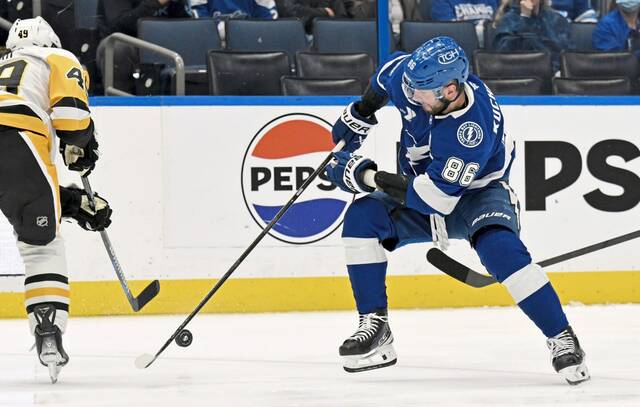
Two-time MVP Nikita Kucherov of Tampa Bay had a blunt assessment about the state of the NHL:
“The game is a lot faster but dumb. And I think that’s all I can say. Yes, it is faster, but it is very dumb. So, low IQ.”
In what way?
“In the hockey way.”
I know exactly what Kucherov means.
So does Penguins defenseman Erik Karlsson.
“I wish I’d said it,” said a smiling Karlsson.
The NHL has no shortage of media stooges who would have you believe that hockey is at its peak.
But that’s not remotely true.
Hockey is faster than ever, like Kucherov said, but that doesn’t equate to better.
Hockey has become a nonstop series of sprints, an endless parade of chip-and-chase, way too vertical.
Look at Edmonton’s Connor McDavid, widely acclaimed as the game’s best. He’s a speedskater more than he is a dangler or playmaker. (Not that he’s lacking in those elements.)
Stickhandling is a lost art.
East-west play is minimal.
You don’t pass through the neutral zone. You just hot-foot it, or whack the puck deep, or both.
Penguins defenseman Kris Letang agreed with Kucherov, adding, “If I could change one rule, it would be to put the red line back in.”
Karlsson echoed Letang’s idea.
Sidney Crosby has previously pondered such.
To clarify: The red line is still obviously on the rink and serves as the line of demarcation for icing.
But before 2005, a pass couldn’t be completed from the defensive zone if it crossed both the near blue line and red line unless it crossed the red line before the player receiving the pass. Play was whistled dead. That was called an off-side pass.
The rule was meant to prevent cherry-picking at the far blue line. But it led to clogged neutral zones via the trap.
When that rule got removed and the off-side pass eliminated, it was expected that the game would open up via more breakaways.
That hasn’t happened.
The trap isn’t as prevalent, but it’s still doable if you just move it back a bit.
But the change did point hockey toward tactics like stretch passes. Not with an eye toward breakaways and odd-man rushes, but instead tipping the puck into the defensive zone and racing after it. Turning hockey into a nonstop series of sprints.
Fast, yes.
Exciting, not always.
Dumb. In the hockey way.
“There’s not enough collective,” Letang said. “Not enough passing.”
So, should the offside pass rule be reinstated?
“A lot of guys would have a hard time adjusting,” Karlsson said.
That’s a good reason to do it.
But hockey has never liked to put the ham-and-eggers at a disadvantage to the more talented.
Sports are too often coached and strategized into stupefaction.
Squeezing more skill out of hockey seems preferable to the current track-meet method. Make teams stickhandle and pass through the neutral zone. If it separates wheat from chaff, even better.
Hockey has a tendency to adopt change in perpetuity. Which contradicts the purpose of change.
Overtime is an example.
Three-on-three isn’t hockey, and it went from being a fun jailbreak to constant regrouping and staying ahead of the foe’s changes.
If the tie isn’t broken, that’s followed by a skills competition: The shootout. Once again, not hockey.
Overtime should be 10 minutes of four-on-four sudden death.
If the score is still tied, then it’s a tie. There’s nothing abhorrent about a tie, especially if it’s a just result.
I saw Mario Lemieux dangle.
I saw Wayne Gretzky create.
That’s a high bar.
But now, I don’t even see the attempt.
All I see are sprints.
Put the red line back in.