
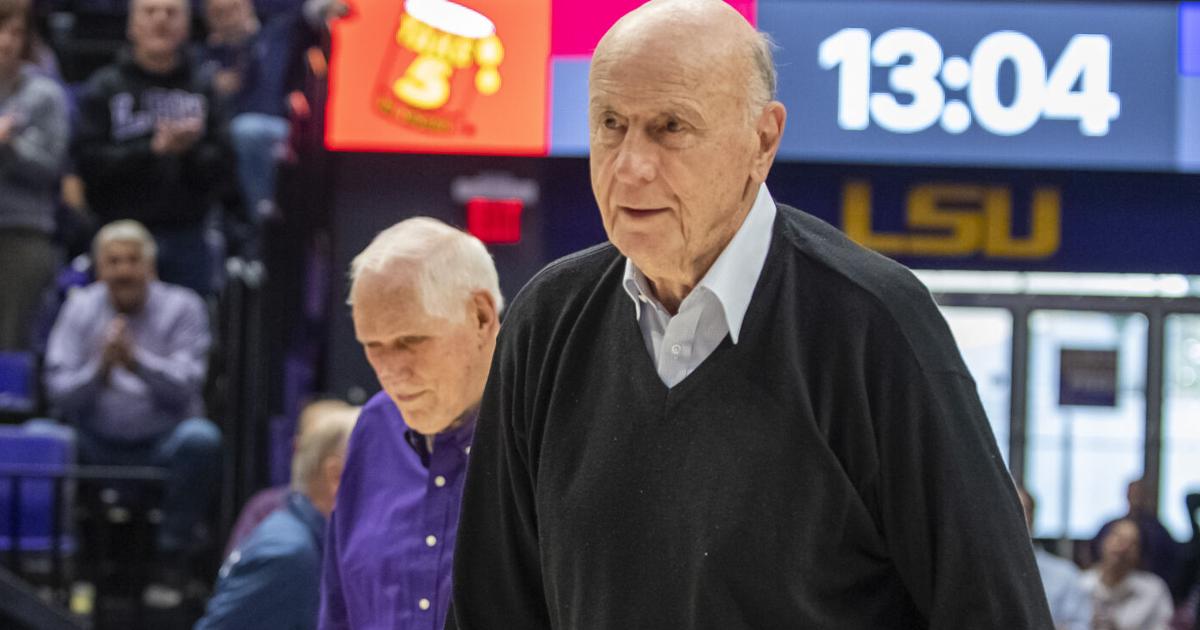
Bob Pettit, arguably the greatest basketball player in Louisiana history, died on Wednesday. He was 93 years old.
A self-made athlete, the Baton Rouge native was a two-time All-American at LSU. He led the Southeastern Conference in scoring and was the key figure as the Tigers reached their first Final Four in 1953.
As a professional with the St. Louis Hawks, Pettit was named first team All-NBA in 10 consecutive seasons, second team in the last of his 11-year career, an All-Star 11 times and the MVP of the all-star game a record four times. He was inducted into the Naismith Basketball Hall of Fame in the Class of 1971.
Pettit also was MVP of the league twice. And he was the MVP of the NBA’s 1958 championship series in which the Hawks broke the string of nine straight titles by the Boston Celtics.
When he retired, Pettit had:
• Scored 20,880 points, then the most in NBA history.
• Pulled in 12,849 rebounds, then the second-most in NBA history.
• Scored the most field goals (7,349) and the second-most free throws (6,182) in NBA history.
Joe Dean, the late LSU athletic director and athlete who watched the college careers of Pete Maravich and Shaquille O’Neal from a close vantage point, was adamant that his old teammate is the best LSU basketball player ever.
He had a case. In 1974, 20 years after his last game as a Tiger, Pettit was voted the best in the history of the SEC.
It was a remarkable rise for a man who said the only game he excelled at as a youngster was marbles.
As a freshman at Baton Rouge High School, Pettit was cut from the football, baseball and basketball junior-varsity teams. As a sophomore, he decided to concentrate on basketball, but coach Kenner Day cut Pettit again. It was a move Day would never live down but one Pettit staunchly defended.
“We were five over the roster limit, and I really wasn’t good enough to make the team,” Pettit said. “He knew it, and I knew it.”
Determined to improve, Pettit joined a church league and spent every spare minute working on his game. He hung a bent hanger on the garage door and shot tennis balls through it for hours at a time.
His father once recalled that his son “put two large reading lamps in the window, turned them toward the basket and practiced at night. He’d made up his mind he was going to make the team.’’
At the time, Bob, scrawny and awkward, stood 5-foot-11.
By the time he enrolled for his junior year, Pettit had sprouted to 6-4 and was playing basketball as he had only dreamed about before. Day also coached the football team so, until that season ended, he had a senior player oversee basketball practices. Pettit said teammate Charlie Roberts told him Day was aghast when he heard Pettit was practicing at center.
But that season, Pettit made the all-city squad, and the following year he was a 6-foot-7 All-American on the state championship team.
Still, college coaches were not bowled over. Harry Rabenhorst offered Pettit a scholarship to LSU, which was fortunate because few other schools came calling.
“Tulane, Loyola, some of the state schools and later DePaul and Western Kentucky came around, but I guess no more than six or seven actually recruited me,” Pettit said. “Coach Raby took me out for a steak one night — that’s how you recruited in those days — and said, ‘Well, we’ve got a scholarship for you if you want to come,’ and I accepted.”
For LSU, which hadn’t made much of a basketball splash since Sparky Wade boosted the Tigers to what was then a mythical national championship in 1935, it was a fateful decision. Pettit’s career yielded a three-year record of 59-15 and two NCAA appearances, including the first Final Four appearance for any SEC team other than Kentucky. He set the SEC scoring record with 1,916 points, which held until Maravich played at LSU 15 years later.
Pettit averaged 27.4 points and 14.1 rebounds for his college career.
He developed into an imposing 6-9 presence with a soft shooting touch accompanied by a wicked hook. Renowned trainer Alvin Roy worked out a weight program for Pettit to improve his strength. By that time, once Pettit got a hand on the ball, few could take it away.
He had transformed himself into a basketball force.
“His work ethic was incredible,’’ said lifelong friend and LSU teammate Ned Clark, who died in March of this year. “That is what eventually showed up on the court. Nobody in the SEC, and very few anywhere, could fake and drive around the basket, put up a hook or hit a medium jumper the way Pettit did.’’
With all his accomplishments as a collegian, it was as a pro that Pettit left his biggest impression — although he wasn’t sure he wanted to go in that direction.
“Pro basketball didn’t have the glamor it has today, and I came very close to signing with an amateur team, one of the teams where you work for the company and played for the company team,’’ he said. “The salaries were close to the NBA’s then, and each year some of the top players went that way. But it was a year-round job. I wanted to come back to Louisiana and go into business. I didn’t want to be known as an old basketball player. I wanted to a young businessman.’’
Picked second by the then-Milwaukee (later St. Louis) Hawks, Pettit asked for a $15,000 contract, a bold proposal at the time for an untried rookie with $100 to his name. Hawks owner Ben Kerner counter-offered $9,500, a salary that equaled the highest amount ever given a first-year player. The parties agreed on $11,000, but Bob had to report to Milwaukee a month ahead of schedule to help sell tickets.
On the court, coach Red Holzman saw Pettit as a center who he thought could play facing the basket, and he transformed Pettit into the game’s first power forward — and one of its greatest players.
An integral part of his basketball legacy was a scintillating Game 6 performance Pettit put on to clinch the 1958 NBA championship: He scored 50 points, including 19 of the Hawks’ last 21, in St. Louis’ 110-109 victory over the Boston Celtics.
Tommy Heinsohn, the primary Celtics defender against Pettit, said he never heard the end of it from legendary Boston coach Red Auerbach, who constantly reminded his old Hall of Fame player, “We would have won 10 straight (championships) if you had held Pettit to 48 points!’’
Funeral arrangements are pending.