
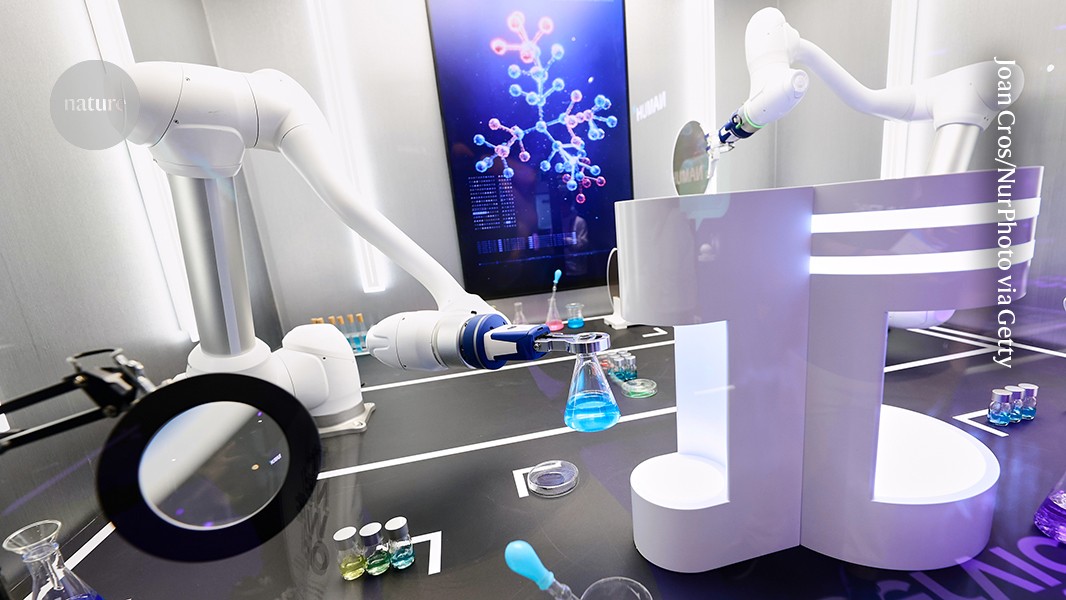
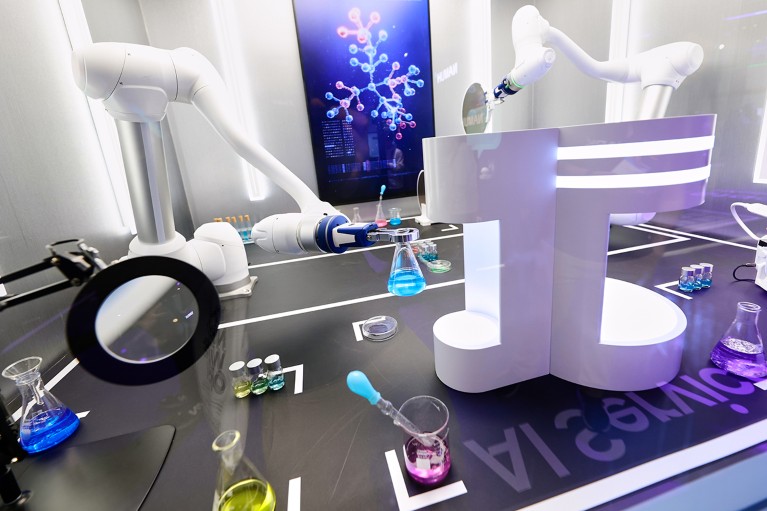
A new AI platform can connect robotic arms and other equipment into a seamless system. Credit: Joan Cros/NurPhoto via Getty
Sina Barazandeh watched in amazement as a robotic arm glided back and forth across his team’s lab. The arm loaded a multi-well plate into an instrument that filled the wells with liquid, then carried the plate to a distant device that analyzed the wells’ contents. Baranzadeh, a computational biologist at Carnegie Mellon University in Pittsburgh, Pennsylvania, was stunned by the seamless interplay of the lab equipment — no human intervention needed.
The autonomous cooperation is thanks to a software framework called the Model Hardware Standard (MHS) that connects disparate laboratory instruments. It also enables an AI system called an agent to control the equipment and orchestrate experiments. The system grew from a collaboration between US artificial-intelligence firm Anthropic and the Howard Hughes Medical Institute’s Janelia Research Campus in Ashburn, Virginia.

Teams of AI agents boost speed of research
The platform is designed to address a common research headache: getting devices to ‘talk’ to each other. It is a notoriously difficult task, because the instruments often come from a range of vendors and use different programming languages. MHS can be integrated into any instrument that has a programmable interface, allowing it to coordinate communication.
MHS is not the first tool to ease communication between scientific devices. The SiLA consortium, a global non-profit organization that develops frameworks for sharing lab data, developed a system called Standardization in Lab Automation, which provides standard language for lab instruments that allows them to talk to each other. But, unlike MHS, the system does not connect instruments directly to AI agents.
Moving from the initial idea for a research project to a functioning experiment can “easily take months”, says Jose Lugo-Martinez, a computational biologist at Carnegie Mellon and who, along with his Ph.D. student Barazandeh, is part of a team that is testing MHS. Using the framework, the team set up an experiment in mere hours. “Reducing that amount of time is the wow factor for us,” says Lugo-Martinez.
Quick set-up
To connect a lab’s devices, scientists and specialists called automation engineers usually write bespoke code that translates between each machine’s programming language. Or they add extra pieces of equipment that link instruments together.
MHS includes software that acts as “connective tissue” to link a lab computer’s operating system to the instruments, eliminating the need for bespoke solutions, says Alek Kemeny, a technical staff member at Anthropic and leader of the MHS effort. Any device connected through MHS can communicate with any other connected device.
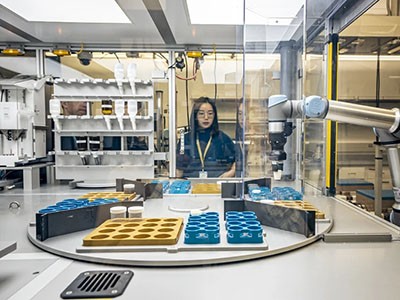
Can robotic lab assistants speed up your work?