
Companies leading the AI infrastructure build-out are scrambling to stand up data centers worldwide to meet crushing demand for computing capacity. But a key part of that plan — Middle East expansion — has hit a hurdle due to the war in Iran.
The Middle East offers benefits for the power-hungry data centers in spades: easy access to abundant energy, wide swaths of open land, government-backed development efforts, and perhaps most crucially, deep-pocketed sovereign wealth funds. US technology companies such as Amazon (AMZN), Google (GOOG, GOOGL), Microsoft (MSFT), and OpenAI (OPAI.PVT), meanwhile, have supplied the chips, cloud platforms, and AI models.
Yet the war in Iran has thrown Big Tech’s plans into flux. Critical infrastructure sites have become live targets for the Iranian military as Tehran looks for leverage in its war with the US, forcing the predominantly American Big Tech industry — long accustomed to cyberattacks — to confront a new kind of threat it hasn’t faced at home.
AWS data center complexes in Bahrain and the UAE have been struck by Iranian drones or damaged in nearby strikes, believed to be the first known instances of an American data center disrupted by military conflict. Iran’s Revolutionary Guard Corps said it struck an Oracle-owned (ORCL) data center in Dubai. UAE officials said damage was caused by falling debris from the strike, not a direct hit.
“These companies have not been in a position where they’ve had to really deal with issues like this in any depth,” said Martijn Rasser, vice president for tech leadership at the Special Competitive Studies Project (SCSP), a technology and security-focused research firm. “They are true geopolitical actors in a sense that they haven’t been before.”
 President Trump speaks during the final stop of his Gulf visit, in Abu Dhabi, United Arab Emirates, on May 16, 2025. (Reuters/Brian Snyder) · Reuters / REUTERS ‘Feet are scrambling’
The infrastructure underpinning the US tech industry has become increasingly global. Amazon, Microsoft, Google, and other major players have built data centers throughout Europe and Asia and, eventually, into the Middle East to meet demand following the cloud computing explosion of the 2010s.
The AI boom kicked that expansion into a new gear. The Middle East still represents a relatively small share of the world’s installed data center footprint — roughly 3% of global live capacity in 2026, per the research firm Knight Frank. But that base is expanding rapidly as Gulf governments make enormous bets on AI infrastructure. Data center capacity in the region stood at 1.6 gigawatts in August, with 2.6 gigawatts under active development and 13.8 gigawatts in the planning pipeline, set to quadruple the region’s capacity by 2030.
Google now operates cloud regions in Doha, Qatar; Damman, Saudi Arabia; and Tel Aviv, Israel. Microsoft’s include Doha, the UAE’s Dubai and Abu Dhabi, and Israel. Amazon’s span Bahrain, Israel, and the UAE.
“If the 20th century ran on oil and steel, the 21st century runs on compute and the minerals that feed it,” Jacob Helberg, undersecretary for economic affairs at the US State Department, said in December 2025 during public remarks at the department’s inaugural Pax Silica summit. Nowhere has that transition been more visible than in the Gulf.
The problem is that the arrangements between US tech companies and governments in the region have also placed an expanding portion of the US technology industry’s physical infrastructure in a region where pipelines, airfields, and power plants have long been targets of war.
“Below the surface, feet are scrambling,” Chip Usher, senior adviser for intelligence and AI adoption at SCSP and a prior senior leader at the Central Intelligence Agency focused on the Persian Gulf, told Yahoo Finance. “Both the industry and US and regional governments have been prioritizing expansion over protection.”
That vulnerability was on full display with the attacks on the AWS data center facilities in the UAE. In the days after the attacks, AWS reported structural damage, power supply interruptions, and water damage caused by fire suppression systems. Several core cloud service offerings were disrupted, per AWS statements.
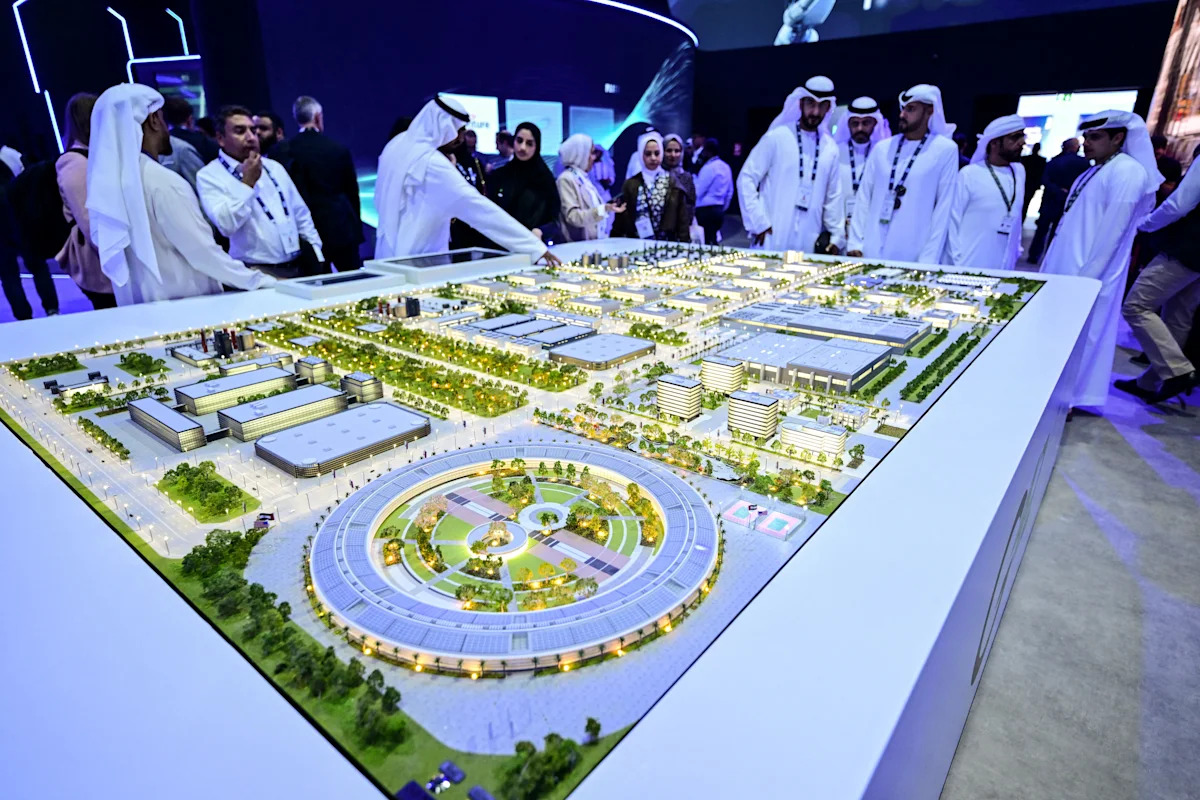
Guests look at a model of the largest data center in the UAE under construction in Abu Dhabi as the Stargate initiative, a joint venture between G42, Microsoft, and OpenAI, during the Abu Dhabi International Petroleum Exhibition & Conference (ADIPEC) in Abu Dhabi on Nov. 3, 2025. (Giuseppe CACACE / AFP via Getty Images) · GIUSEPPE CACACE via Getty Images
Six months later, AWS service remains disrupted throughout the Middle East. In the company’s UAE cloud region, AWS remains “unable to restore access to the resources and data” hosted in one of the region’s three affected service zones, the company said in its most recent status report.
Those kinds of outages complicate reliability commitments cloud providers make to customers, Dallas Dolen, head of the technology, media, and telecommunications practice at the auditing giant PwC, told Yahoo Finance. And that can ultimately hit the companies’ bottom line.
Cloud firms negotiate uptime rates — the percentage of time their service is operational and available to users — to decimal places beyond 99% with clients including banks, medical centers, and governments. A guaranteed uptime rate of 99.9% means service can be unavailable for only 8 hours and 46 minutes per year; an uptime rate of 99.99% means downtime can’t exceed 52 minutes and 34 seconds.
“They’re saying, ‘I can never let this thing go down, and when it goes down, I owe [the customer] a major financial penalty,'” Dolen said.
A spokesperson for AWS referred questions on the UAE cloud disruption and the company’s expansion in the region to a statement from CEO Matt Garman in Forbes, where he said, “We continue to be extremely bullish about our partnerships in the Middle East and about the long term potential of the region. We think everybody hopes for a quick end to fighting, but it doesn’t really dampen our long term views on the prospects of the region.”
Microsoft declined to comment for this story. OpenAI, Oracle, and Alphabet didn’t respond to requests for comment.
The companies at the center of the Middle East build-out — Oracle, Amazon, Microsoft, and others — have largely remained quiet over the complications now facing their technology. In public comments and earnings reports, the war is rarely discussed.
Perhaps the clearest references come from risk statements buried deep inside quarterly disclosures filed by the companies leading the build-out.
“Abrupt political change, terrorist activity, and armed conflict, such as the conflicts in Ukraine and the Middle East, pose economic and other risks, which may negatively impact our ability to sell to and collect from customers, increase our operating costs, or otherwise disrupt our operations in markets both directly and indirectly impacted by such events,” Microsoft said in its most recent annual filing, published in July.
“Geopolitical instability may lead to sanctions and impact our ability to do business in some markets or with some public-sector customers. Any of these changes could adversely affect our results of operations.”
‘A wake-up call’
None of this is to say that the development of data centers and other AI infrastructure in the Middle East will stop as a result of the war in Iran. The major Gulf nations have begun major pivots toward technology as the next and best front for economic development as the long-term outlook for oil and natural gas declines.
In the US, Microsoft has reasserted plans to spend more than $15 billion on AI development in the UAE by the end of 2029, with more than $5.5 billion in capital expenses earmarked for “ongoing and planned expansion of our AI and cloud infrastructure.” Overall, the war in Iran has “paused, not canceled” the Middle East’s AI capacity outlook, according to the commercial real estate firm Jones Lang LaSalle.
A commercial vessel is anchored off Yemen’s coast at Bab al-Mandeb in the strait connecting the Red Sea with the Gulf of Aden and the Indian Ocean on Sept. 12, 2026. (AFP via Getty Images) · – via Getty Images
The conflict has already begun reshaping infrastructure development in the Middle East, including at some of the region’s leading projects.
The UAE-US AI Campus was originally envisioned as a 5-gigawatt campus spanning 10 square miles in Abu Dhabi. Construction on the first phase of that project, labeled Stargate UAE, began last year.
Those plans are changing. Instead of one central campus — a large target for military operations — the project is now expected to be built as a series of data centers throughout the UAE, per Reuters, decentralizing targeting risk. Some of the most critical facilities that would host highly sensitive data could be built into mountains and feature air defense systems, Reuters reported.
Other adjustments reportedly under consideration for Stargate UAE include building data centers underground, blast-resistant materials, and air-defense systems. Some of the security requirements, such as missile defenses, will have to come from host governments, SCSP’s Usher explained. Some will be the responsibility of the data center and cloud providers themselves.
“What we’re seeing in the Iran war has served as a wake-up call to these companies, to the industry, and to governments that they need to take it into account,” he said. “I don’t think they have developed or priced in what they will need to do in order to secure these facilities.”
Jake Conley is a breaking news reporter covering US equities for Yahoo Finance. Follow him on X at @byjakeconley or email him at jake.conley@yahooinc.com.
Click here for in-depth analysis of the latest stock market news and events moving stock prices
Read the latest financial and business news from Yahoo Finance