
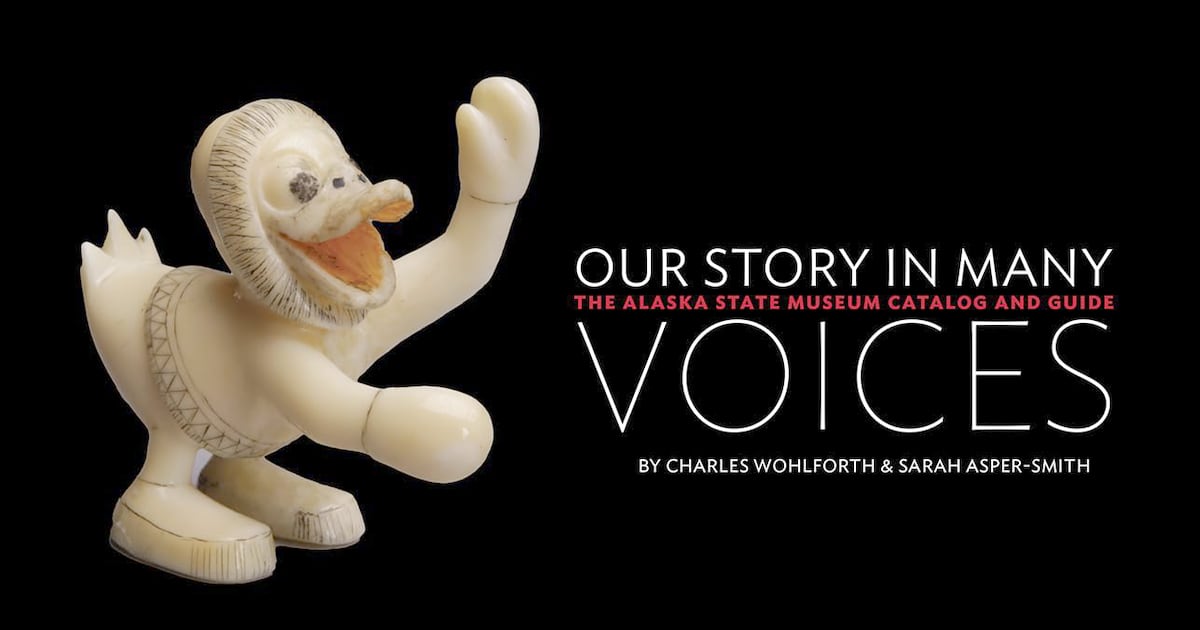
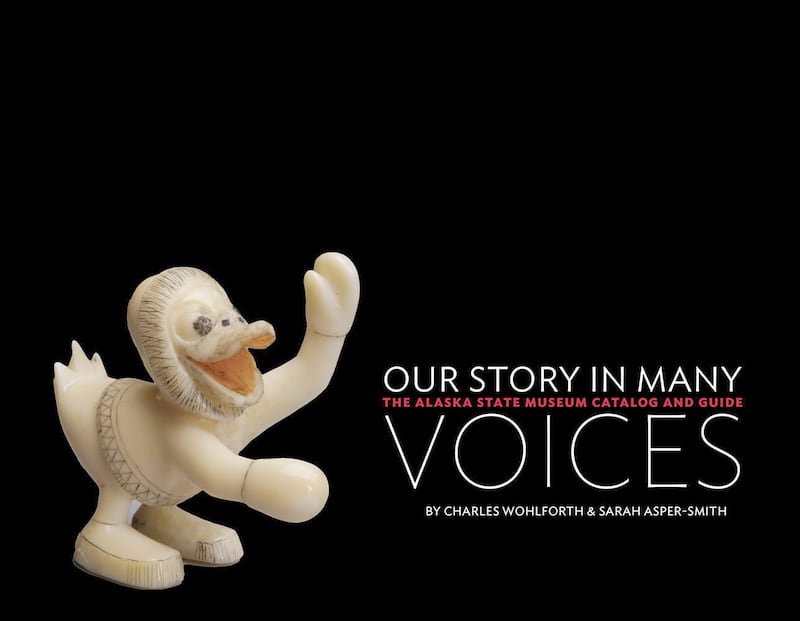
 “Our Story in Many Voices: The Alaska State Museum Catalog and Guide” by Charles Wohlforth, with design by Sarah Asper-Smith
“Our Story in Many Voices: The Alaska State Museum Catalog and Guide”
By Charles Wohlforth, with design by Sarah Asper-Smith; University of Alaska Press, 2025; 155 pages; $29.95.
Q: When is a museum catalog not a museum catalog?
A: When it is so much more than that, as is the case with this highly readable, informative and provocative book by Charles Wohlforth, a longtime Alaskan and accomplished writer who was intimately involved in the state museum’s new exhibits.
In 2016, the Alaska State Museum reopened in Juneau in the Father Andrew P. Kashevaroff Building, sharing space with the state library and archives. The new space and design offered the opportunity for new exhibits and present-day interpretations of Alaska’s history.
Wohlforth and illustrator Sarah Asper-Smith were independently funded to present the process and updating and were not beholden to the museum, its staff or the book’s publisher — although they did consult with staff and others and quote liberally from the “many voices” who were involved.
The “many voices” is in fact key to the book and extends well beyond the living to include Indigenous and historical perspectives from earliest times to the present. As Wohlforth writes in his introduction, he and Asper-Smith have attempted to guide readers, especially Alaskans, “into a deepening Alaska story in this current moment of change, as familiar characters and incidents reorient themselves in new dimensions.”
The result is a personal narrative in which the author inserts his own experience and point of view while telling a fact-based and peer-reviewed account of Alaska’s history and cultures. A great deal of emphasis is placed on the ongoing challenge to any museum of what to exhibit, in what context, to tell the stories of place and people — and to encourage visitors to think deeply and find their own meanings.
The reconfigured museum, aside from the small earth sciences section, the changing exhibits galleries and a kids’ discovery room, is sectioned into three areas — Native Alaska (time immemorial to the present), Russian Alaska (1741-1867) and American Alaska (1867-the present).
The book, after an orienting section about Alaska’s geography, natural history and human ecology, tells Alaska’s story in three sections that differ somewhat from the museum’s organization. These are Native Alaska, Conquest and Resistance, and American Colony. These three, together, acknowledge the complexities of our history. The singular story of the state’s settlement and development, with its pioneering optimism, is here replaced by a more complicated one, one that is still unfolding.
Much discussion is given by Wohlforth to how the “Native story” has changed over the years and will continue to develop. The older museum had treated Native objects (and the lives they belong to) largely as from the past while the new exhibits, with the involvement of many people from within the cultures, emphasizes the continuation of traditions.
Wohlforth takes a critical look at the economic and cultural influence of both the Russian years and the later American colonization and assimilation policies. Recent art — like Nicholas Galanin’s “What Have We Become?” sculpture of a human head as a book of pages — is both integrated into exhibitry and highlighted by Wohlforth. The Alaska Native Claims Settlement Act is placed in historical context and examined in the context of rising tribal sovereignty.
The extensive section titled “Voicing Alaska’s Story” is full of insider details and surprises. We learn that the architectural firm had contracted with an exhibit design company for the exhibits, the usual practice, but museum staff were unhappy with the initial designs. They requested permission to take on the job themselves, even under the pressure of deadlines, and were trusted to do so. The building design itself was controversial, with the ideas that the architects brought to it being replaced, after many community meetings and iterations, with “what people wanted and needed.”
As part of the mitigation for the demolishment of the cherished older museum — a project, like others around the state, funded to celebrate the centennial of Alaska’s transfer from Russia — a book of text and photos was commissioned to “share what became of those big ideas of 1967.” (This reviewer wrote the section about projects on the Kenai and in Kodiak.) According to Wohlforth, the completed book, “The View from the Future—2017” was “essentially disavowed” by the director of the Division of Libraries, Archives and Museums at the time and disappeared, along with its digital version. The director considered the Alaska “purchase” a shameful taking of Native lands and thus unworthy of acknowledgment.
One of the many people who appear in these pages is Bob Banghart, whose tenure with the museum began in 1974, when he installed a spruce tree with taxidermied eagles in the old museum’s spiral staircase. Forty years later Barnhart was tasked with dismantling the tree. Because he’d used formaldehyde and asbestos in assembling it, it was designated as hazardous material. Specialists in protective suits were brought in to encapsulate and then dispose of it. The new museum includes a new tree, one that had to be lowered by a crane through the unfinished roof.
The book’s layout is truly beautiful, with examples from the museum’s collection displayed on every page. In the Native section, for example, the text emphasizes technologies used by the various cultures, and the photos show examples. Here readers can contemplate an inflation valve for a float, a wrist guard for bow hunting, a 5,000-year-old spruce root basket that had been preserved in wet mud, a birchbark canoe, a three-cockpit kayak for sea otter hunting during the Russian period, snow goggles, and a modern fiddle used in the art of Athabascan fiddling. The theme here is of innovation, adaptation and resilience.
“Our Story in Many Voices,” in its latter pages, includes a section of sources and suggestions for further reading as well as a more traditional catalog of objects. This is a book that deserves attention from anyone interested in Alaska history and cultures, with or without the opportunity to visit the State Museum.