
The final official act in a sprawling, seven-month effort to bring Elon Musk’s SpaceX to Louisiana took place in a nondescript room at the Vermilion Parish Courthouse.
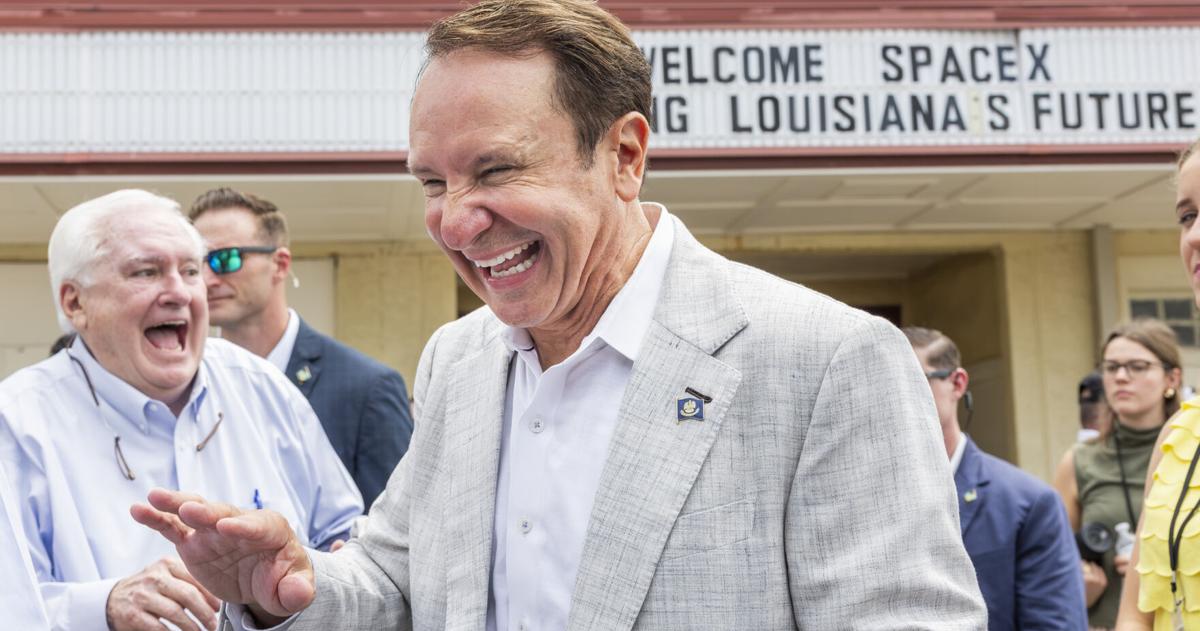
On Aug. 25, two hours before Gov. Jeff Landry stepped onstage at Magdalen Place, Abbeville’s largest reception venue, to announce the $100 billion project that’s set to forever reshape parts of coastal Louisiana, the seven-member Vermilion Parish Industrial Development Board met for the second time ever.
The agenda for the public meeting had been posted on the courthouse door 24 hours earlier, though nobody seemed to notice. It included several routine items and one that was anything but: a vote authorizing a property tax break that would turn out to be the largest in state history, for “Project Osprey,” the code name for the SpaceX deal.

Guests listen to Governor Jeff Landry talk about the $100 billion SpaceX facility coming to Vermillion Parish, at Magdalen Place in Abbeville, La., Tuesday, Aug. 25, 2026.
STAFF PHOTO BY SOPHIA GERMER
Approval of the $24 billion tax incentive was the final step in a sprint by Landry and his deputies to try to win the biggest industrial project the state has ever known. Conducted largely in secret, it involved more than two dozen state officials and the cooperation of several state agencies, utilities and businesses. State legislators approved seven new laws. The incentive deal had to be struck. And at the same time, the Landry administration needed to secure control of a 120,000-acre property wrapped up in one of the state’s most complicated legal battles.
To get it done, the Landry administration negotiated and coordinated with legislators, SpaceX executives, Vermilion Parish officials, one of the world’s biggest oil companies and one of Louisiana’s most successful trial lawyers. It required dozens of public officials to sign nondisclosure agreements, keeping the public-private deal largely out of the public eye.
In the weeks since the announcement, state leaders and residents have tried to make sense of the whirlwind deal with Musk, the world’s richest man, and what’s ahead for Louisiana. Some are hopeful for thousands of jobs and the potential for more coastal protection. Others, including some nearby residents, say they’re worried about how the massive facility will impact the environment and their way of life, and have criticized the tax breaks and the lack of transparency.
Landry, who said he took on many of the details himself to ensure the deal went through, sees the project as transformational for the state and one that he’s comfortable letting voters judge him on.
Gov. Jeff Landry speaks during the announcement of plans to build a SpaceX spaceport on the Louisiana coast south of Pecan Island Tuesday, August 25, 2026, in Abbeville, La.
STAFF PHOTO BY LESLIE WESTBROOK
“I have no problem letting the people in the state of Louisiana decide whether what we put together was worth it,” Landry said in a phone interview Wednesday. “You don’t do these deals in the public. At some point, you have to give the people elected to lead this state the opportunity to lead.”
This account of how SpaceX decided to set up a massive spaceport in Louisiana is based on public records and interviews with people involved in the deal. SpaceX did not respond to multiple requests for comment.
First calls
Seven months before the events in Abbeville that August day, the office of Louisiana Economic Development Secretary Susan Bourgeois got a phone call. It was from a SpaceX official, and the company wanted to talk. The next day, Bourgeois and a top staffer held their first meeting with two SpaceX lobbyists.
“They didn’t share a lot,” said Bourgeois. “They told us that they were very interested in Louisiana for a potential project and that they had identified some sites.”
Susan B. Bourgeois, secretary of Louisiana economic development, speaks to the media during the announcement of plans to build a SpaceX spaceport on the Louisiana coast south of Pecan Island Tuesday, August 25, 2026, in Abbeville, La.
STAFF PHOTO BY LESLIE WESTBROOK
SpaceX, it turns out, knew the site it wanted. Two weeks later, Landry would learn as much at a meeting with SpaceX lobbyist Matt Dunn in Washington. Musk’s company, a sprawling firm involved in satellite communications and aerospace that the entrepreneur hopes will achieve his goal of colonizing Mars, had its eye on 30,000 acres of coastal marsh in Vermilion Parish.
The problem was that the land was owned by ExxonMobil and tied up in a yearslong lawsuit between the oil giant and the state.
The Freshwater City Lock photographed in Vermilion Parish, La., Wednesday, Aug. 19, 2026.
STAFF PHOTO BY SOPHIA GERMER
“The litigation was clouding the property,” Landry said.
Landry, who was involved in the state’s coastal suits as attorney general, said SpaceX’s interest in the Exxon property seemed like a golden opportunity — a chance to settle the coastal suits and snag a major economic development project at the same time.
Laying out terms
Early on in the talks with LED officials, SpaceX laid out what it needed to come to Louisiana — law changes, tax incentives and the Exxon property. The company had given LED “a conceptual list” of regulations and tax incentives, Bourgeois said.
SpaceX also wanted confidentiality. On Feb. 10, Bourgeois invoked a state law allowing her to keep records related to certain economic development negotiations secret. She issued a public notice that said LED was negotiating a deal for Project Osprey and that records wouldn’t be released.
In the weeks that followed, elected officials, state agency heads, lobbyists and companies were looped in, according to the dates on a series of NDAs that were issued. Landry’s administration facilitated more than 30 NDAs, records show.
Governor Jeff Landry answers questions after the SpaceX announcement at Magdalen Place in Abbeville, La., Tuesday, Aug. 25, 2026.
STAFF PHOTO BY SOPHIA GERMER
Paige Carter, Bourgeois’ top staffer, took point on the deal, leading twice-weekly meetings with SpaceX on the economic development issues, with SpaceX lobbyist Ben Lancaster on the other side of the table. Among the regulars on the calls were SpaceX attorney Sheila McCorkle, rocket scientist Mark Soltys and Mark Juncosa, one of Musk’s top executives and the company’s vice president of vehicle engineering.
Separately, Landry, his executive counsel Angelique Freel, Baton Rouge mediator Sid Moreland and a team of lawyers from ExxonMobil were meeting multiple times a week on the coastal suits.
“This was two conversations going on, an economic development deal and the lawsuit settlement,” said Bourgeois, who credited Landry with shepherding it all. “He was the common thread.”
One of the company’s requirements was legislation shielding aerospace companies from public records laws and from nuisance and damage lawsuits. It also wanted legislation that would prevent local governments from trying to limit those companies’ activity.
Rep. Tony Bacala, R-Prairieville, left, speaks with Rep. Jack G. McFarland, R-Jonesboro, in the house chamber during Governor Jeff Landry’s special session focusing on crime, Wednesday, February 28, 2024, at the Louisiana State Capitol in Baton Rouge, La.
STAFF PHOTO BY HILARY SCHEINUK
The administration tapped two allies in the state House to carry the bills, state Reps. Jack McFarland, R-Jonesboro, and Tony Bacala, R-Prairieville. McFarland said the bills he was asked to file closely mirrored laws in Texas and Florida. Freel in the governor’s office had drafted them, Bourgeois said, “pulling statutes from other states to see how they were worded.”
The legislation was filed hours before this year’s deadline. Coming so late in the process, the bills raised eyebrows in the Legislature. They also gave the public the first hint that an aerospace company was seriously eyeing Louisiana. No opposition turned out when the legislation came up for debate, though. The package sailed through.
Getting the land
While the legislation was falling into place, the state was finalizing a settlement with Exxon in the long-running coastal lawsuits. Though it wasn’t clear at the time, the resolution of the coastal suits would give SpaceX land that it had long been eyeing on Louisiana’s coast.
The lawsuits brought by the state and coastal parishes blamed the oil giant for damaging wetlands and contributing to coastal erosion. Baton Rouge attorney John Carmouche led the case out of Vermilion Parish, as well as the statewide effort, spanning 42 separate lawsuits, to hold oil and gas companies to account for polluting the coastline. Exxon owned an 18-mile stretch of coastal marsh in Vermilion Parish, more than 120,000 acres in all.
John Carmouche, right, speaks on recent litigation alongside his father and colleague, Donald Carmouche, left, Thursday, May 22, 2025, at their firm, Talbot, Carmouche & Marcello, in Baton Rouge, La.
STAFF PHOTO BY HILARY SCHEINUK
Mostly empty and used for duck hunting, the land was far from big population centers and was on the northern shore of the Gulf. Though eroding and exposed to hurricanes, it was close to shipping channels and had easy access to natural gas. For SpaceX, it was perfect for building launch pads, power complexes, fuel depots and other facilities.
Landry knew that the Exxon settlement was key to making the SpaceX deal work, but it wasn’t at all clear it would happen. Both Carmouche and Landry said that the negotiating process was difficult. Chevron took another of the coastal lawsuits all the way to trial — and it was possible that Exxon would do the same.
“You had to bring people who had decades of hatred for each other to the table,” Landry said during Wednesday’s interview. “We were trying to get them in the mind frame that this is good for everyone.”
Pelicans fly over marshland where SpaceX is planning to build a multibillion-dollar spaceport in Vermilion Parish, La., Wednesday, Aug. 19, 2026.
STAFF PHOTO BY SOPHIA GERMER
One element that helped forge the deal was SpaceX’s willingness to expand the amount of land it wanted from 30,000 acres to 120,000 acres — virtually all of Exxon’s property.
In late May, after the two sides had reached an agreement in principle, Landry announced the deal on X. It would be two more months before all the paperwork was finalized.
Exxon donated the land to the state, which then sold it to SpaceX for $100 million, or about $800 an acre. Landry said that Exxon had also provided the state with “a couple hundred million” for additional coastal restoration efforts. The exact amount is not publicly known.
The sun rises over marshland along Freshwater City Road near where SpaceX is planning to build a multibillion-dollar spaceport in Vermilion Parish, La., Wednesday, Aug. 19, 2026.
STAFF PHOTO BY SOPHIA GERMER
Bourgeois argued that the price SpaceX paid was more than fair.
“The land is eroding,” she said. “We literally sold them swampland.”
Exxon did not respond to multiple requests for comment.
On the island
By mid-May, people in Pecan Island were beginning to wonder what was going on. The law changes, social media chatter and a growing number of media reports were giving rise to speculation in Vermilion Parish that some sort of aerospace company was coming.
Many locals were uneasy. They sought answers but couldn’t get any since most parish leaders also were in the dark.
Vicky Harrington, who works at Marsha’s Corner Store about 15 miles north of Pecan Island, said at the time that “it’s all anybody’s talking about.”
Marshland photographed along Freshwater City Road near where SpaceX is planning to build a multibillion-dollar spaceport in Vermilion Parish, La., Wednesday, Aug. 19, 2026.
STAFF PHOTO BY SOPHIA GERMER
“We’ve all heard the rumors but we don’t know who to believe,” she said.
Meanwhile, the final piece of the deal — the incentive package — was being hammered out, an effort led by Shreveport attorney Mike Busada, who’d crafted the state’s tax deal with Meta two years earlier. It included a property tax abatement worth $23.8 billion plus a state aerospace sales tax rebate worth an additional $3.6 billion.
To qualify for the incentive, known as a PILOT, or payment in lieu of taxes, SpaceX donated its newly bought land to the Vermilion Parish Industrial Development Board, then leased it back for a nominal amount. It also agreed to make a one-time payment of $20 million to the parish plus $25 million a year for 25 years.
Musk on the scene
Around 1 p.m. on Aug. 13, Musk’s plane landed at the Lafayette airport, where he got into a helicopter. A SpaceX scientist tagged along, as did three of Musk’s children and Landry. A company film crew shot the chopper as it descended into the Vermilion Parish marsh. Musk stepped out, wearing a black T-shirt and black jeans.
“This is perfect,” Musk said, taking it all in. “It’s going to be so exciting for Louisiana.”
A video plays with Elon Musk during the SpaceX announcement at Magdalen Place in Abbeville, La., Tuesday, Aug. 25, 2026.
STAFF PHOTO BY SOPHIA GERMER
Twelve days later, on Aug. 25, shortly before the big announcement in downtown Abbeville, the complex series of conveyance records for the land deal were filed with the Vermilion Clerk of Court. The tax incentives had also been passed. The deal was officially done.
As Landry and other Louisiana officials stood onstage, a seven-minute video of Musk was played inside the Abbeville reception venue. The crowd erupted in applause.
Looking back on it, Landry said negotiating the settlement was “exhausting” and closing the deal “surreal.”
Gov. Jeff Landry speaks during the announcement of plans to build a SpaceX spaceport on the Louisiana coast south of Pecan Island Tuesday, August 25, 2026, in Abbeville, La.
STAFF PHOTO BY LESLIE WESTBROOK
“And bittersweet,” he said.
“You have to realize as you negotiate, it’s easy to armchair quarterback and say, ‘The governor gave this up,’” said Landry. “But when you think of what we gave up in return for $100 billion, it’s a rounding error.”
Back in Pecan Island, Wayne Miller, 66, a farmer who has lived about 5 miles from the site of the planned spaceport for much of his life, eyes the project warily.
“It’s probably going to be good for the parish, and maybe the state,” Miller said. “But my main priority is the people of the island. I’m not against the betterment of the state, but I am against the destruction of the island.”
It’s been hard for residents to imagine the changes ahead. The boost SpaceX will bring to the economy will have its benefits, Miller and others said, but they worry about the loss of their current way of life.
An old RV parks at the end of Freshwater City Road near where SpaceX is planning to build a multibillion-dollar spaceport in Vermilion Parish, La., Wednesday, Aug. 19, 2026.
STAFF PHOTO BY SOPHIA GERMER
Corbett “Cobb” LeBoeuf, the chairman of the board that approved the property tax break and an Abbeville resident, said there are lots of concerns about how the spaceport will affect the coast.
“But I have more concern,” he said, “that we won’t have a coast if this doesn’t come in.”