
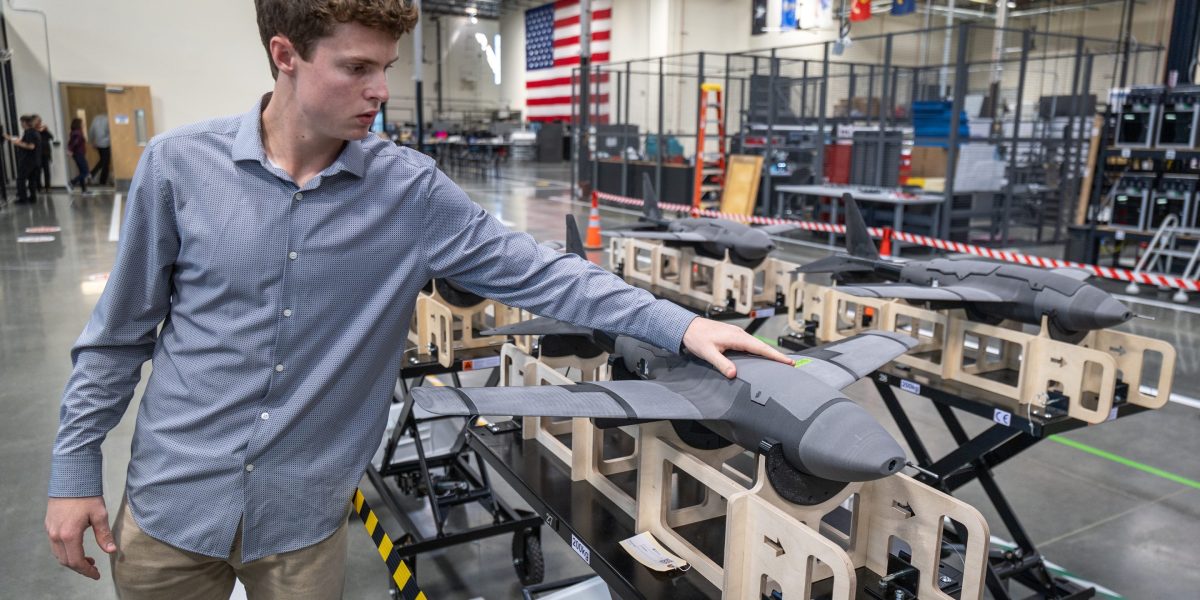
Hi, it’s Preston Fore, in for Allie. Earlier this month, defense tech firm Mach Industries raised $600 million in a Series C extension at a $3.7 billion valuation.
That’s more than double the $1.8 billion valuation Mach reached just three months earlier when it raised its initial $300 million Series C led by Ribbit Capital, Infinite Capital, Bedrock Capital, and Sequoia Capital. But perhaps more striking than the pace of the raises is who’s leading them: Mach, which builds autonomous defense systems, is run by a 22-year-old.
Founder and CEO Ethan Thornton launched Mach in 2023 at 19, after developing an interest in defense as a teenager. Since then, he’s built the company around a willingness to move quickly, take risks, and adapt as its technology and the broader defense industry evolve.
“You’re never going to know everything, especially when you’re starting young, and you shouldn’t expect to,” Thornton told Fortune. “If you wait until you have all the answers, you’ll probably never start.”
By 2024, Mach landed a deal with the Army Applications Laboratory to develop a vertical-takeoff precision cruise missile—and the company’s momentum has only accelerated since.
Today, the Gen Zer is running a company with six weapons programs, a 115,000-square-foot headquarters and manufacturing facility in Huntington Beach, California, and ambitions to build everything from airframes and jet engines to solid rocket motors, energetic systems, and autonomous technologies.
The company’s rapid growth comes amid a broader boom in defense tech. Allie reported earlier this year that a record $19.8 billion was deployed into the sector in the first quarter of 2026 alone. Thornton, however, is betting that Mach can do more than simply ride that wave. After several years spent developing and testing its technology, the company is now shifting its focus toward production.
“For a company like Mach, private capital lets us take risk earlier. We can build before there’s a massive program behind something, test it, learn from it and change it quickly,” Thornton told Fortune. “And because we think about manufacturing from the beginning, we’re not designing something and figuring out how to produce it years later. We’re building the product and the production capability at the same time.”
Turning teenage military interests into a defense tech unicorn
Thornton’s interest in defense started well before Mach—and before he was old enough to drive a car.
Growing up in a military family in Texas, Thornton increasingly became concerned about China’s rise and what he described as an “impending great power conflict.” By 16, he was already prototyping defense applications on his parents’ property, experimenting with hydrogen-powered weapons using materials sourced from Home Depot and Amazon.
He took that interest to MIT, where he studied aerospace (and even made the football roster) while working with the school’s federally funded defense research center, Lincoln Laboratory. Before finishing his first year, Thornton received a Thiel Fellowship and left MIT to focus full-time on his company.
Mach quickly caught the attention of Silicon Valley. In June 2023, Sequoia Capital led a $5.7 million funding round in Mach—the VC’s first investment in a hardware defense technology company. Stephanie Zhan, a Sequoia partner who led the investment, summed up Thornton’s ambitions at the time:
“Ethan is a force of nature: from his technical depth and genuine obsession with the problem to his bias for action and maturity beyond his years,” Zhan said. “Defense technology is central to our safety and security, and Mach is a step-function advancement to the state of the industry.”
For Thornton, however, the lessons from building Mach so young have been less about having all the answers than about knowing who to surround himself with.
“Find people who are better than you at the things you don’t know, who will challenge you and who believe in what you’re trying to build,” he said.
Thornton’s core advice for other young people with ambitious ideas is similarly straightforward: Don’t be afraid to fail.
“You have to be willing to learn as you go, make mistakes and keep moving. Have conviction in the problem you’re trying to solve, and then surround yourself with people who can help you solve it.”
Preston Fore
X: @forepreston
Email: preston.fore@fortune.com
Submit a deal for the Term Sheet newsletter here.
Joey Abrams curated the deals section of today’s newsletter. Subscribe here.
VENTURE CAPITAL
– The Biological Computing Company, a Baltimore, Md. and San Francisco-based developer of neuron-derived software designed to make AI models faster, cheaper, and more efficient, raised $25 million in a seed extension. Builders VC led the round and was joined by Wonder Ventures, Jeff Dean, and Tusk Ventures.
– Prime Minute, a Palo Alto, Calif.-based developer of disaster-response technology, starting with wildfire response, raised $15 million in pre-seed funding. Eclipse led the round and was joined by 8VC.
– Autoheal, a San Francisco-based developer of AI agents that automate software-development and IT-operations tasks, raised $7.9 million in seed funding. Innovation Endeavors led the round and was joined by Emergent Ventures, U&I Ventures, Darkmode Ventures, Batch Ventures, and Param Hansa Values.
– Feather, an East Palo Alto, Calif.-based developer of an open hardware and software platform for humanoid robots, raised $7.6 million in pre-seed funding. Gradient Ventures led the round and was joined by Builder Capital, Geometry, SEED Innovations, and Virgo VC.
PRIVATE EQUITY
– Madison Dearborn Partners agreed to acquire The Marygold Companies, a San Clemente, Calif.-based diversified holding company with businesses in financial services, food manufacturing, printing, and beauty products, for $2 per share.
– PrimeSource Brands, backed by Clearlake Capital Group, acquired JACLO Industries, a Cranford, N.J.-based manufacturer of luxury bath fixtures and plumbing products. Financial terms were not disclosed.
EXITS
– Rexel agreed to acquire GCG, a Chicago, Ill.-based distributor of specialty wire, cable, connectivity, and power products, from Audax Private Equity in a deal that values the company at approximately $1.4 billion.
IPOs
– TFP Group, a London, U.K.-based specialty insurance managing general agent, filed to go public on the New York Stock Exchange. The company posted $723 million in sales for the year ended June 30. Alfa Entities, Blackstone, Capital Z, Cooper FG Holdco, SPFM Holdings, and Ocorian Trustees Limited back the company.
FUNDS + FUNDS OF FUNDS
– Zero Infinity Partners, a New York City-based venture capital firm, raised $156 million for its second fund focused on early-stage infrastructure tech companies.