
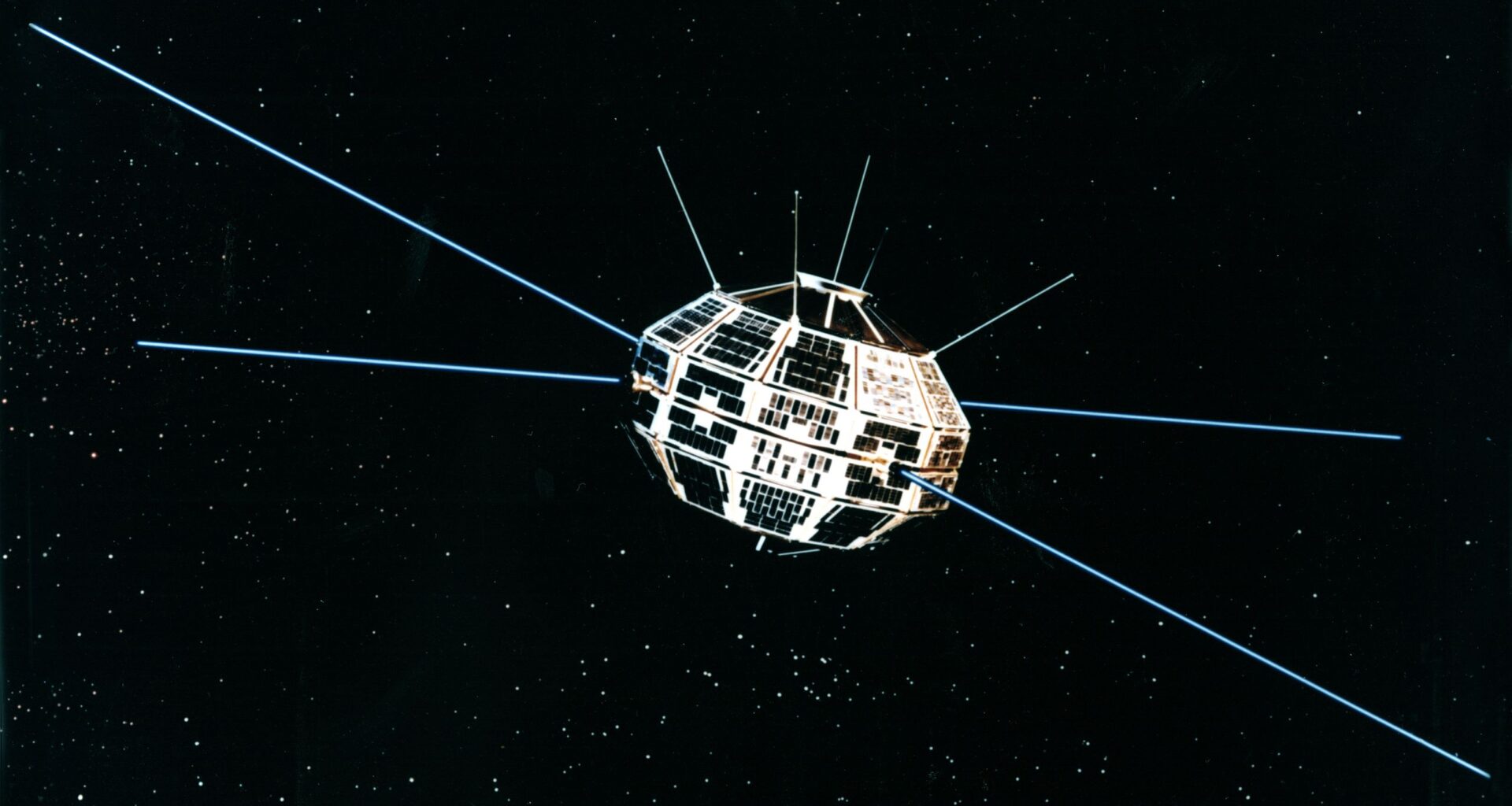
On Sept. 28, 1962, Canada launched its first satellite, Alouette 1. This made Canada the third country to build and launch its own satellite after the U.S. and the Soviet Union.
Alouette 1 was designed to study Earth’s ionosphere, which is a region in the upper atmosphere that is ionized by solar and cosmic radiation.
The mission lasted 10 years before the satellite was decommissioned, but the derelict satellite is still orbiting the Earth.

A model of Canada’s Aloutte 1 satellite, the country’s first, which launched on Sept. 28, 1962 late in the evening Pacific Time from California. (Image credit: Canadian Space Agency)Why it mattered
While the launch of Alouette 1 lifted off on Sept. 28, you may see citations that it actually happened on Sept. 29. Both are technically true. Alouette 1 launched from the U.S. military’s Pacific Missile Range in California at 11:06 p.m. Pacific time, placing liftoff of its American-built Thor-Agena rocket at 2:06 a.m. Eastern time on Sept. 29 (or 0606 GMT).
But time zones aside, the launch marked a watershed moment for Canada’s future in space. The launch actually predates the Canadian Space Agency, itself, which formed in March 1989.
You may like
The mission came about from a call for collaboration by the then nascent NASA in 1958, with scientists with Canada’s Defence and Research Telecommunications Establishment submitting a proposal for two Alouette satellites to study Earth’s ionosphere.
The satellite was designed to last just one year in a 621-mile (1,000 km) orbit. It lasted a full decade instead, snapping over 1 million images of Earth’s ionosphere during that time, according to the Canadian Space Agency.

Canada went on to work with NASA to launch Alouette 2 in 1965 along with two follow-up missions through 1970. But the pattern of collaboration with NASA was set.
Canada would go on to work with NASA on the Canadarm robotic arm used on NASA’s space shuttles, as well as the Canadarm2, its bigger descendant used on the International Space Station. That’s in addition to the country’s ongoing satellite missions.
The Canadian Space Agency and MDA has also drawn up plans for a new Canadarm3, that was to be used for NASA’s Gateway lunar space station, though that station project is stalled for now, NASA has said.
On this day in space! Sept. 27, 1997: Mars Pathfinder lander sends last transmission