
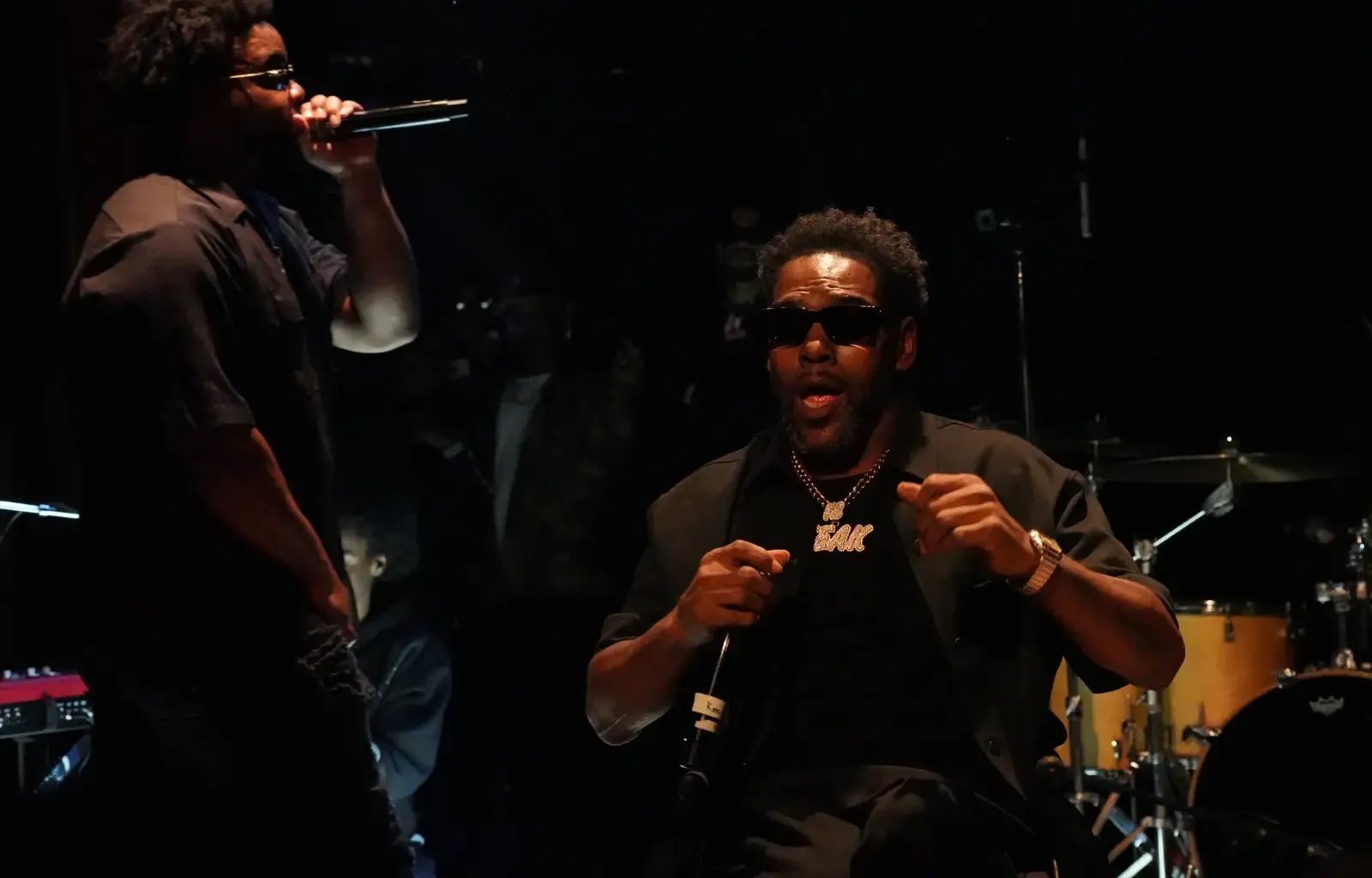
Twenty years ago, hyphy, a music and cultural movement that came out of Oakland and the Bay Area, exploded nationally. It had its own slang, fashion, dance style, car culture, and much more.
This year, The Oaklandside published two stories looking back at that moment and at what has happened since, both reported by Eric K. Arnold. Eric has covered the Bay Area’s hip hop scene since the ’90s and chronicled hyphy’s rise and fall as it happened.
Eric joined me to talk about the summer of 2006, when the movement broke nationally, and to what happened when the spotlight faded. He also picks up the story today, as a new generation of Bay Area artists reaches back to reclaim that sound, and some of the people who lived through it start talking openly about what happened behind the music.
Below is a short version of our conversation. Hear the whole thing — I highly recommend it — above or anywhere you get podcasts.
— Tasneem Raja, editor-in-chief, The Oaklandside
Eric, for someone new to all of this, what was hyphy?
Hyphy was not just a music genre. It was the soundtrack to a culture and a lifestyle that started out in the streets of Oakland. It combined sideshow culture with hardcore rap, and there was a club element and a fashion element.
Hyphy had a kind of neo-psychedelic aspect to it. People wore these huge sunglasses they called stunna shades, and very vibrant colors. You’d see people in these loud hoodies, in colors most people would be scared to wear, but that was the dress code.
What about the sound?
The sound of hyphy is an evolution of the Bay Area sound. The Bay Area underground sound is bass-driven and funk-driven, and it’s slow to mid-tempo. Hyphy upped the tempo and took away the funk basslines, so now you just have the bass drops, like the 808.
Lyrically, what were hyphy artists interested in?
Hyphy artists were mainly talking about their lifestyles, and those lifestyles were about rebellion and youthful expression from a 2000s counterculture point of view. This was the sound of inner-city Oakland. They jump in their car, they ride down Foothill. They may smoke a blunt. They may try to holler at some women. Later on they go to the club, meet up with their partners, and get hyphy.
You wrote that in Bay Area hip hop circles, “2006 now holds the kind of reverence 1988 does on the East Coast, a legendary year.” What made it legendary?
For frame of reference, 1988 in East Coast hip hop is when Public Enemy dropped, and when Eric B. & Rakim dropped their second album. The whole year was studded with releases that became landmarks and classics. When I looked back at what was released in 2006, it was like, whoa, this is a motherlode.
You had Too Short. You had E-40. Mistah FAB from Oakland started the year with “Yellow Bus” and ended it with “Ghost Ride It.” Every single month, there were two or three notable albums dropping. Plus, the Bay got featured on MTV and BET and in USA Today. Everyone was talking about the hyphy movement, and it came after a buildup of three or four years before it reached fever pitch.
2005 was pretty intense, too. But then in 2006, when you think you can’t top it, here comes the video for E-40’s “Tell Me When to Go.”
That song and video are widely credited with putting hyphy on the national map. What was it about them?
It was just a great treatment. First, you have the beat, made by Lil Jon, the godfather of crunk music from Atlanta. It’s a very primal, tribal-sounding beat that starts out with just hand claps and kick drums. Then the 808 kicks in with a Run-DMC sample, and it builds in intensity. Even in the first 20 to 30 seconds, before the raps kick in, you feel like you’re being taken on a journey to the land of Oakland, the land of hyphy.
You hear the chorus before you hear the verses, so you’re already primed for a peak experience. Then E-40 comes in with a verse full of biblical imagery.
What are we seeing in the video while all this is happening?
It’s very cinematic. It’s in black and white, and it’s very stylized. It makes Oakland look like this amazing, almost futuristic world, even though they use very street locations, like Ben’s Burgers, the East Bay Dragons headquarters, and Youth Uprising out on MacArthur and 82nd.
There are quick jump cuts before the verses by E-40 and Keak Da Sneak. They show the Turf Feinz, a turf dance group, going wild and shaking their dreads, intercut with quick shots of Keak, E-40, and others who cameo in the video. It all builds up to E-40’s verse, which tells you there’s something going on in the Bay.
It also sets the stage for Keak Da Sneak, who is an acquired taste, shall we say, because his rap style is so unique. He’s one of the most unique voices in all of rap history. No one can imitate or duplicate his style, and when his verse comes in, it’s something uniquely Oakland.
It’s more minimal, and there are almost no melodic elements to it. It’s all rhythm. It’s all percussion.
There are songs from this era that you see as just as iconic as “Tell Me When to Go.” Tell us about some of them.
You can’t have a hyphy movement without “Super Hyphy” by Keak Da Sneak. That came out in 2005, and it took hyphy to another level. It was promoted in other markets outside the Bay, and it did really well there. It set the table for “Tell Me When to Go.”
Also in 2005, there was Mistah FAB’s “Super Sick Wit It,” off his Son of a Pimp album on Thizz Entertainment. It brought Oakland and Vallejo together like they were one neighborhood, because Turf Talk, who I think is E-40’s cousin, is featured on it, and so is E-40. Bay Area rap is very regional, and it can feel territorial at times. When different cities come together, it sends a message of unity, and that’s what that song did. Plus, the beat was inescapable.
Tell us about Keak Da Sneak. What was his life like in Oakland before all this blew up?
Keak goes all the way back to the mob music era of the ’90s. He was in the group 3X Krazy from East Oakland, and they released an album called Stackin’ Chips in 1997 on Virgin’s Noo Trybe label. I actually wrote the press release for it. I remember Keak, Agerman, and Bart coming to our office and sitting down for the interview, and they were talking so much slang that I had no idea what they were talking about. They had their own language, their own code. There wasn’t a word left untouched.
Keak took that with him when he became a solo artist in the late ’90s, and I think his album Sneakacydal was the first mention of hyphy on a record. He claims to have made up the word, which is a combination of “hyper” and “fly.” Originally, it had negative connotations, because it meant you were doing too much. You walk into a room and knock over all the cups, and you don’t even look back to pick them up. You just go sit down. That’s hyphy. But over time, it became an expression of a vibrant energy that had a value all its own.
Keak’s first appearance was in the early ’90s, on C-Bo’s Autopsy, when he was a teenager, alongside Agerman. So he’s always been in the hardcore gangster rap arena. But his character is interesting because he combines the gangster and the trickster from African American folklore. On one hand, he’s hardcore, and he’s not afraid of confrontation. On the other hand, he’s a trickster, always bragging that he’s so hyphy he’ll steal your girl. I went back and listened to Sonny Boy Williamson II and John Lee Hooker, blues from the 1950s, and they’re talking about the same things.
The “Tell Me When to Go” video was filmed in part at YouthUprising, a youth center in deep East Oakland that still operates today and used to hold turf dance battles. What was the relationship between these artists and Oakland institutions and communities?
The artists were embraced by the community. Too Short volunteered at Youth Uprising; I wrote a story about that for the East Bay Express in, I believe, 2007. They were giving young people free studio time as part of an initiative to get them off the streets and into something productive. While you were there, they’d encourage you to take a teen pregnancy class or sign up for employment training. It had all these wraparound services, but they were definitely using hip hop as a way to get youth in the door.
They started hosting turf dancing competitions that drew hundreds of people. There were three or four main groups, like the Animaniacs, the Architeckz, and the Turf Feinz, but it was open to everyone, so people from the community who had been practicing could compete, too. It was very vibrant.
When I did a feature for Vibe in 2006, we did the photo shoot at Youth Uprising. E-40 was there, FAB was there, and all these people came out to be part of the vibe and represent the hyphy movement. It felt great that these rappers were giving something back to the community.
Many of our readers know Mistah FAB today as the streetwear designer behind Dope Era and as an Oakland community organizer. In your story, he describes 2006 as both the best and the most chaotic year of his life. Bring us inside his story.
FAB was at the center of the storm. His 2005 album Son of a Pimp on Thizz Entertainment was one of the most iconic hyphy albums. I’d put it alongside The Slapaddict by Traxamillion, which is a compilation of tracks he produced but sounds like a coherent album because it’s all one producer.
FAB started out as a battle rapper and a conscious rapper. If you listen to his debut album from around 2002 or 2003, there’s no hyphy on it at all, because hyphy wasn’t a thing yet. By 2005, it was. When I talked to him, he told me he only had three hyphy tracks on Son of a Pimp. But those three tracks were infectious. They got on the radio, they defined the moment, and they accelerated the movement.
The photos in your first story were taken by Bay Area photojournalist D-Ray. Who is she, and how did she make those images?
D-Ray is a Bay Area icon. She’s married to Gary Archer, who was part of FAB’s management team very early on. She told me a story about being out at a show taking photos, and Mac Dre asked who that woman taking photos was. He was astonished to see a woman photographer in that environment, completely fluid and 110% comfortable in a setting some might consider rough. D-Ray told me, “Well, I’m a tomboy.”
She’s tough as nails, but she has a heart of gold. She became the official photographer for Thizz Entertainment, and she was also working with FAB. So she was in a position to document the hyphy phenomenon like no other person. She didn’t have to get called for a shoot, because she was already there, touring with these artists. She also worked at YouthUprising, so she was there when the “Tell Me When to Go” video was shot. She was very deep in the culture, with good friendships and working relationships with all these artists.
Not all of the attention on hyphy was positive. What were critics saying?
There’s always a discourse in mainstream popular culture over cultural phenomena created by ethnic minorities, especially young people. That’s been going on since the jitterbug and the cakewalk. And then that same mainstream culture will try to appropriate the culture created by the underserved.
With that in mind, there were two reported fatalities from people attempting to ghost ride the whip.
For people who don’t know, what is ghost riding the whip?
You open all the doors on a moving vehicle, put it in neutral, get out, walk around it, and get back in while the car is still moving.
How did that play out in the national media?
It happened right when Mistah FAB had his “Ghost Ride It” song and video in rotation on MTV. All of a sudden, the Today Show and Fox News are reporting on it, and FAB has to go on those shows to defend himself and defend hyphy culture. Maybe there are legitimate public safety concerns over ghost riding the whip. But it’s never been reported that anyone in the Bay Area has died from it.
By the end of the 2000s, the mainstream spotlight had moved on. What happened to hyphy, and what was that period like for the artists who built the movement?
There was all this momentum built up in 2006, and then in 2007, for various reasons, there wasn’t another national hit to keep it going. MTV went away, USA Today looked somewhere else, and commercial radio stations went back to what they’d been doing before.
It’s really just a matter of perception that hyphy fell off. What actually happened is there wasn’t major label national support for it. Rap sales were down 20% in 2006 from 2005, so labels were thinking about their investment, and it takes a lot to break a regional artist. E-40 had been out since the ’90s. He’d already been on a major label and had a national profile. Same with Too Short. But Mistah FAB, Dem Hoodstarz, Keak Da Sneak were untested artists. No one knew them outside the Bay.
Hyphy didn’t just curl up in a ball and go away, though, because it was based on a culture and a lifestyle, and that was organic. The diehards, like Keak Da Sneak, Mistah FAB, and D-Lo, kept doing what they had already been doing.
Then, interestingly, a producer from LA named DJ Mustard picked up elements of the sound and started having national hits with it, with artists like Tyga and 2 Chainz. Bay Area artists were like, “Hey, they’re taking our sound.” Around the middle of the 2010s, people started looking at hyphy as something with a cultural legacy, and Bay Area artists started reclaiming it.
Your second story picks up today, 20 years later, as a new generation of Bay Area artists reaches back to reclaim that legacy. What does the revival look like, and what’s different about this post-hyphy sound?
The sound isn’t exactly the same as it was in 2006, but there are hyphy elements to it, and a lot of times there are references to hyphy or to 2006. We’re talking about artists like P-Lo and Iamsu!, who came a generation after hyphy and were very much influenced by it.
What’s remarkable is the intergenerational collaboration between artists like E-40, P-Lo, and G-Eazy. They might even throw B-Legit and Too Short on a track. Everyone’s coming together for the Bay.
Is that collaboration mainly happening through the music?
It’s definitely happening through the music. I don’t know if it’s happening in other areas. But there are 10, 20, 30 songs in just the last three or four years that are these kinds of intergenerational collaborations, building on the legacy of hyphy so that it becomes a cultural tradition.
You spoke with a lot of people for this work, including journalist Pendarvis Harshaw. Many of them remember the exhilaration and joy of that moment. Some also look back on those years with complicated feelings of loss and grief. Tell us about that.
It’s a double-edged sword. In 2006, there was about a 50% spike in homicides in Oakland while the hyphy movement was going on. People were losing loved ones and dealing with their grief, and going dumb was an outlet to relieve the pain they were feeling. In retrospect, it’s probably good that it was there for them.
People were teenagers or in their early 20s at the time. As you mature and get older, you look back and reflect, and you’re able to put your feelings and what you went through into words in a way you maybe couldn’t at the time.
Mistah FAB went on to start Thug Therapy, a program where Black men can talk openly about mental health. How does that fit into the story of hyphy?
I think it’s one of the most amazing outcomes of the whole hyphy movement: an inner-city men’s support group where they’re encouraged to be emotionally vulnerable.
It’s a free community meeting. They’ve held it at various locations, including Dope Era and Oak Stop, and I think at a college, possibly Merritt College. People are encouraged to tell their stories and share their experiences, and they also bring in speakers.
They’ve had Ryan Coogler, the Oakland-based filmmaker. Many people know him from Black Panther, and he also directed Sinners and Fruitvale Station, the Oscar Grant movie. Having Coogler talk about what gives him anxiety, and about being so high-strung that it’s hard for him to relax, is something people can relate to. Like, wow, this amazing Hollywood film director goes through the same thing I go through.
What’s it been like for you to look back on this time in your own life? What was your life like then?
I was a full-time writer. When I did the Vibe story on hyphy, I was working at the East Bay Express, I think as the calendar editor, but I was also writing features and profiles. Vibe called me up and said they wanted someone from the Bay to do the story.
I was actually the first journalist to write about hyphy in a national magazine, in 2004, for XLR8R. Over the years, I covered it for the East Bay Express, the San Francisco Chronicle, SF Weekly, and Vibe. Coming back to it 20 years later was kind of a trip. While doing research, I came across my own articles that I’d forgotten about, and they were extensive, with all these quotes. It was good to look back, but then you’re also like, “Wow, I’m quoting myself here.”
The arc of hyphy is also the arc of the Bay. We had this whole thing of regional pride, and then other regions kind of took it from us. Now we’re taking it back, and it feels good to take it back. And it feels good to be a grown person at this point and say there’s still a little bit of me that’s a little hyphy.
“*” indicates required fields