
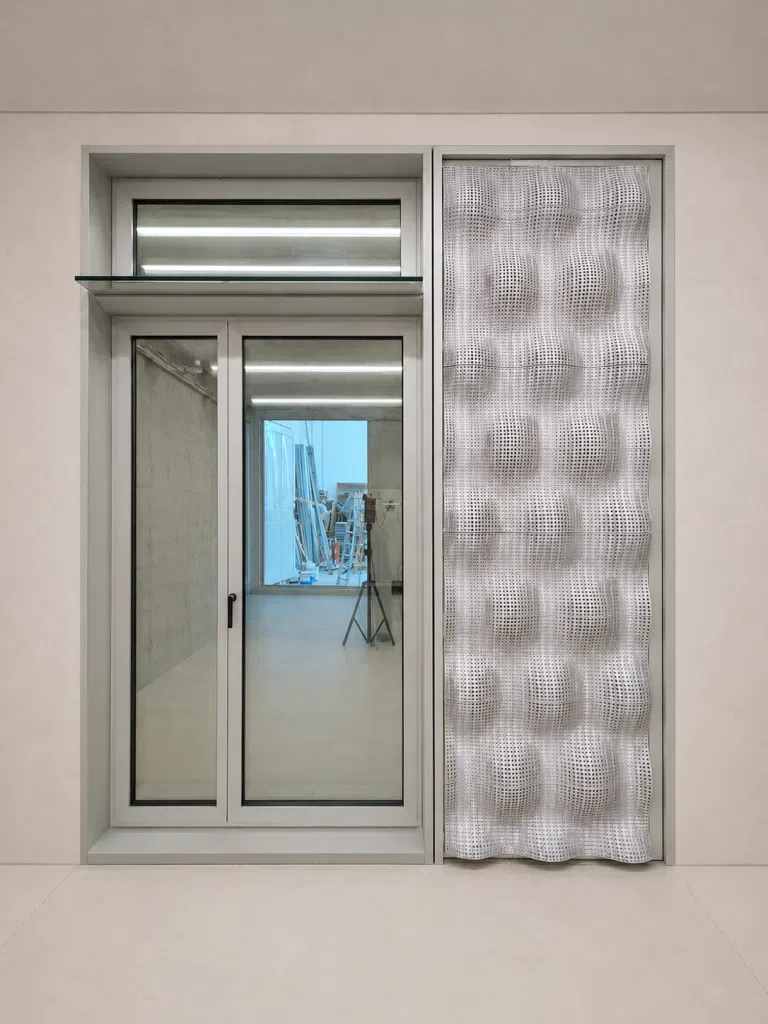
Italian printer manufacturer Kentstrapper has 3D printed an acoustic panel that achieved Class A sound absorption in standardized testing. The manufacturer produced it for REVERSING, a University of Florence research project developing retrofit facades for schools and offices. Tested in a reverberation chamber according to ISO 354, the panel reached a weighted sound absorption coefficient (αw) of 0.90, Class A under ISO 11654.
Compared with a mineral wool panel alone, it reduced reverberation time by 41% at 500 Hz and 45% at 1,000 Hz. It also raised the Speech Transmission Index (STI), a measure of speech intelligibility, from 0.47 to 0.52. The results are published in “Designing Sound with Geometry: A Hybrid 3D-Printed Acoustic Panel” in AM Perspectives, and in a second paper on additive manufacturing for low-impact facade systems in issue 30 (2025) of TECHNE, the University of Florence’s architectural technology journal.
A printed component in a prefabricated facade
REVERSING, short for Regenerative EnVelopE foR deep regeneration of School and office buildINGs, is funded by the Tuscany Region under the PR FESR 2021–2027 program. The project is led by the University of Florence’s Department of Architecture (DIDA) under the scientific direction of Professor Rosa Romano. It has produced a prefabricated, dry-assembled facade system for the energy retrofit of existing schools and offices.
Alongside Kentstrapper, the project partners are Polistamp (opaque modules), Santelli Vetri (high-performance transparent system) and Z-Lab (acoustic analysis and validation), in whose reverberation chamber the panel was tested. Kentstrapper’s contribution is one of the system’s four products: an interior finishing panel for classrooms and offices, where controlling reverberation directly affects how well people understand speech.
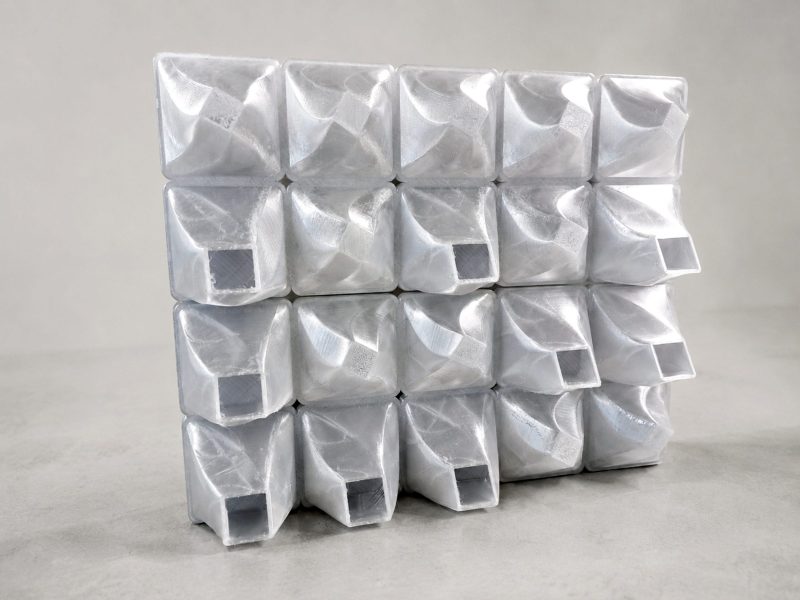 REVERSING project. Photo via Kentstrapper.
Geometry set by acoustic calculation
The panel has a sinusoidal profile perforated with holes of varying diameter, and the shape is set by acoustic calculations rather than aesthetics. Hole diameter and the depth of the cavity behind the surface change from point to point so that the printed shell works together with a mineral wool layer mounted behind it.
The University of Florence team developed the parametric model in Rhinoceros and Grasshopper, and Kentstrapper worked with them to keep the design within printable limits. The paper credits Kentstrapper co-founder Luciano Cantini with supporting the development of the FDM process.
Printing took place on a Kentstrapper Mille, which has a 1,000 × 1,000 × 1,000 mm build volume. The team used PETG with a 0.8 mm nozzle and a low deposition rate, which kept the corrugated surface stable during the build. The complete panel is made of eight sub-components, each measuring 860 × 344 mm, and each one took about 2.5 kg of material and 56 hours to print.
Limits of the current process
The researchers state openly that those figures suit an experimental prototype but not mass production under the same conditions.
For Kentstrapper, the project moves the Mille into new territory. The company’s printers are typically used for jigs and production equipment, while this panel is a building component with certified acoustic requirements, validated to ISO standards and published by an independent university. It gives facade designers and retrofit specialists measured evidence that large-format printing can produce functional building elements rather than only demonstration models.
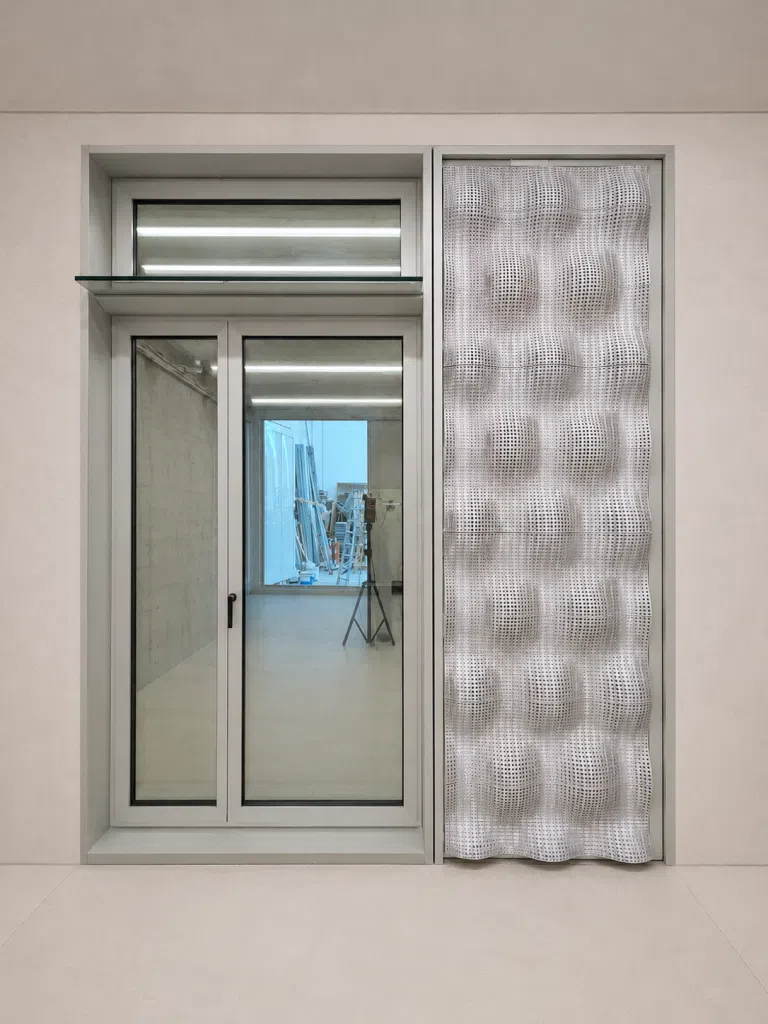 REVERSING project. Photo via Kentstrapper.
Large-format printing moves into building components
Kentstrapper is extending its large-format printers from jigs and production equipment into building components. In REVERSING, that means producing an interior acoustic panel within a prefabricated, dry-assembled facade system for the energy retrofit of existing schools and offices, where the panel’s geometry is shaped by acoustic calculation.
Other large-format players are moving into architecture too. In the US, Printerior launched Circdal, a company that applies 3D printing to architectural systems and takes large-format printing beyond its usual role in prototyping and limited production. It started with two product categories, panels and screens, designed as modular components for interior and architectural spaces and printed on demand in St. Louis, Missouri.
In Italy, WASP worked with Gola Studio, Pacha Group’s in-house creative and production division, on three large-scale 3D printed facades for the Pacha Ibiza nightclub’s 2025 summer season. The three parametric designs can be swapped on the existing structure, and hundreds of unique pieces were printed in two months.
Those projects show printed panels are entering buildings. REVERSING shows they can also meet certified acoustic performance. Print time is the next hurdle.
Register now for AMA: Software 2026. Join 3D Printing Industry on 22 October for expert presentations, panel discussions and live audience Q&A exploring the software shaping additive manufacturing. [Register here.]
To stay up to date with the latest 3D printing news, don’t forget to subscribe to the 3D Printing Industry newsletter or follow us on LinkedIn.
Explore the full Future of 3D Printing and Executive Survey series from 3D Printing Industry, featuring perspectives from CEOs, engineers, and industry leaders on the industrialization of additive manufacturing, 3D printing industry trends 2026, qualification, supply chains, and additive manufacturing industry analysis.
Featured image shows REVERSING project. Photo via Kentstrapper.