

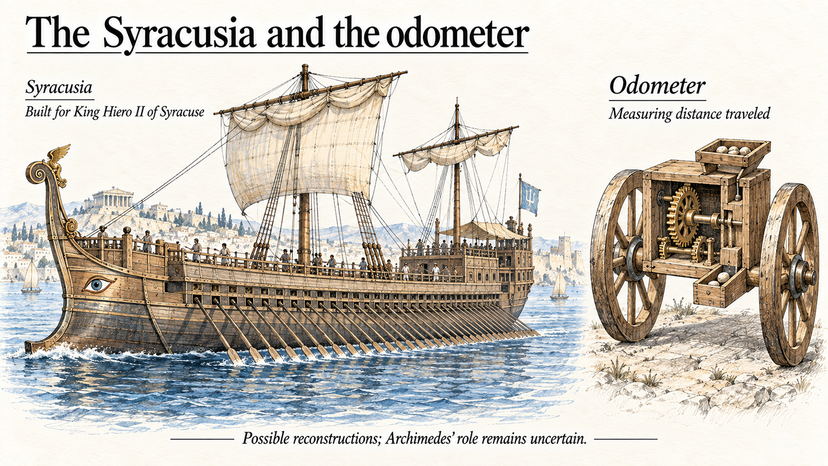
Sketch for demonstrative purposes. Nicole Antonio / ChatGPT
The Syracusia was one of the most ambitious ships associated with the ancient world. Built for King Hiero II of Syracuse, the enormous vessel was eventually sent to Egypt.
Later accounts connect Archimedes with the ship’s engineering, although claims that he personally “designed” the entire vessel should be treated cautiously. The Archimedes screw itself is sometimes linked to the need to pump water from a large ship.
Archimedes has also traditionally been credited with an odometer, a mechanical device for measuring distance traveled. As with several mechanical inventions attributed to him, the historical evidence isn’t strong enough to treat his authorship as certain.
What is certain is that Archimedes became the ancient world’s model of the mathematician-engineer: someone who could move from an abstract geometrical proof to the mechanics of heavy objects, floating ships and military machines.
His life ended violently when Roman forces captured Syracuse in 212 B.C.E. Later stories say a Roman soldier killed Archimedes despite orders that he be spared. Plutarch tells several versions, including one in which Archimedes was absorbed in a mathematical diagram when the soldier approached him.
Even Archimedes’ supposed last words differ depending on the version, which is a useful reminder of how his history works. The mathematics he wrote down gives us solid ground. The farther we move toward death rays, dramatic last words and a naked sprint from the bath, the more ancient history blends with legend.
We created this article in conjunction with AI technology, then made sure it was fact-checked and edited by a HowStuffWorks editor.