
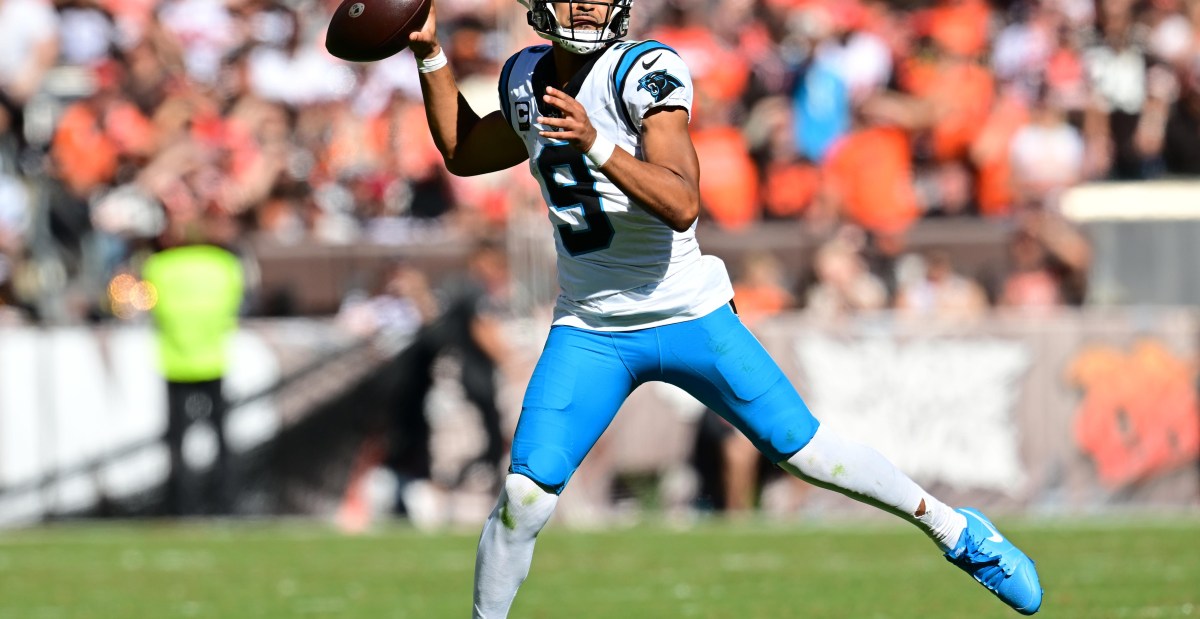
To begin my scouting of the Detroit Lions’ next opponent, I like to watch their most recent game played. For the Carolina Panthers, that means checking in on their 21-18 loss to the Cleveland Browns in Week 3.
I took notes during the game, and here are my five biggest takeaways on what it may mean for Lions vs. Panthers, along with some data to support those observations.
The Panthers defense can get to the passer… but they have to get aggressive
Against the Browns, the Panthers posted a 38.5% pressure rate, but that dropped significantly when just rushing four. Here are their pressure rates in Week 3 with and without blitz:
Blitzing: 55.6% pressure rate (fourth highest), 2.76 seconds to pressure (29th)No blitz: 33.3% pressure rate (10th), 2.93 seconds to pressure (22nd)
When the Panthers don’t send extra blitzers, they generate their pressure utilizing the speed of their edge rushers. Princely Umanmielen is second in pressures on the team, only trailing Jaelen Phillips, and his speed and bend were on display against Cleveland. But the Lions dealt with a pair of speed rushers last week against the Jets and held up very well.
That said, they’ve got some interior players with some pass rushing skills, including Derrick Brown (7.0 sacks last year). That could be the bigger threat against Detroit’s young interior.
Bryce Young’s arm talent is a problem
Man, Bryce Young is fun to watch when you’re only looking at arm talent. He can make any throw. And while the deep shots are what get most of the national attention, I’m impressed with the throws he can make on the perimeter in tight windows. Just look at his passing chart against the Browns and how he utilized every inch of the boundaries:

It takes a ton of arm talent to drive that ball all the way to the sidelines, and he is not afraid to do so.
He is also not afraid to air it out deep. He currently holds the longest intended air yards per pass attempt in the league (10.2) and leads the league in passes of 20+ air yards (17). The accuracy is a bit up and down, but there’s more good than bad there.
And while we’re on the topic of Young, his mobility is obviously something defenses need to be aware of. He can extend plays with his legs and his pocket presence is clearly improving. However, interestingly, he is much less inclined to run and scramble. Against the Browns, he passed up several opportunities for easy yards to try for the big play. For the season, he has attempted just three rushes for 16 yards and a touchdown.
Panthers’ standard run game struggled, but came alive late
For the season, the Panthers run game has been fairly ineffective. They rank 21st in DVOA, 23rd in EPA, and 23rd in success rate.
However, they do have the ability to wear teams down as the game continues. Against the Browns, Carolina had just 22 yards on 11 carries through three quarters. But in the final quarter, they ran the ball down Cleveland’s throat, rushing for 76 yards on just 12 carries (6.3 YPC).
With a pair of bruising backs in Chuba Hubbard (6-foot-1, 210) and AJ Dillon (6-foot, 247), they can wear you down—but they are not explosive. The Panthers’ longest run of the season is 24 yards by… Kenny Pickett. The running backs don’t have a run over 16 yards.
Detroit may need to defend all four downs
Panthers head coach Dave Canales is not afraid to get a little aggressive on fourth down. Twice in the first half against the Browns, Carolina opted to go for it near midfield. Here were the two opportunities:
8:38 left in the second quarter: 0-0 tie, fourth-and-3 from the Browns’ 43-yard line3:40 left in the second quarter: 3-0 Browns, fourth-and-1 from the Panthers’ 40-yard line
The Panthers failed both attempts, and it immediately led to two Browns’ scoring drives and a 10-0 deficit. If Detroit can stand their ground on fourth down (Lions currently have stopped zero of three fourth down attempts), it could be a game-changer.
For the year, the Panthers are just 1-of-6 on fourth down. Last year, they attempted the second most fourth downs in the NFL (40), converting on 27 of them (67.5% conversion rate, fourth best).
Panthers run defense maybe better than advertised
If you look at the season-long stats for Carolina’s run defense, they look god awful. They’ve allowed an NFL-high 5.7 yards per carry, 193.3 rushing yards per game, and they rank 23rd in run defense DVOA.
However, I think three things are happening: the data is being swung by a terrible Week 1 performance against the Bears, they’re being disproportionately hurt by mobile quarterbacks, and they’ve also just made some clear progress.
Against Chicago, the Panthers allowed 291 rushing yards and 7.5 yards per carry. It was a truly awful performance, led by D’Andre Swift and Kyle Monangai, who combined for 224 yards and four touchdowns on 28 carries (8.0 YPC). The following week wasn’t great, but it was a marked improvement: allowing Bijan Robinson and Brian Robinson to combine for 123 yards on 27 carries (4.6 YPC). Against the Browns, the Panthers allowed 132 rushing yards on 4.4 yards per carry—but Quinshon Judkins managed just 70 yards on 18 carries (3.9 YPC).
In total, of the 580 rushing yards the Panthers have allowed, 146 (over 25%) have come from quarterbacks. That won’t be an issue this week.
Particularly, when it came down to needing their defense to stop the run, they did. The Browns had an opportunity to put the game away late with a single first down clinching it. Despite facing a second-and-2, the Panthers were able to get three straight stops on runs to give the offense one more shot. That is reflected in their overall run success rate allowed (35.6%), which is actually ninth best in the NFL
Now, the Browns’ rushing attack (31st in DVOA) is way worse than the Bears (ninth) and Falcons (sixth), and the Lions have one of the best in the NFL (second). But I still think the early numbers are skewing a run defense that can hang.