
The United States Department of Energy (DoE) is offering up $215 million in funding to help domestic firms develop the world’s first reliable quantum computer. The race to unlock quantum computing has heated up as the next-gen technology has arisen as a potential solution to the Pandora’s box of energy demand that the AI boom has opened.
The DoE’s Quantum Genesis Q Competition is now accepting proposals on ideas for how to “deploy quantum computers with at least 100 logical qubits that are capable of performing hundreds of millions of fault-tolerant operations and scientific demonstration programs.” DoE Undersecretary for Science Darío Gil says that the competition is encouraging the involvement of the commercial sector through Quantum Genesis Q “to allow both collaboration and competition to take place … to bring the best of the competitive spirits” as part of its broader goal to ensure that the United States establishes itself as the leader of the global quantum computing race.
In addition, the DoE has rolled out a complementary program called the Quantum High-Performance Computing Validation and Verification Testbed Lab Call, which is soliciting proposals from the United States’ network of national laboratories “to develop and apply a complete set of necessary tools and expertise to perform performance verification of fault tolerant quantum computers.”
This push to fast-track the development of cutting-edge quantum technologies comes at a time when such a breakthrough is sorely needed to tame the energy monster that AI is creating. A new report from the BCG Institute finds that quantum computing, once it is sufficiently advanced, could one day address 20 to 40 percent of emissions from hard-to-abate sectors like steelmaking and cement production, according to an exclusive preview from Semafor. Moreover, the report says that the technology could be applied in carbon capture, green hydrogen and ammonia, and batteries.
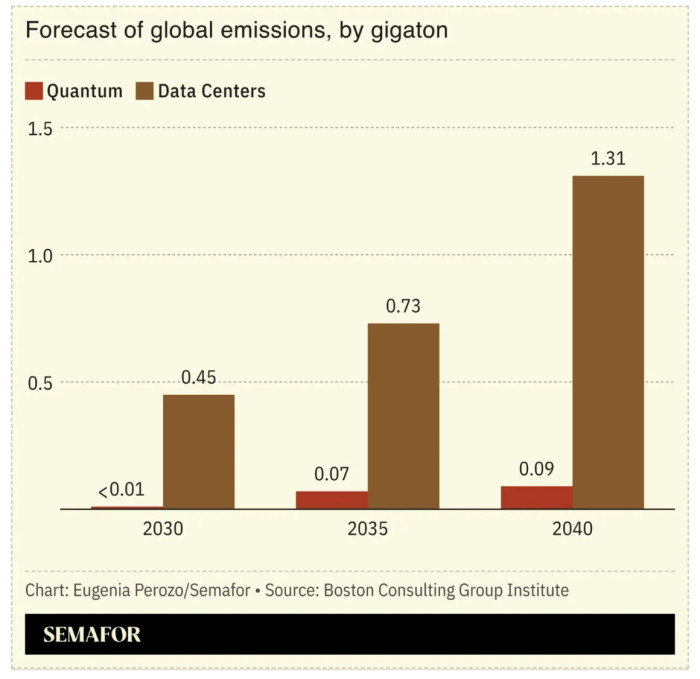
While quantum computing also requires significant energy to run, it pales in comparison to the amount of energy being gobbled up by the data centers powering the AI boom. According to Seamfor, the new BCG study “estimates the sector’s carbon footprint will be relatively small compared to the AI industry’s because quantum is more likely to be used to address specific problems rather than as a general purpose technology.”
Furthermore, quantum computing could make AI itself more energy efficient by changing the way that large language models function. “For the things that quantum computing is good at — such as AI processing — there’s no way for any GPU to compete against us. Those workloads are ultimately going to go to quantum and current technology just literally can’t compete,” Peter Chapman, President and CEO of quantum computing company IonQ, was quoted by Forbes back in 2024. “Quantum computing — our next-generation chip — to simulate what it’s doing, you would need something like two and a half billion GPUs and it runs off a two standard wall sockets,” he added.
Quantum holds promise for improving clean energy technologies. Quantum batteries could one day, mind-bendingly, emit more energy than they store if they are in a shared quantum state with the device they are providing energy to. Quantum mechanics could also enable a new form of energy harvester that captures waste heat emanating from electronics and industrial machinery. And researchers at MIT announced last year that they have discovered a method to observe a so-called “edge state” of electrons that results in a lack of energy loss with enormous disruptive potential for the tech sector. According to reporting from Interesting Engineering, ”such frictionless movement of electrons can enable data and energy transfer across devices without any transmission losses, leading to the development of super-efficient electronic circuits and quantum computers.”
By Haley Zaremba for Oilprice.com