
NEED TO KNOW
Ranim Haddad endured unexplained pregnancy losses over a decade while doctors searched for answers
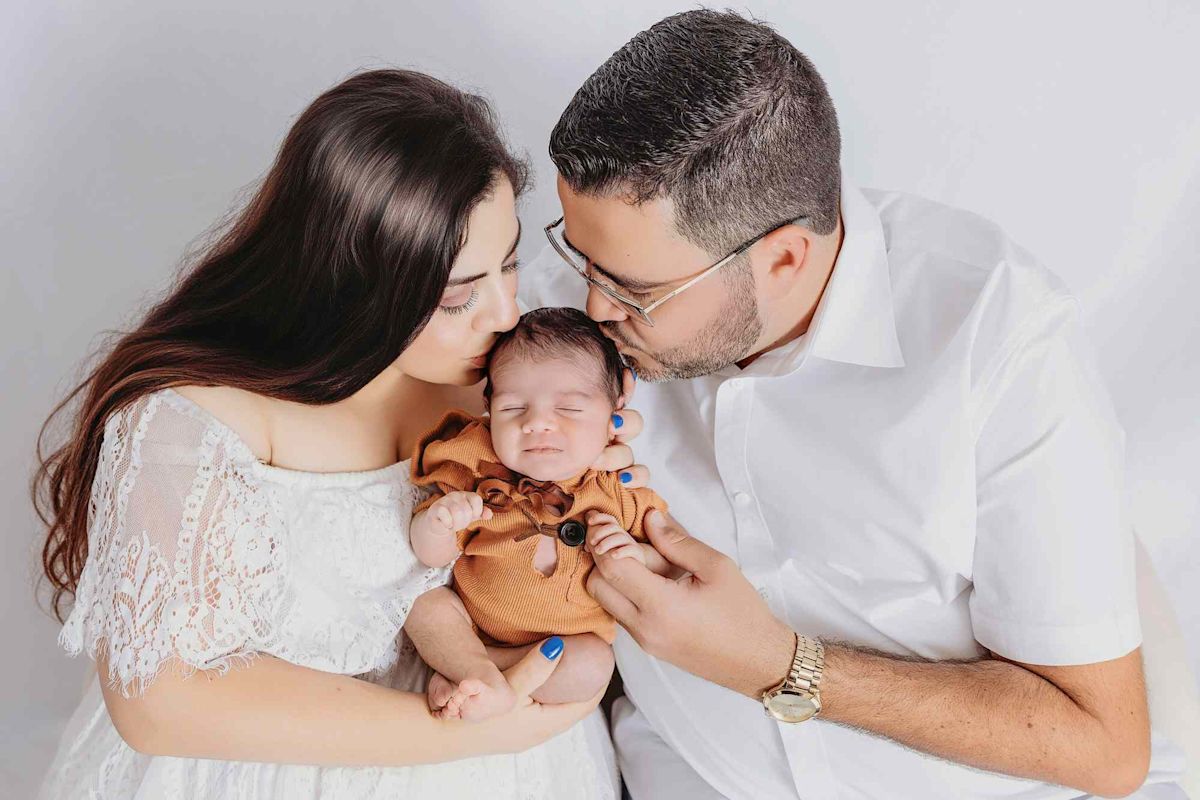
She and husband Fuad welcomed Emmanuel in October 2025 after close monitoring throughout her pregnancy
As Emmanuel approaches 1, Ranim hopes her story encourages others facing infertility and loss
Just 7 months after getting married, Ranim and Fuad Haddad were thrilled to find out they were expecting a baby in February 2015.
The Chicago-area couple — she is now 36 and a stay-at-home mom, and he’s 40 and owns a private car service — were excited for their future.
But something went wrong with the pregnancy, and Ranim was told she was having a miscarriage. Although it was the first time she heard those words, it wouldn’t be the last.
Over the next ten years, Ranim had at least 20 miscarriages, she says.

Ranim and Fuad Haddad
Credit: Ranim Haddad
Time and again, Ranim and Fuad mourned their lost babies. Time and again, they sought answers. But doctors couldn’t explain why her pregnancies were not viable.
“Our biggest problem was that they couldn’t find the problem,” says Ranim, now 36, and living in Alsip, Ill., about 20 miles from Chicago. “If they had told me, ‘Okay, this is why you’re not able to keep the babies,’ then I would’ve made peace with it. But they kept saying, ‘We don’t know. If you keep trying, it might happen.’ So I just couldn’t give up when there was a chance.”
In 2018, her doctor recommended the couple undergo IVF. They created about eight healthy embryos, and the genetic tests looked good. But after the first transfer, she miscarried at 9 weeks. Then, the second transfer failed.
“At that point, I was done,” she recalls. “I told my husband, ‘I need a long break. I can’t keep doing this.’ “
In March 2020, they sent their remaining embryos to long-term storage.
Two months later, they were shocked to find out Ranim was pregnant naturally. For the first time, they heard their baby’s heartbeat and saw the baby on the ultrasound; previous miscarriages had occurred too early for imaging.

Ranim and Fuad Haddad
Credit: Ranim Haddad
“It was so exciting,” she says. “It was like a miracle after all those years of trying and trying and trying to finally to see that little thing on the screen.”
The couple hosted a gender reveal party when Ranim was 18.5 weeks pregnant. About 100 guests learned that Ranim and Fuad were expecting a baby girl. They called her Miracle.
A day later, she felt a gush of fluid — it was her water breaking. Alarmed, she rushed to the hospital, only to be told she could go home because everything looked fine.
The next day, she was going to the bathroom and the umbilical cord came out. She and her husband called 911. At the emergency room, the OB/GYN on call said that their daughter would not survive. There was no way to save her.
Before Ranim knew what was happening, she was in active labor — while also being told she needed to plan her daughter’s funeral. When Miracle was born on Aug. 12, 2020, her heart stopped beating. She weighed less than one pound. Ranim remembers her being perfectly formed, with the tiniest eyelashes, eyebrows and fingernails.
This was followed by yet another miscarriage.

Baby Emmanuel Haddad in October 2025
Credit: Courtesy of Ranim Haddad
Take PEOPLE with you! Subscribe to PEOPLE magazine to get the latest details on celebrity news, exclusive royal updates, how-it-happened true crime stories and more — right to your mailbox.
“My regular OB said, ‘I can’t help you anymore,’ ” Ranim recalls. She was referred to maternal fetal medicine specialist Dr. Susan Gerber at Northwestern Medicine.
Ranim underwent many of the same tests ordered by her OB, and Gerber saw nothing different. “Dr. Gerber told me, ‘I can help you get pregnant, but you have to be ready for anything to happen, because we can’t find anything wrong,’ ” Ranim recalls. “She said, ‘When you do get pregnant, all we can do is monitor you very, very closely.'”
In 2021, Ranim got pregnant again, this time with a little boy. She went to Gerber right away. “She starts monitoring me, everything looks good at first,” Ranim says.
Unfortunately, around 14 weeks, she learned that the baby boy had a very rare condition called sirenomelia. He did not have kidneys, so he didn’t produce amniotic fluid. That meant his lungs could not develop.
“I asked, ‘Is there any chance this baby will survive when he’s born?’ Dr. Gerber said, ‘No, it’s very very very unlikely for this baby to survive even if you carry to full term,’ ” Ranim recalls.
The couple was given the choice to terminate the pregnancy, but they decided against it.
“We have a lot of faith,” Ranim says. ‘I remember thinking, ‘I can’t end this pregnancy or end this baby’s life.’ “
The doctor cautioned that Ranim could go into early labor. “I prayed about it and I said, “If God wants to give us this baby, maybe it’ll be a miracle after everything we went through,” she says. “I want to do everything I can do to try and save this baby.”

Fuad and Ranim Haddad and baby Emmanuel in October 2025
Credit: Courtesy of Ranim Haddad
She went into labor at about 29 weeks. Samuel was born on Feb. 2, 2024, weighing about 3 and a half pounds.
“They had a whole team of specialists ready to go, even though they knew already the baby was not going to survive,” Ranim says.
After Samuel was born, he was placed on his mother’s stomach. “I heard my husband say, ‘Let him go. Let them try.’ “
She watched as a team of specialists tried to save her son.
“They tried everything,” she says. “Then the doctor came to us and she said, ‘There’s nothing else we can do. Would you like to hold him until the heart stops?’ “
She held her son, who had a very soft, slow heartbeat until it stopped hours later. The couple took pictures with Samuel. “Then we had to plan another funeral,” she says.
They buried him beside his sister, Miracle.
“When I went to the funeral home, it was a flashback,” Ranim says. “I lost it in the funeral home and at the cemetery. Again.”
But because she still had no answers, and no reason why her babies were not surviving, she was more determined than ever to keep trying. “I said, “I’m not giving up. I can’t give up.’ “

Emmanuel Haddad in October 2025
Credit: Courtesy of Ranim Haddad
After burying two babies in identical coffins, they needed a fresh start, she says.
She and Fuad moved out of their home into a smaller apartment. They sold the gas station her husband owned with his father, and they both got new jobs. Ranim got a part-time job with fewer hours and responsibilities so she could focus on doctor’s appointments. Her husband opened a business providing transportation for schoolchildren.
Ranim got pregnant again — “that was never the problem for us” — in February 2025 and immediately went to see Gerber.
She started with ultrasounds and blood tests. “At every single appointment, she would come out and say, ‘Ranim, everything is completely fine. Everything looks perfect.’ At the beginning, I’m not having a lot of hope, because I’m like, “I’ve been through this before. Everything is perfect, then something happens.’ One day, my husband’s looking at me, and he says, ‘You’re not getting excited.’ I said, ‘Because the more excited I get, the bigger the disappointment if something does happen.’ “
Because of her history, Ranim had appointments with Gerber every week. Everything continued to look good.
Near the end of the pregnancy, Gerber placed a cerclage to close Ranim’s cervix to prevent early birth. She developed gestational diabetes and pre-eclampsia with high blood pressure. At 35 weeks, she was admitted to the hospital, and induced at 37 weeks.
This time, the baby survived.

Ranim Haddad and baby Emmanuel in October 2025
Credit: Courtesy of Ranim Haddad
Emmanuel was born weighing 7 pounds 12 ounces on Oct. 1, 2025.
“I was scared because he didn’t cry for the first 15 seconds,” Ranim says. “My husband started recording right when he cried. When I watch the video, all I hear myself is saying, ‘Oh, thank God, thank God.’ “
The nurses told her the baby was perfect, and she got to hold him right away.
“It was the best feeling in the world,” Ranim says, “to finally hold a live, crying baby. I was so happy it felt like a dream.”
For the first 11 months, Emmanuel barely slept, Ranim says, adding that he woke every half hour. “But honestly, I loved every moment of it,” Ranim says. “I’m so grateful. When he wakes up in the morning and sees me, he starts smiling.”
Doctors still haven’t learned why she lost so many babies.
“Ranim’s case is very unusual — she’s had more losses than I’ve ever seen a patient have and go on to have a healthy, liveborn, full-term infant,” says Gerber.

Fuad, Ranim and Emmanuel Haddad at Emmanuel’s first tooth party August 2026
Credit: Courtesy of Ranim Haddad
That’s why she supports Ranim’s desire to try again.
“She carried a baby to term, so we know her body can do it,” Dr. Gerber says. “There’s reason to be hopeful that she can do this again.”
Ranim recalls blaming herself for loss after loss. She remembers feeling overwhelmed and alone as friends celebrated their successful pregnancies.
But now she is ready to share her story.
As she approaches Emmanuel’s first birthday, she is reminding others not to lose hope.
“I just want to tell every woman out there: Don’t ever give up.”
Read the original article on People