
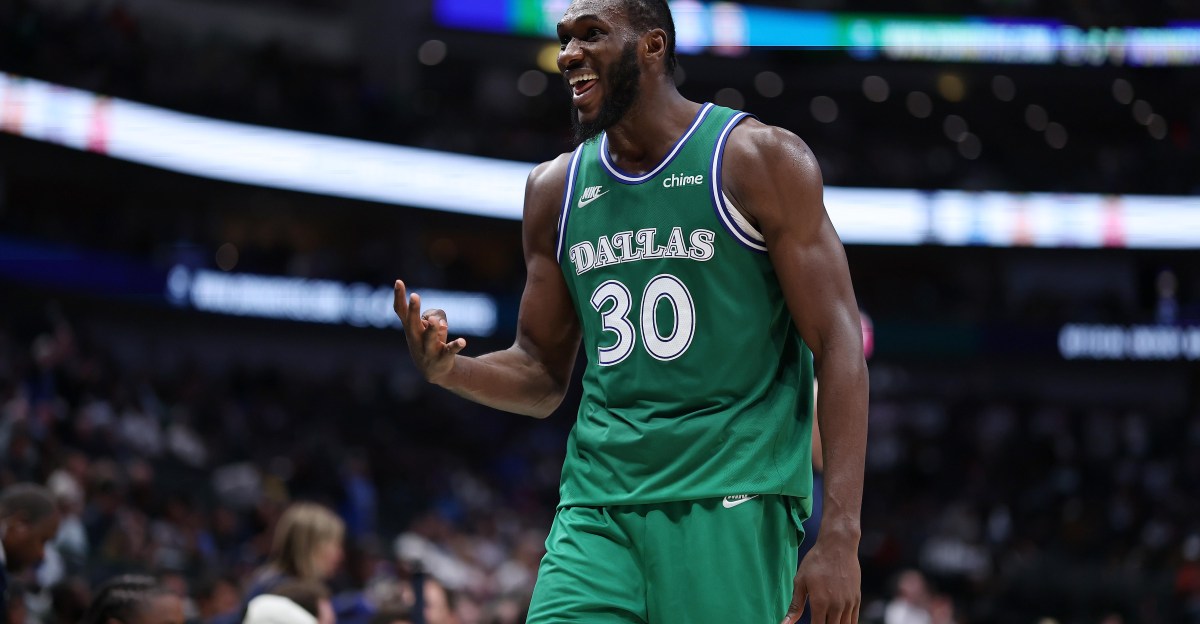
If one thing is for certain, it’s that Moussa Cissé is a trooper. The Guinean big man signed a two-way deal with the Dallas Mavericks in October of 2025, and in doing so, entered into one of the strangest and most chaotic seasons of Dallas basketball in a long time. The Nico Harrison firing, the Anthony Davis trade, Cooper Flagg’s emergence—that’s quite a lot of drama for a rookie season. But Cissé has taken it in stride. He played nearly 40 games for the Mavericks in 2025-2026; while he only averaged around 5 points and 6 rebounds in 14 minutes, his time on the floor was impactful, giving Dallas defensive energy and rim protection in a season where it was desperate for both.
Headed into 2026-2027, Cissé has a real chance to continue that momentum. Contract-wise, he’s on solid ground, having just signed a 2-year, nearly-$5-million-dollar contract with Dallas (matching the New York Knicks’ post-championship offer sheet). Now, the question is what Cissé can do with this opportunity—and what that opportunity will realistically look like.
With the 2026-2027 season on the horizon, there are real concerns regarding Dallas’ center rotation. From a raw skills perspective, Dereck Lively II has the highest ceiling—but ongoing right foot issues led to a major surgery in December 2025, which sidelined him for the remainder of the season. As of the most recent news, there’s no timetable for his return, and there’s no telling how he’ll look once he is back. Next in line is Daniel Gafford. He fared a bit better last season, playing 55 games for the Mavericks in 2025-2026, with averages hovering around 10 points and 7 rebounds. But in the absence of high-level facilitators like Kyrie Irving and Luka Dončić, Gafford’s role on the team is shakier than it used to be.
How does Moussa Cissé fit into this puzzle? Well, that’s the big question. If Lively can’t come back and play meaningful minutes this season, it’s very likely that Cissé will have to soak up some of that playing time. Likewise, if a trade market emerges for Gafford and Dallas decides to move on, Cissé should slot into the Mavericks’ rotation quite naturally. However, if both Lively and Gafford are present and healthy, the picture starts to get murkier, especially with a new head coach at the helm.
The best case for Moussa Cissé’s growth is probably one of the two scenarios above. In a world where Lively or Gafford (or both) aren’t playing, it’s easy to imagine Cissé getting a more consistent 15 minutes per night. He’s unlikely to be starting many of these games—but he certainly could be subbing in for Santi Aldama or Morez Johnson Jr., who may both find themselves sliding over to play the five this season. Viewing the situation optimistically, Cissé might capitalize on this opportunity, bumping his season averages up to 8 points and 8 rebounds while maintaining excellent rim protection.
If all of this comes to pass, some of his impressive stretches last season may begin to feel more regular. His three-game January 15–19 run, for instance: against the Utah Jazz twice and the Knicks once, Cissé averaged 11 points, 11 rebounds, and nearly 3 blocks, all in about 20 minutes of playing time. The last three games of the 2025-2026 season also stand out. Cissé played meaningful time in all of them—and against the Chicago Bulls, he put up 17/20 with 2 steals and 2 blocks in around 41 minutes. There’s no reason to expect that type of single-game performance to become the norm; however, if all goes well, it’s possible we see Cissé post those numbers a few different times next season.
Of course, there’s also a less optimistic read here: that perhaps Cissé’s rookie season was a bit of a mirage. In this scenario, Cissé enters 2026-2027, and he hits the sophomore slump hard. His defense holds, but he hasn’t added much to his game in the offseason, and his offensive averages look more and more stagnant. Even when Lively and Gafford aren’t available, Dusty May starts to rely more on unconventional small-ball lineups with Aldama and Johnson Jr. We get toward the end of the season, and Cissé hasn’t scratched his way into the rotation. Mavericks fans are left disappointed, and Moussa Cissé’s future with the Mavericks (and in the NBA) becomes doubtful.
How does Cissé avoid this outcome? The answer feels pretty obvious: small improvements on the offensive side of the ball. This could take the form of finishing better through contact, which Cissé sometimes struggled with in 2025-2026. Or, more attention to the fundamentals: screening and rolling harder to the rim would go a long way toward creating better opportunities for his teammates. The real moonshot would be developing a decent short-range jumper—the most unlikely outcome, to be sure, but why not dream a little bit? If Cissé ever became a more reliable scoring threat somewhere down the line, Dallas would have no choice but to keep him on the floor.
Entering into next season, Moussa Cissé has what feels like a clean slate. His money is secure, he’s got a new coach, and there’s a real chance his number will be called to fill the inevitable gaps at center. This is his biggest opportunity yet to prove his value to the Dallas front office, and if he does, Mavericks fans may be seeing him on the floor next to Cooper Flagg for some time.